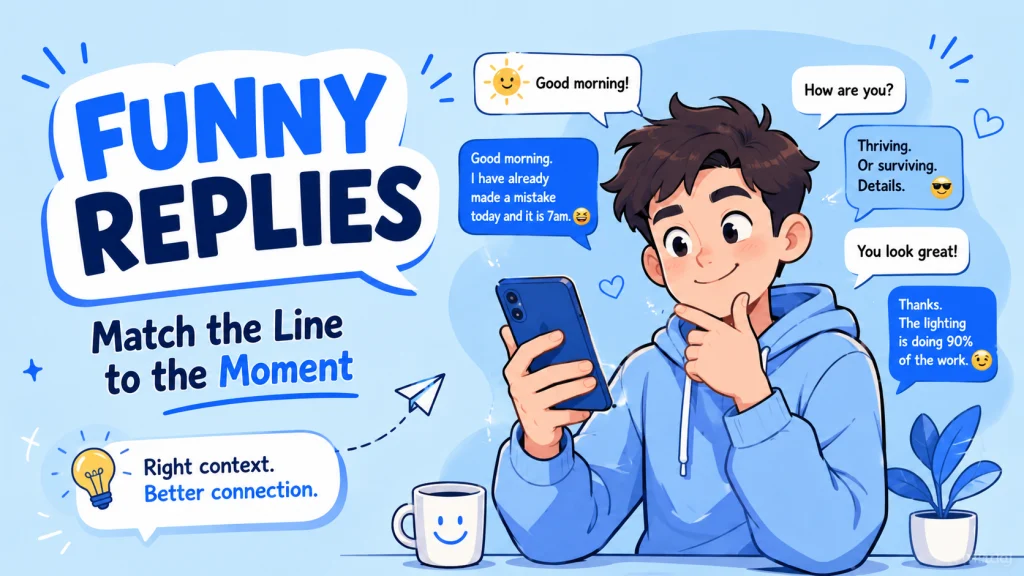
Funny replies are not about having the best line. They are about reading the moment before you type anything, because the same line that lands perfectly in one context falls flat in another. I spent nine years behind a bar watching people get this right and wrong, and the difference was almost never the quality of what they said. This page helps you figure out which kind of moment you are in before you start looking for the reply.
The Line Was Fine. The Moment Was Not.
There was a regular at one of my bars who was genuinely funny. Not performing funny, actually funny, the kind of person who could make a stranger laugh with a single dry observation. He also had a habit of delivering those observations a beat too late, after the conversation had already shifted, to a person who had not been in on the setup. He would get a polite smile at best and spend the next round convinced the line had not worked. The line had worked. The moment had not.
Funny replies over text fail the same way. Someone spends ten minutes typing and deleting, settles on something that feels right, sends it, and gets one word back. The instinct is to assume the joke was bad. More often the joke was fine and the read on the situation was off. Maybe the other person sent something quick between meetings and had no bandwidth to engage. Maybe the relationship was not far enough along for that level of dry humor to land cleanly. Maybe the original message was low-energy and the reply came in too hot. The line did not fail. The context was wrong for it.
This is why funny replies are not one thing. A funny reply to a good morning text is operating on a completely different frequency than a funny reply to a check-in from a coworker, which is different again from a funny response to a compliment that caught you off guard. The line has to match the moment, and the moment is built from things that have nothing to do with wit: the relationship, the timing, the energy of the original message, and what the other person was actually doing when they sent it.
What a Funny Reply Is Actually Doing
Most texts operate on autopilot. Someone sends “haha” because they have nothing else. Someone sends “lol” because typing nothing felt worse. A lot of text conversations run on that fuel for weeks without either person actually engaging. A funny reply, a real one, breaks that pattern. It forces the other person to process something specific, react to something they were not expecting, and usually send something back that has more than three letters in it.
Good ones also leave a door open. The best funny replies are not punchlines. They are openings. I have seen a single dry line restart a conversation that had been running on fumes for days, not because it was incredibly clever but because it gave the other person somewhere to go. A line that makes someone laugh and then wonder what to say back is doing exactly what it should. A line that gets a reaction and then closes the thread is a joke, not a reply.
What most people skip is calibrating the line to the actual relationship. The same text you send to your best friend reads differently when it goes to a coworker you barely know, and differently again when it goes to someone you have only been texting for two weeks and are not sure about yet. A funny reply has to be built for the relationship as it actually is, not the version of it you are hoping to get to. Sending something the relationship cannot carry yet is one of the fastest ways to make a thread go quiet.
The Message Type Changes Everything
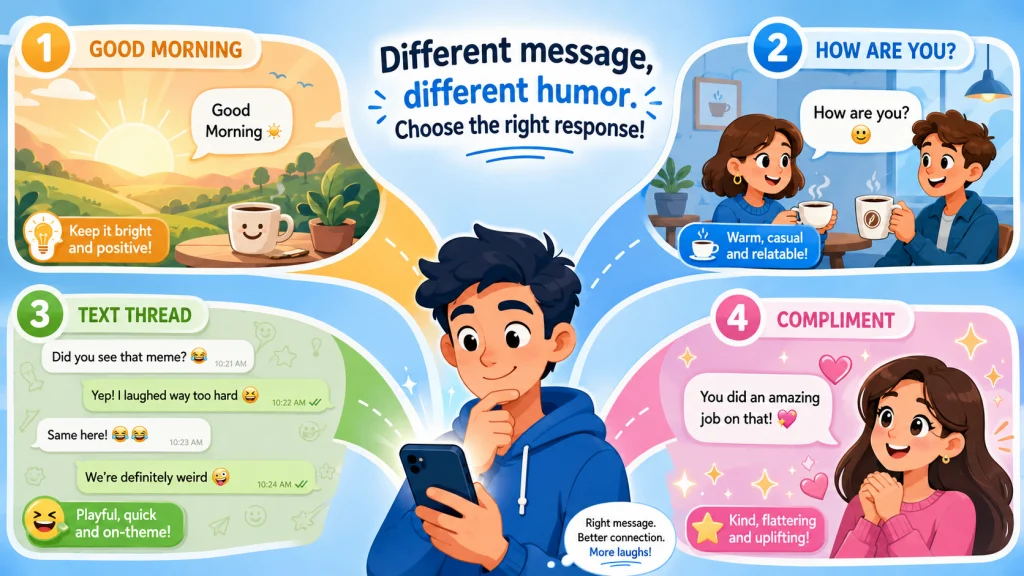
Not every text is asking for the same kind of funny. A good morning text is a ritual, and the funny reply to one needs to work inside that rhythm without disrupting it. A “how are you” is often automatic, sent without much behind it, and the right funny reply takes advantage of that autopilot nature rather than fighting it. A compliment is a different situation entirely because it comes with an implied social contract: the other person put something out there and is waiting to see what you do with it. Everyday texts that are just keeping a thread alive have their own logic, one that depends more on shared history than on any generic reply idea.
Matching the reply to the message type is not about overthinking it. It is about recognizing that “funny” is not a single tone, and that the situation shapes which version of it actually lands. The table below maps out the four most common message types, what each one is actually doing, and the register of funny that tends to fit each one without landing wrong.
| Message type | What it is actually doing | Tone of funny that fits | What it can sound like |
|---|---|---|---|
| Good morning / good night text | Opening or closing a daily ritual, keeping the thread warm | Dry and low-key. Does not need to land hard. Easy enough to receive first thing in the morning. | “Good morning. I have already made a mistake today and it is 7am.” |
| Check-in (“how are you”, “what are you up to”) | Often automatic, low-effort, not expecting much back | Subverts the expected answer without being abrasive. Short and slightly absurd tends to work best. | “Thriving. Or something close to it. You?” |
| Everyday thread-keeping texts | Keeping a conversation going without a specific reason | Depends most on shared history and inside references. Generic funny rarely holds here. | “This feels like the part where we both pretend we had a normal day.” |
| Compliment | Acknowledging something about you and waiting for a reaction | Deflects with warmth rather than awkwardness. Playful without dismissing what they said. | “I will let my mirror know. It has been doubting me all week.” |
The table is a starting point, not a script. Within each of these message types there is still a read to make on the specific person, the specific day, and the energy of what they actually sent. But knowing which situation you are in narrows down the kind of reply that has any chance of landing, which is most of the work.
Where Funny Ends and Something Else Begins
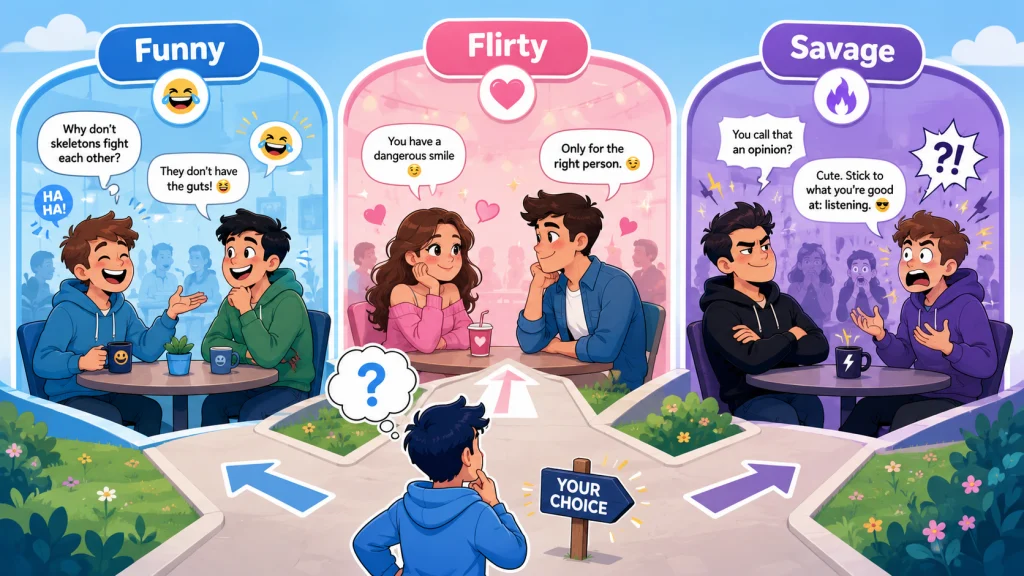
Funny, flirty, and savage are not the same thing, and they do not belong in the same moments. They can look similar from the outside because all three involve some degree of wit and confidence, but they signal different things and carry different risks. Getting them mixed up is one of the more reliable ways to make a text conversation go sideways quickly.
Funny is the most neutral of the three. It does not signal romantic interest, and it does not carry an edge that implies the other person deserved something sharp back. You can use a funny reply with a coworker, a close friend, a stranger on an app, or someone you have been with for years and it stays in basically the same lane across all of them. That neutrality is what makes it useful in moments where you are not sure which direction to take things.
Flirty has direction. It signals something specific, and even a subtle flirty reply shifts what the conversation is about in a way that is hard to walk back without making things awkward. Savage has real weight behind it. It assumes the other person can take it and sometimes implies they had it coming. Neither of those is wrong in its place. They just belong in specific moments that funny does not, and the line between them is not always obvious when you are mid-conversation trying to decide what to send.
The risk in crossing these wires is real and usually not obvious until after the fact. A reply that reads as savage when the moment called for funny comes across as mean rather than sharp. A reply that reads as flirty when funny was the right call sends a signal you may not have meant to send. Funny is the safer default when you are genuinely unsure, but it still requires knowing what the other person sent and what they were doing when they sent it.
| Reply type | What it signals | When it goes wrong |
|---|---|---|
| Funny | Playfulness, ease, comfort in the relationship | Falls flat if the relationship or timing cannot support it |
| Flirty | Interest, attraction, willingness to shift into a different register | Signals intent you did not mean to send if the moment was not asking for it |
| Savage | Confidence, willingness to push back, comfort with friction | Reads as mean rather than sharp if the other person was not ready for it |
Knowing which one the moment is actually asking for is most of the game. If you are looking for something with a sharper edge or something that belongs in a flirty thread, those moments have their own reply sets built for them specifically, and what works there is different enough from funny that it is worth keeping separate.
The Same Line, Two Different Moments
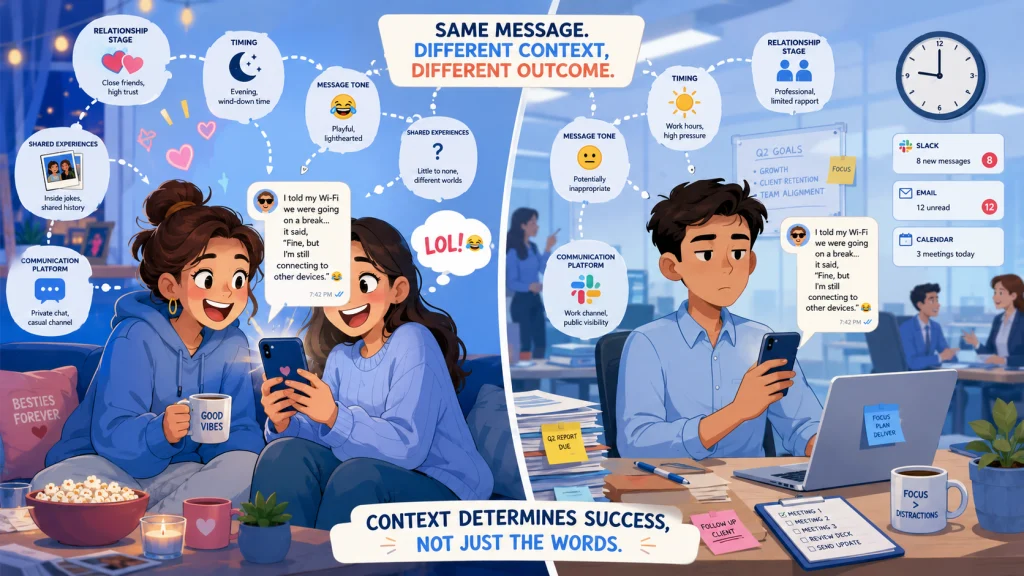
There is a line I have handed to probably fifteen different people over the years. It is short, dry, and lands well when the setup is right. The results have been all over the place, not because the line itself was inconsistent, but because the moments were all different and not everyone was calibrated for it. One person sent it and the other person screenshotted it immediately. Another person sent it and heard nothing back for two hours. Same line. Different moment. Completely different result.
The moment is built from things that exist before the reply gets written. How long the two people have been talking. The tone of the message being replied to, whether it came in quick and distracted or considered and deliberate. What that person finds funny based on how they actually text. Whether there are shared references available to draw on or whether the line has to carry itself alone. Whether it is a weeknight or a weekend, morning or night. None of those things change based on which line you pick. They are already there when you start typing, and they decide how the line will land before it even arrives.
Swapping out a line that did not work for a better one is often the wrong fix. The better fix is asking what was different about the moment and whether any funny reply was going to work there at all. Sometimes the honest answer is no, and the right call was something shorter and lower-effort, or nothing at all. These are the factors that actually decide it:
- Relationship stage: An early-stage thread cannot carry the same weight as one that has been going for a year. The line that reads as charming between two people who know each other well reads as strange from someone who has sent three texts total.
- Time of day: The same reply lands differently at 11pm on a Friday than at 8am on a Monday. Energy, context, and what the other person is in the middle of all shift with the time.
- Tone of the original message: A short, distracted text is not an invitation for a carefully constructed reply. Match the energy before trying to shift it.
- Shared references: Generic funny is weaker than funny that draws on something specific to the two people in the conversation. When there is no shared reference yet, the line has to do all the work alone, which raises the bar considerably.
- Platform and format: A dry one-liner that lands perfectly in text can read toneless in a voice message, where delivery and timing are expected to do some of the work the words are not doing.
With most people you text regularly, this calibration is already there and automatic. But when a reply falls flat and you cannot figure out why, one of these is almost always the answer, and it is almost never the line.
Final Thoughts: Pick the Situation Before You Pick the Line
The lines exist. There are plenty of them, and a lot of them are genuinely sharp. But a line is only a guess if you do not know which kind of moment you are in first. Knowing whether the message you got is a morning ritual, a low-effort check-in, an everyday thread filler, or a compliment narrows the search considerably. Knowing whether the moment is calling for funny rather than something with more edge narrows it further. What is left after that is the actual work, finding the specific line that fits the specific person you are talking to, and that part only you can do.
I still freeze sometimes. Not because I do not know what to say but because I know how much context actually goes into a line landing right, and sometimes the honest answer is that no funny reply is the right call in that particular moment. That is not a failure. The whole point is being able to tell the difference before you send something and spend the next hour wondering why it went quiet. If you have already figured out the situation and you are ready to find the line, the sections below route to the message type you are actually working with.
Find the Reply for Your Specific Situation
Each message type that lands in your inbox has its own register of funny and its own set of ways to get it wrong. The four pages below are built around the situations that come up most often, with reply sets written specifically for what each one is actually asking for. If you already know which kind of message you are dealing with, go straight to the one that matches it.
| Situation | What you will find there |
|---|---|
| Funny good morning and good night replies | Low-key lines built for daily greeting texts that feel warm without going boring |
| Funny replies to “how are you” | Short, dry answers that subvert the automatic check-in without making it weird |
| Funny replies for everyday text conversations | Replies for the general thread-keeping texts that do not fit cleanly into one category |
| Funny responses to compliments | Lines that play with a compliment without dismissing it or making things awkward |
If you are not sure which situation fits yet, start with the message type that feels closest and read a few of the lines. The right situation usually becomes obvious quickly once you see what the replies are actually built for.
FAQs
💬 What makes a funny reply actually land?
Timing, relationship, and tone. A line that fits the moment and the relationship tends to land. The same line in the wrong moment reads flat or strange. The line itself is usually the last thing that decides it.
😬 Why do my funny texts never get the reaction I expect?
Usually it is a context mismatch rather than a bad line. Look at the tone of the original message, the time of day, and how far along the relationship actually is. One of those is almost always the answer, and it is almost never the wit level of the reply.
🤔 What is the difference between a funny reply and a witty one?
Funny makes someone react, usually by laughing or wanting to say something back. Witty tends to be more about the craft of the line itself. In practice the most effective texts are funny first and witty second. Nobody is grading the sentence structure.
📱 Do funny text replies work the same as funny replies in person?
No. Delivery, tone of voice, and timing are all absent over text, which means the line has to carry more on its own. Something that lands in person because of how it was said can fall flat in a message with nothing around it. Short and clear tends to travel better over text than anything that relies on tone to finish the job.
⏱️ How do you know when not to send a funny reply?
When the other person seems distracted, short, or clearly in a quick-reply headspace. If their last few messages were one line each and obviously fast, a carefully constructed funny reply is going to feel like a lot. Sometimes matching the energy and keeping it short is the smarter call than going for the laugh.
🔄 Is there a go-to funny reply that works in most situations?
Not really, and I would be suspicious of anyone who told you there was. A line that works in most situations is usually a line that does nothing particularly well in any of them. Specific tends to outperform general every time, which is why knowing the situation you are in matters more than finding the most universally applicable reply.