Savage comebacks get a bad reputation because most people picture cruelty when they hear the word. Nine years behind a bar taught me the sharpest line in the room is rarely the meanest one, it is the one that lands clean and lets you walk away looking like the calmer person. Here I sort rude behavior, direct insults, and disrespectful texts into three separate problems, each needing its own answer, and point you toward the right one for whichever you are actually facing.
What Actually Makes a Comeback Savage, Not Just Mean
Savage comebacks work when they hit once and stop, not when they keep swinging after the other person has already gone quiet. I learned this rule the hard way, slinging drinks for nine years across three cities, watching people win a moment and lose the room in the same breath. The best line I ever saw delivered was four words long. The guy who said it did not raise his voice, did not call anyone a name, and the table went silent anyway because the timing did the work the volume did not need to do.
There is a version of savage that is really just cruelty wearing a confident outfit, and there is a version that is controlled, specific, and over fast. I only deal in the second kind. A comeback that leaves you cleaner than the person who started it does not need a slur, a threat, or a low blow about something the other person cannot change. It needs precision. That is the whole difference, and it is the line everything else here is built on.
Most lists of savage comebacks online treat every situation the same way, a hundred lines stacked on top of each other with no sense of when any of them actually apply. That is the mistake I see most often, someone grabbing the meanest line on a list because it sounded good, without asking whether the moment actually called for that much weight. A line built for someone who genuinely crossed a line, said at someone who was just mildly annoying, makes you look like the one who escalated. The line itself was never the problem. The mismatch was.
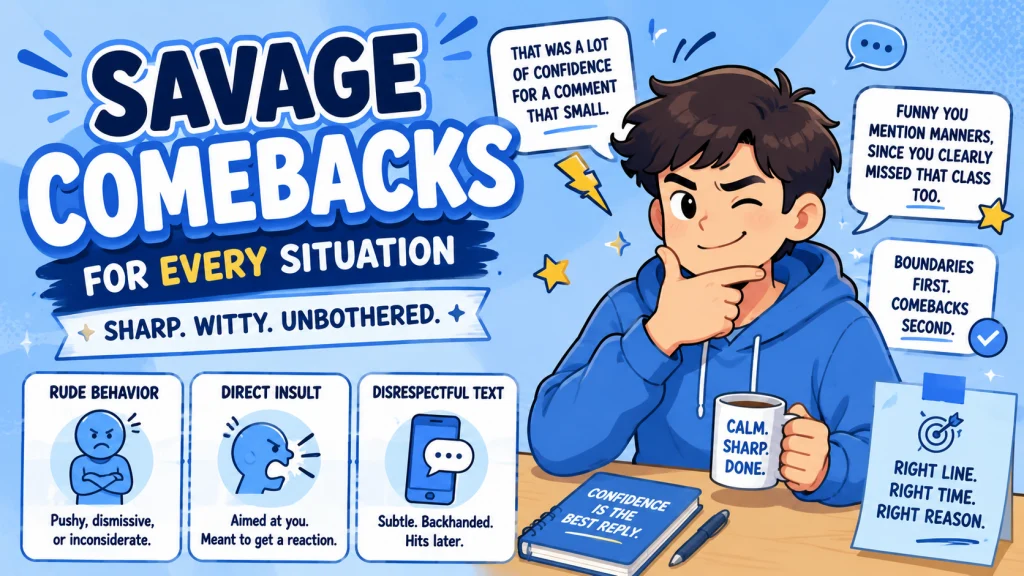
A controlled savage comeback usually sounds more like “That was a lot of confidence for a comment that small” than anything aimed at a person’s looks, intelligence, or worth. Something like “Funny you mention manners, since you clearly missed that class too” works the same way, it answers the disrespect without becoming the thing it is responding to. The best witty comebacks are not always the funniest ones either, sometimes the sharpest reply is the one that makes the boundary obvious without making you look cruel. That is why these land harder and age better than anything that needed cruelty to work.
Rude People, Insults, and Disrespectful Texts Are Not the Same Problem
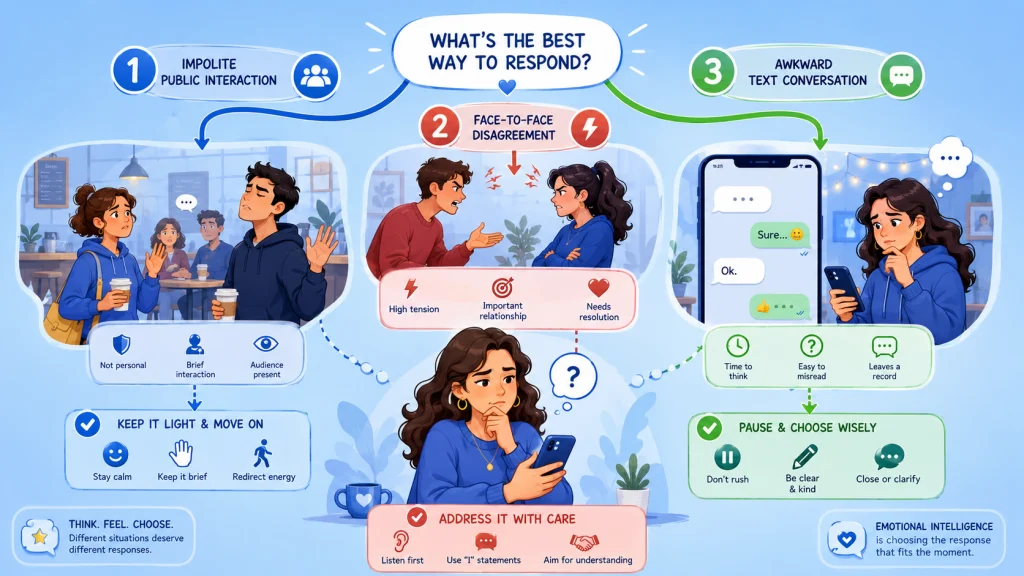
I get asked some version of “what is a good savage comeback” almost every week, and my first question back is always the same: what kind of disrespect are you actually dealing with. A rude person and someone who insulted you outright are not playing the same game, and treating them the same way is how a lot of comebacks misfire. A rude stranger cutting in line or talking down to a server is testing whether anyone will push back. An insult is more direct, it is aimed at you specifically, and it usually wants a reaction. A disrespectful text is the slowest burn of the three, often something that does not even read as rude on the surface until you sit with it for a minute and realize what just happened.
Treating an insult like a rude-stranger moment makes you look like you missed the point entirely. Treating a quietly disrespectful text like a direct insult makes you look like you are overreacting to something subtle, even when your read on it was completely right. Knowing which one you are actually dealing with is most of the work, before you have even written a word back.
- Rude behavior: pushy, dismissive, or inconsiderate, usually not personal, often from someone you barely know.
- A direct insult: aimed at you by name, your appearance, your choices, or something you said, meant to get a reaction.
- A disrespectful text: subtler, sometimes buried in a joke or a backhanded compliment, the kind of message that gets worse the longer you think about it.
Once you know which category you are in, the next decision gets a lot easier, because it is no longer about finding any sharp line. It is about finding the right one for the situation in front of you.
I watched a regular get this wrong once, badly. Someone at her table made an offhand comment about her ordering “the safe drink again,” clearly fishing for a laugh at her expense. She heard it as a direct insult and came back with something built for a much harder hit, a line meant for someone who had actually crossed a line on purpose. The table went quiet for the wrong reason. The comment was rude, mildly so, not an insult, and her response landed like she had misjudged the room entirely. Reading the category correctly before you respond is not a small detail. It is the difference between looking sharp and looking like you brought a bigger weapon to a small fight.
When a Comeback Works and When Walking Away Wins
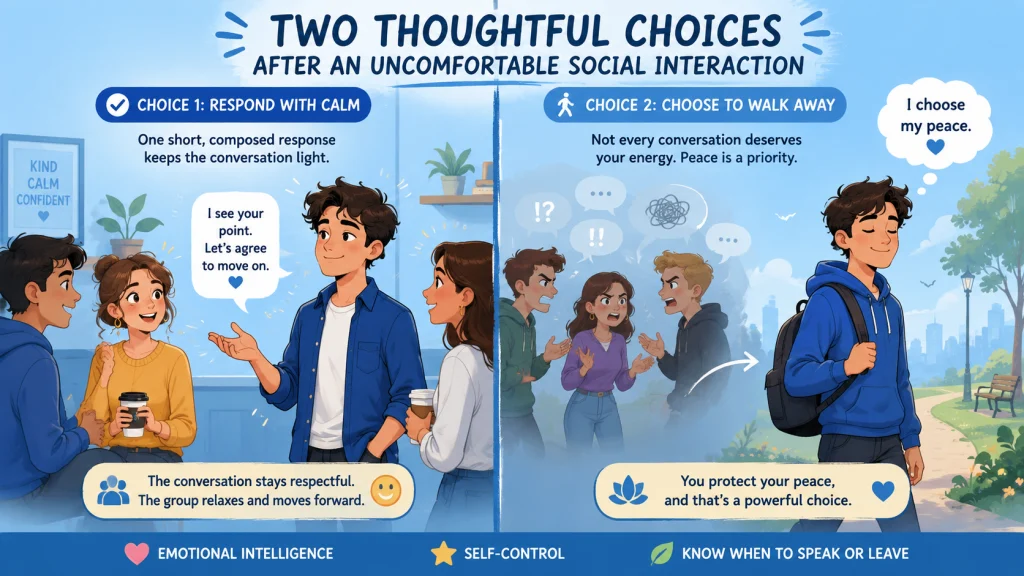
Not every moment that stings deserves a reply. I have watched people talk themselves into firing back at something that genuinely did not need an answer, and I have watched the opposite too, someone swallow a comment they absolutely should have answered because they froze and the moment passed. Reading which situation you are in matters more than having the perfect line ready.
A comeback tends to work when the other person is testing a boundary in a low-stakes setting, a group chat, a one-off rude comment from someone you do not have history with, a text that crossed a line but was not actually threatening. In those moments, a sharp, controlled reply can close the conversation on your terms. Walking away wins when the person is someone with a pattern of disrespect you cannot fix with one good line, or when the situation has any edge of real hostility, intimidation, or danger to it. No reply, however clever, is worth escalating something that has already gone past the point where words are the right tool.
This sounds obvious written down, but in the moment, with your phone in your hand and your pride a little bruised, it rarely feels obvious at all. That is exactly why it is worth saying plainly here.
I think about a guy who used to come in most Fridays, always polite, always tipped well, until one night he got needled by a friend in front of the whole group over something small, his job, his car, I do not even remember which. He had a comeback ready, sharp and honestly pretty funny, and he used it. The friend laughed, the table moved on, and that was the end of it. That is a comeback doing exactly what it is supposed to do, closing a low-stakes moment cleanly.
Compare that to a woman who once told me about a text from an ex who kept needling her months after things ended, each message a little colder than the last. No reply she could have sent would have fixed that pattern. She stopped responding entirely, and that was the stronger move by a wide margin, even though it did not feel as satisfying in the moment as firing back would have.
Three Places to Go, Depending on What You Are Actually Dealing With
I do not believe in one master list of savage comebacks that fits every situation, because the rude coworker, the person who insulted you to your face, and the text you cannot stop rereading are three different problems with three different right answers. Below are the three directions worth taking, sorted by the kind of moment you are in rather than how angry you feel about it.
| Situation | Where to go |
|---|---|
| Someone is being rude in person or over text, cutting you off, talking down to you, generally inconsiderate | Comebacks for rude people |
| Someone insulted you directly, your looks, your choices, your intelligence, something said to provoke a reaction | What to say when someone insults you |
| A text left you stewing, something disrespectful, dismissive, or backhanded that landed harder the more you thought about it | Savage replies to text messages |
Each of those covers its own territory in more depth, with reply variations built for that exact kind of moment. Pick the one that matches the situation in front of you, not the one that sounds the most satisfying in theory.

The Rule I Will Not Bend On
I have handed out a lot of sharp lines over the years, and there is one rule that does not move no matter how badly someone wants to win the moment. No threats. No slurs. No punching down at something the other person did not choose, their body, their background, anything that was never the actual issue in the first place. A comeback that needs cruelty to land was never sharp to begin with, it was just loud.
I also do not believe in trying to win every room. Some people are not worth the line, and giving them one anyway just hands them more of your evening than they earned. The goal was never to dominate every exchange. It was always to walk away from the moments that matter with your composure intact, and to know when a moment simply is not worth the breath it would take to answer it.
I have also noticed that people who chase a comeback for absolutely everything tend to look worse over time, not better. They start reaching for sharpness in moments that did not call for it, and the line stops landing because the room can tell it is reflex, not judgment. Save the sharp ones for the moments that actually earned it. That restraint is part of what makes the line work when you do use it.
This matters even more online than it does across a bar top. A comment thread does not forget the way a room full of people moves on by last call. I have seen a reply that was genuinely funny in the moment turn into something the person regretted a week later, once strangers piled on with it and took the line places it was never meant to go. Before sending anything sharp in a public space, ask whether you would still want it attached to your name if a hundred strangers saw it out of context. If the answer is no, soften it or skip it entirely.
Final Thoughts
A good comeback is not about proving you are clever. It is about not leaving a moment unanswered when you genuinely wanted to answer it, in a way you would not take back the next morning.
The line itself matters less than knowing which kind of moment you are in, and whether replying is even the right call. Get that part right first. The right direction above will have what you need once you do.
FAQs
💬 What is a savage comeback?
It is a short, controlled reply that shuts a moment down without needing cruelty to do it. Precision over volume, every time.
😬 Is it ever better to not respond at all?
Yes. If the situation has any edge of real hostility or danger, or the person has a pattern you cannot fix with one line, walking away is the stronger move.
🗯️ What is the difference between a rude comment and a direct insult?
Rude behavior is usually impersonal and about boundary testing. A direct insult targets you specifically and is built to get a reaction out of you.
📱 Why do some texts feel worse the longer I think about them?
That is the disrespectful kind, often dressed up as a joke. It takes longer to register because it was never meant to look like an attack on the surface.
🚫 What makes a comeback cross the line?
Threats, slurs, or attacking something the other person did not choose. None of that is sharp, it is just cruelty with extra steps.
🔥 Is it bad to use a comeback I found online?
Not inherently, but a line that does not match the actual situation will fall flat or make things worse. Match the weight of the reply to what actually happened, not to how good the line sounds on its own.
😶 Why do I always think of the perfect comeback too late?
Because in the moment your brain is busy managing the surprise, not crafting a line. That delay is normal. It is exactly why it helps to know your categories ahead of time instead of starting from zero.