After nine years behind the bar in three different cities, I have watched flirty replies live or die in about two seconds of hesitation. What follows breaks flirty texting down by what is actually happening when someone flirts with you, whether it is a fresh opener, a romantic line with some history behind it, or a teasing challenge daring you to keep up. I will walk through the difference between playful and bold, the one rule that keeps a flirty reply from reading as desperate, and exactly when flirty needs to step aside for something funnier or sharper. By the end you will know which kind of flirty moment you are standing in and what actually belongs in it.
Flirting Is Signal Control, Not Performance
Good flirty replies are not about being clever. They are about controlling how much interest you show without spilling all of it at once. I learned that watching strangers flirt across a bar top long before I ever wrote a line of it down. The ones who landed it were rarely the funniest people in the room. They were the ones who knew exactly how much to give back, and then stopped.
Performance is what happens when someone tries too hard to be entertaining instead of just being interested. You can feel it in a text the same way you can feel it across a bar, the joke that runs one beat too long, the compliment stacked on another compliment until it stops sounding sincere. A flirty reply that works is almost always shorter than the one that does not. It tells the other person you noticed them, you liked what they said, and you are not afraid to say so, without turning the moment into a show.

Playful, Warm, Bold, and Too Much: Knowing the Difference
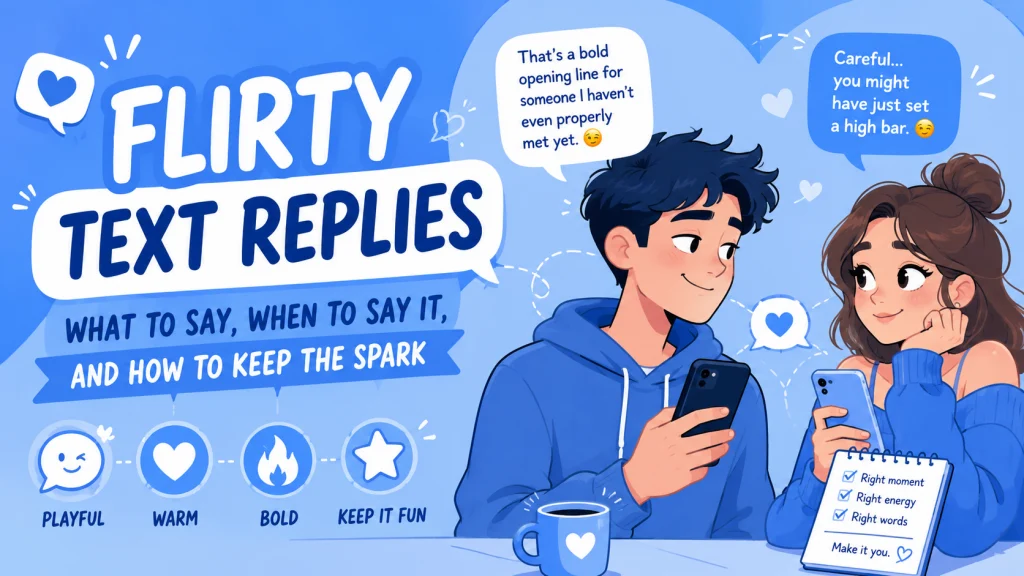
Every flirty reply sits somewhere on a scale, and the mistake most people make is reaching for the same intensity no matter who they are talking to or what has already happened between them. Playful is the safest place to start, the light tease that signals interest without putting anything on the line yet. Warm is a half-step up, where a little real affection shows through the joke instead of hiding behind it completely. Bold means naming the interest outright, no metaphor to retreat into if it does not land. Too much is what happens when bold shows up in a conversation that has not earned it.
- Playful: a tease or a wink, nothing on the line yet
- Warm: real affection starting to show through the joke
- Bold: naming the interest outright, no hiding behind humor
- Too much: bold language landing in a conversation that has not earned it
Most lists of flirty things to say skip this part entirely. They hand you the line without telling you which shelf it belongs on, so the same joke that would have killed in a warm conversation reads as cold in a brand new one. I have watched someone send something firmly in “too much” territory on a conversation that had only existed for a day, and watched the energy in the chat go quiet within a minute, not because the line itself was bad, but because it showed up before anyone asked for it.
Three Kinds of Flirty Moments You Will Actually Run Into
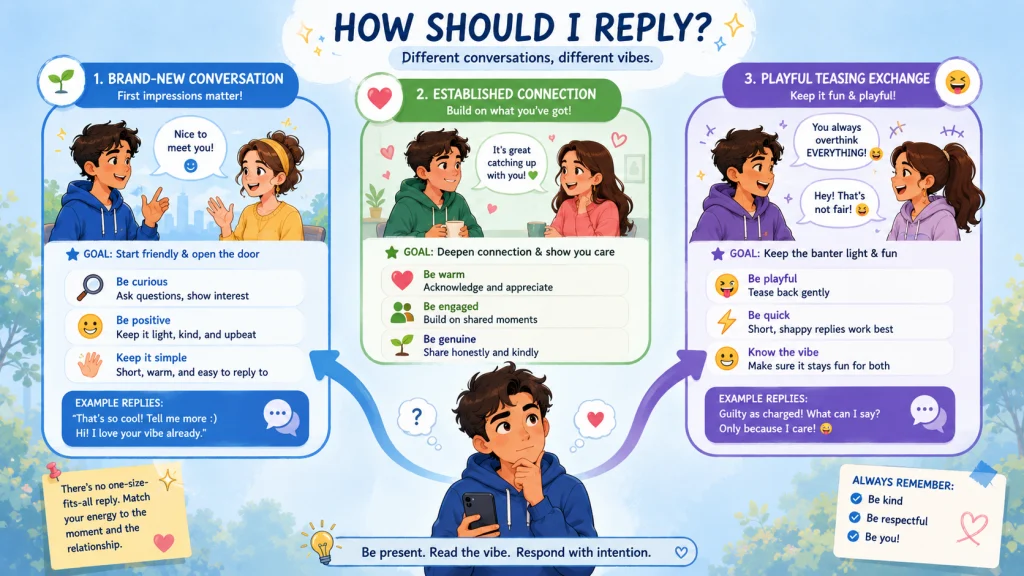
Almost every flirty text falls into one of three buckets, and figuring out which one you are in matters more than finding the perfect line. The right flirty text replies for a brand new opener look nothing like what works once a teasing challenge is on the table. Treating all three the same is how a good line ends up landing in the wrong moment.
The Opener
The opener is the easiest place to flirt back by text, because nothing has been risked yet on either side. Someone sent the first flirty line, which means they already decided the risk was worth it, and all you have to do is meet that energy without overshooting it. The best replies at this stage stay short and specific to whatever they actually said, instead of reaching for a generic compliment that could have gone to anyone. A playful one keeps it light:
“That’s a bold opening line for someone I haven’t even properly met yet.”
A warmer version lets a little more show through:
“Okay, I’ll admit that line worked. Try not to let it go to your head.”
And if you want to push it a half-step further without going bold yet, something like
“I see what you did there, and I kind of like it.”
still leaves the door open without sprinting through it.
The Romantic Reply
Flirty responses carry more weight in a romantic moment than they do in an opener, because there is already something between you, even if it is small. The history changes what a line is allowed to say. A reply that would feel like too much from a stranger can feel exactly right from someone you have been quietly building something with for weeks. A softer one leans into the warmth without naming it outright:
“I’ve been smiling at my phone for the last five minutes because of you.”
One with a little more nerve admits it out loud instead of dancing around it:
“You’re making it very hard to play it cool right now.”
And the most direct version just says it plainly:
“I like you. There, now you don’t have to wonder anymore.”
The trick either way is letting the existing warmth do some of the work, instead of trying to manufacture a bigger moment than the conversation actually calls for.
The Teasing Challenge
A teasing challenge needs a comeback more than a soft line, since the other person just threw something at you and wants to see if you can catch it. This is where most people overthink it. I have watched someone spend ten minutes typing and deleting a response to a simple tease because they were scared of sounding mean, when the moment only needed four words sent back fast. That fear is normal, and it happens because a tease can start to read as an attack if you slow down too much and start explaining yourself instead of just answering it. Something quick keeps the energy light:
“Careful, that’s the most confidence you’ve shown all conversation.”
or, if they are really asking for it:
“Cute. Try that again when you’ve got something better.”
Either way, mirror the energy quickly instead of building a case for why your comeback is fair.

The Only Rule That Matters: Only Send What the Relationship Can Catch
Every flirty line either fits the size of the relationship or it does not, and no amount of clever phrasing fixes a line that is simply too big for where two people actually are. A line is not universally bold or universally safe. The same words can read as charming after three weeks of texting and as alarming after three days. What matters is not the line itself so much as whether the relationship has had time to build a place for it to land. The same logic runs in reverse, too. If someone keeps pulling back instead of leaning in, the relationship is telling you it does not have room for more yet, and the best flirty reply at that point is no escalation at all.
There is a reply I almost did not hand over to a regular at the bar because it felt too direct for someone she had only been texting for a week. She sent it anyway. She told me two days later it was the first time he had texted her back within a minute instead of within an hour, and that the line had not felt risky to her at all once she actually knew him better than I did from the outside. That gap between how a line looks from the outside and how it actually lands inside a specific relationship is the whole reason no flirty line works the same way twice.
Where Flirty Stops and Something Else Starts
Not every text that comes in with energy behind it is actually a flirty moment, and treating it like one is its own kind of mistake. A funny, lighter reply works better when nothing romantic is actually on the table and the other person is just looking for someone who can keep up with a joke. A sharper, savage reply belongs to a completely different situation, the rude text or the jab that needs to be shut down rather than flirted with. Mixing the two up is how a flirty line ends up in a conversation that was never romantic to begin with, or how a reply to someone’s actual rudeness comes out sounding like an invitation instead of a boundary.
I have seen both versions of this mistake play out. Someone flirts back at a comment that was actually just a joke between friends, and the friendship gets weirdly tense for a week over nothing. Someone else softens a reply to something genuinely rude because they are worried about sounding too sharp, and the rudeness keeps happening because nothing about the reply told the other person to stop. Reading which one you are actually in, romantic interest, harmless joke, or real disrespect, matters more than having a clever line ready for all three.
Final Thoughts: Read the Moment Before You Reach for the Line
None of this works if you skip the first step, which is figuring out what kind of moment you are actually in before you start hunting for words. An opener wants something light and quick. A romantic reply wants you to lean on whatever warmth already exists instead of inventing more than is there. A teasing challenge wants speed and a light touch, not a defense of your own joke. Get that part right and most of the actual wordsmithing takes care of itself.
I still freeze sometimes too, even after nine years of watching this exact moment play out from behind a bar. The difference now is that I know what I’m really stuck on: not whether I can reply, but how big the reply should be. That is the whole point of having a sense of where you stand before you start typing, so the freeze gets shorter every time instead of staying exactly the same.
Where to Go for the Actual Lines
Everything above is about reading the moment correctly before anything else. Once you know which one you are in, the next step is finding the right set of lines for it, since the three places below are each built around a different kind of moment. Picking the right one saves you from copying a line that technically works but does not fit what is actually on your screen.
| Where to look | What it covers |
|---|---|
| Flirty Text Openers | Replies built for the first flirty message someone sends, before any history exists to lean on. |
| Flirty Romantic Text Replies | Lines for conversations that already carry some warmth and can hold more weight than an opener. |
| Playful Flirty Comebacks | Quick, light comebacks for the teasing dare that wants to be matched and beaten, not explained. |
Pick whichever one matches what is actually on your screen right now, not the one that sounds most impressive in your head. The right lines only work when they are answering the actual message in front of you.
FAQs
💬 What’s a good flirty reply to a good morning text?
Match the warmth without escalating past it. Noticing the timing or the effort behind the message usually lands better than reaching for something clever, since a good morning text is rarely asking for a whole performance.
😏 How do I flirt over text without sounding desperate?
Give less than you want to and slow down. Desperate almost always sounds like over-explaining, sending three texts where one would have worked, or chasing a reply that has not come yet. Send one short line, then actually wait.
🔥 What do I say when someone flirts with me first?
Mirror their intensity instead of trying to top it. If they kept it playful, answer playful. If they went bold, you are allowed to go there too, but matching almost always reads better than raising the stakes right out of the gate.
😅 What if my flirty reply doesn’t land?
It happens, and it is not always about the line itself. Timing matters, and sometimes the other person simply was not in the headspace for it that day. One flat response is not proof the whole approach was wrong, so do not scrap it over a single quiet reply.
💭 How forward is too forward over text?
Too forward is whatever the relationship has not earned yet. A line that feels exactly right after weeks of warmth can feel alarming on day two, so the words matter less than how much time and trust already exist underneath them.
📱 Should I match their flirty energy or wait for them to go first?
If they already went first, you can match them right away, that is what makes it feel mutual. If nothing has happened yet, a small playful opener is safer than waiting around for permission that may never come.