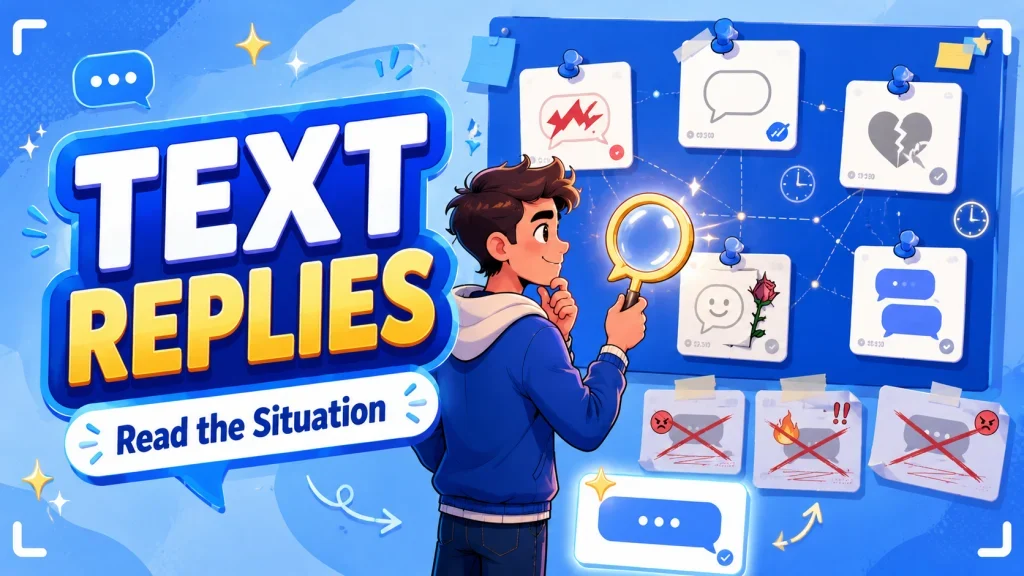
Savage replies to text messages aren’t one category. What works when someone texts you something openly rude is completely different from what works when your ex surfaces after months of silence, or when a message arrives that’s technically polite and still leaves you feeling like you swallowed something wrong. This page covers five distinct text situations where the reply actually matters, explains why each one plays by different rules, and points to the right set of responses for each. Find the situation that fits what landed in your inbox and start there.
Why Savage Replies to Text Messages Work Differently Than Any Other Situation
Savage replies to text messages carry weight that in-person comebacks don’t, because text leaves a record. Read receipts tell the other person when you opened their message and when you chose not to reply. Timestamps sit on every decision you make in the conversation, including the decision to say nothing at all. Screenshots exist and get forwarded. The wrong reply in the wrong tone can end up in front of the wrong person without you ever knowing it happened. These aren’t minor differences. They change what a sharp response actually needs to look like in this format.
More people have shown me their phones at the bar than I can easily count. Not to show me something funny. To ask what to type back. The question almost never comes out as “what should I say.” It comes out as “is this too much.” That question tells me more about the situation than the message itself does, because the person already knows what they want to say. What they don’t know is whether the situation actually calls for it.
Savage responses to text messages that actually land aren’t just about sounding sharp. They’re about knowing what the other person was hoping you’d do next, and doing something else instead.
Savage text replies that work account for three things at once: the relationship, what the message was designed to do, and what you want to happen after you hit send. A line that shuts down a stranger’s rude text can look genuinely unhinged if you send it to someone you see every Tuesday at work. The same tone doesn’t transfer across these situations because the situations themselves aren’t the same. That’s what this page is built around.

The Quick Decision You Need to Make Before You Type Anything
The sharpest text replies I’ve seen come from people who took an extra thirty seconds before responding. Not because they needed time to think of something clever, but because they got clear on one thing first: what is this message actually trying to do to me? Not what does it say. What is it doing. A message can say almost anything and still be designed to pressure you, make you feel small, re-open something you’d already closed, or drag a reaction out of you that the message didn’t earn. Once you can name what’s happening, the reply gets much easier to choose.
Two questions get you there faster than staring at your screen. The first is the relationship and the stakes around it. A stranger, a coworker, a friend who’s been difficult lately, an ex: the same message reads differently depending on who’s sending it, and the right response shifts accordingly. The second is what the message is doing. Five situations come up again and again in a text inbox, and each one calls for a different approach.
- A message that’s openly rude or dismissive: direct disrespect, nothing coded or deniable about it.
- No reply to something you sent: someone left you on read, and the silence is saying something.
- Your ex texting out of nowhere: history lives inside the message whether the words show it or not.
- Technically polite, still stings: coded hostility with plausible deniability written into every word.
- An angry follow-up you didn’t ask for: someone sent a second message because you hadn’t replied yet, and they want you to know they’re annoyed about it.
Each section below handles one of these. If you already know which situation you’re in, go directly there. If you’re not sure, the two-line framing at the top of each section usually makes it clear within about ten seconds of reading it.
Rude Texts: Direct Disrespect by Message
The clearest situation on this list is when someone texts something openly disrespectful and there’s no decoding required. Nothing coded, nothing deniable. They were rude. You got it in writing. The clarity is actually an advantage here, because direct disrespect allows a direct response. You’re not having to interpret anything. You’re not risking reading too much into a tone. The message is what it is, and the reply can be too.
What makes sharp replies to rude messages land in this situation is control. The instinct to immediately fire something back tends to produce replies that say more than they need to, and say it louder than the situation calls for. A single dry line, something like “Noted” or “That’s a choice you made,” carries more composure than a paragraph. Length signals effort, and effort signals the message got somewhere it wasn’t supposed to go. The most effective replies here tend to be the shortest ones, and that’s not a coincidence. The full range of options for this situation, from flat dismissal to something with real edge, is in rude text comebacks.

Left on Read: When Silence Is the Move They Made
Being left on read is a different kind of text situation because there’s no message to respond to. Someone chose not to reply, and now you’re deciding what that means and what, if anything, to do about it. The discomfort is the ambiguity: silence can be avoidance, it can be a deliberate power move, it can be genuine busyness. The read receipt tells you they saw it. It doesn’t tell you why they didn’t answer.
Most of the time, waiting is right. But there are situations where the silence is clearly intentional and doing nothing feels like handing something over without meaning to. What you should do next depends almost entirely on what you sent before the silence, and on what kind of relationship this is. A casual message that goes unanswered for a day is not the same as a direct question that someone opened, sat with, and chose not to answer. The options for navigating that, and for deciding what to say if you decide to say anything at all, are in what to text when someone leaves you on read.

Ex Texts: When the History Is Inside Every Word
When an ex texts, even the simplest message isn’t a simple message. A “hey, you good?” that arrives four months after going quiet is not the same as a “hey, you good?” from anyone else. There’s a reason they’re reaching out, there’s what they say the reason is, and then there’s whatever’s actually underneath that. Reading all three correctly at the same time is genuinely hard, especially if the relationship ended with anything unresolved. And most of them do.
The most common mistake in this situation is replying to the surface of the message without thinking about which layer you’re actually talking to. A perfectly reasonable reply to what the text literally says can look completely different once you factor in the motive behind it. The opposite mistake is treating every ex text as a hidden agenda when occasionally a message is just what it appears to be. The right reply is built on reading the situation clearly, not on defaulting to one stance for every ex in every context. A breakdown of how to read that and what to send back is in how to respond when your ex texts you.
Passive Aggressive Texts: Coded Hostility With Plausible Deniability
Passive aggressive texts are the most frustrating situation on this list because of how carefully they’ve been built to be hard to call out. The message is technically fine. Nothing in it crosses a line you can point to cleanly. And yet it lands like a small jab, and you know it was meant to. The hostility is in the word choice, the punctuation, the “no worries!” that clearly means something else entirely, the “okay” with a period in a context where a period signals nothing friendly. Writing strips out tone and leaves only the words, which can be held up later as perfectly innocent.
Responding to this kind of message well means responding to what it’s doing, not just what it says. React to the hostility directly, and you risk looking like you’re reading too much into something that wasn’t explicitly hostile. The other person walks away with the “you’re being oversensitive” exit, and they’ll take it. Passive aggressive text comebacks have to close that exit while still naming what’s happening. That’s a different skill than handling something direct, and the lines built for exactly this dynamic are in passive aggressive text comebacks.
Double Texting Anger: Pressure Dressed Up as Impatience
Double texting anger belongs in its own category because the problem isn’t what the second message says. It’s the assumption behind it. The person has decided that your not replying is something they’re entitled to comment on, and they’ve done it by sending another message before you got back to them. That assumption, that your attention belongs to them on their schedule, is what separates this from a standard rude text. The rudeness is structural. It’s in the fact that the follow-up was sent at all, not necessarily in anything the follow-up says.
The response range here runs from saying nothing to naming the dynamic directly. Neither is automatically right. Someone who does this once after a message they were genuinely worried about is different from someone who does it regularly as a pressure tactic, and the reply that fits one of those situations can backfire completely in the other. In ongoing relationships, the pattern matters as much as the individual message. What to actually say back across both versions of this, and how to read which one you’re dealing with, is in what to say to someone who double texts you.
The Situation Shapes the Reply, Not the Other Way Around
Text rewards the person who takes thirty seconds before typing. Not because clever replies need time to construct, but because the most common mistake in every one of these situations is responding before getting clear on what’s actually happening. Rude, passive aggressive, loaded with history, built on entitlement: each one plays a different game, and a reply that works in one can make things significantly worse in another. Knowing which situation you’re in is not a small thing. It’s most of the decision.
Savage replies to texts aren’t about sounding sharp for its own sake. They’re about composure. The person who sends one line and stops, who closes the loop without leaving anything open for the other person to pull on, who sounds like they never needed to think about it even when they did: that’s what actually lands. Not volume, not length, not the most creative thing you could think of at 11pm when you’re angry. The right line, in the right situation. The links below are organized to get you there.
Where to Find Replies for Each Situation
Each of the five situations covered here has its own set of replies built specifically for the dynamics at play in that scenario. A rude text and a passive aggressive text might look similar on the surface, but they require a completely different approach underneath, for the same reason that a direct insult and a coded one don’t respond to the same move. These are organized by situation rather than by tone, because tone applied without context is what tends to make text replies land wrong.
| The situation | What you will find there |
|---|---|
| Rude Text Comebacks | Replies for texts that are openly disrespectful, ranging from flat dismissal to something sharp enough to register. |
| What to Text When Someone Leaves You on Read | For when someone saw your message and chose not to answer, and you’re deciding whether saying something is even the right move. |
| How to Respond When Your Ex Texts You | Built around reading the motive behind the message, not just the words, so the reply fits what’s actually happening. |
| Passive Aggressive Text Comebacks | Replies that name the dynamic without handing the other person the “you’re reading into it” exit they were counting on. |
| What to Say to Someone Who Double Texts You | For the follow-up that arrived because you didn’t respond fast enough, across situations from a one-time thing to a recurring pattern. |
If none of these five fits exactly, start with the closest one. The dynamics in these situations overlap more than they differ, and the thinking underneath each one transfers across a wider range of text scenarios than the specific framing might suggest. The situation that’s almost right is usually more useful than starting from scratch.
If the Disrespect Isn’t Coming Through Text
The five situations above are all text-specific. They’re built around read receipts, the written record, screenshot risk, and the particular way timing works in a conversation that isn’t happening out loud. If the exchange you’re dealing with is happening in person, if someone said something to your face in a room full of people or directly across from you at a table, the approach changes. The stakes shift, the timing is different, and the audience dynamic doesn’t work the same way it does in a message thread.
The full range of sharp responses for situations that don’t live in an inbox is in savage comebacks, which covers the broader landscape across formats and settings. Text is one specific case within that. If you’ve found what applies to you here, that’s the next place to look for the rest.
FAQs
📱 Does the right reply really change that much depending on who sent the text?
Yes, significantly. A line that lands with a stranger has a real chance of making things worse with someone you see every day. The history, the stakes, and what happens next are all different depending on the relationship. The same words carry different weight depending on who’s on the other end of them, and that changes what the right reply actually looks like.
⏳ Should I wait before replying to a disrespectful text?
Long enough to not reply angry. The specific amount of time matters less than the state you’re in when you type. Replies sent immediately after a rough message tend to say more than they need to and in a tone that’s harder to walk back later. Even five minutes changes what ends up getting sent.
🤐 Is not replying ever the right move?
Regularly. Not replying is a real option and in a lot of situations it’s the stronger one. Silence denies the other person the reaction they sent the message to get. The question worth sitting with is whether the silence communicates what you want it to, or whether it leaves something open you’d rather close.
📸 How much should I think about screenshots when I reply?
If the situation is already tense, quite a bit. A good rule is to not send anything that would look worse for you than for them if it ended up in a group chat or in front of a mutual. This doesn’t mean you can’t be pointed. It means what you send should hold up in a context you didn’t choose.
💬 What if I genuinely can’t tell which of these five situations I’m in?
Start with the relationship. If the person is an ex, that situation has its own rules regardless of what the text actually says. If the message is technically fine but leaves you feeling off, passive aggressive is probably the right frame. If you can’t tell whether something is rude or you’re reading into it, that uncertainty itself is usually a sign you’re dealing with something coded.
🔁 Do these replies work outside of text, like in DMs or on social media?
Some of them transfer, some don’t. Social media adds a public audience, which changes the stakes considerably. A reply that works in a private thread reads completely differently when other people can see it. The principles here still apply, but the format and audience matter more when the conversation isn’t just between two people.