“Are you okay” is not a casual check-in. Whoever sent it noticed something, or thinks they did, and that small weight behind the question changes what the reply needs to do. A funny reply works here, but only if the reassurance comes first and the humor follows it, not the other way around. These 60 replies are organized by situation. What to say to a friend who is clearly teasing you is a completely different call from what to say to someone who is genuinely worried, and mixing those up is where most people get it wrong.
Why “Are You Okay” Hits Differently Than a Regular Check-In
Funny replies to are you okay texts require one thing before they can do anything else: they have to let the other person breathe. The question is not “how are you,” and the reply cannot treat it that way. “How are you” is social filler, practically speaking. It goes out, something cheerful and vague comes back, the thread moves on. Nobody expects a real answer. “Are you okay” carries actual weight. Someone interrupted their day to ask it, which almost always means they noticed something: a long silence in a group chat where you are usually loud, a post that read differently than you intended, a message with an edge in it that they could not quite place.
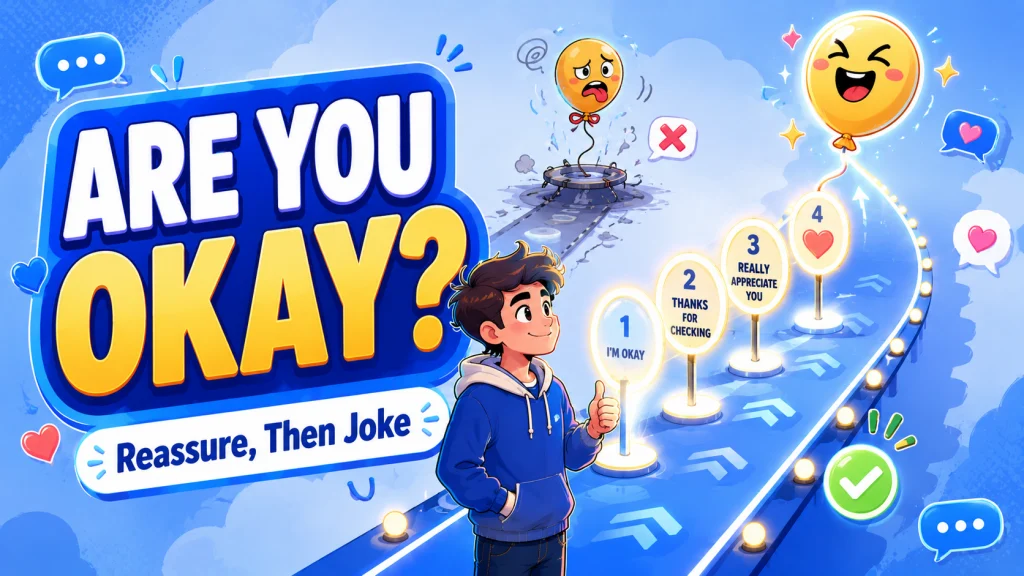
The most common mistake I have watched people make here is going straight for the joke. I understand why. If you are fine, the concern can feel like a little much, and humor is the fastest way to signal that everything is okay without making a whole conversation out of it. But a joke that skips the reassurance entirely tends to read as deflection, and a person who was already worried reads deflection as confirmation that something is wrong. One quick line of “yes, I’m okay” before the humor and the whole reply lands differently. Without it, the joke is doing twice the work it should have to.
That distinction is specific to this question. If the text was more of a casual “how are you” than a genuine check-in, the approach is different, and there is a separate set of options for funny things to say when someone asks how you’re doing that covers that lower-stakes territory. But when the text says “are you okay,” the reply is working in a different room.
| Your situation | What the reply needs to do |
|---|---|
| Someone who seems genuinely worried | Reassure clearly, keep the humor soft |
| Someone who caught you being quiet in a chat | Breezy and brief, nothing that reads as defensive |
| Someone who is clearly just teasing you | More personality, minimal reassurance needed |
| An in-person check-in | Match your delivery to your face, not just the words |
| You are not okay but not ready to say so | Warm deflection that closes the door without slamming it |

Funny Replies That Reassure Before the Joke
These are the core replies for when the question had some real weight behind it. Not crisis-level, but genuine enough that the reply needs to do a small amount of work before it gets to the punchline. The reassurance here does not have to be elaborate or long. A brief yes, a quick “I’m okay but…” and then the message can go wherever it wants. What matters is that the worry is addressed, even briefly, before the humor steps in front of it.
A friend of mine got a text like this from her mom after she posted something vague on Instagram late at night. She went straight for the deadpan, which was a genuinely good line. Her mom called her sister in a mild panic anyway. Thirty seconds of “I am actually fine, that was a mood not a moment” before the joke would have fixed the whole thing. The line was right. The order was off.
- “Physically? Yes. Emotionally? We are doing our best.”
- “Alive and operational. Thank you for checking.”
- “I’m fine. My drama is purely aesthetic.”
- “Yes, just going through a character arc. I think I am close to the resolution.”
- “Completely okay. I am just choosing to narrate it differently in my head right now.”
- “I’m good. I just forgot to pretend everything was fine for a second.”
- “Yes! I was doing my annual spiral. I think it is wrapping up.”
- “Okay is a strong word, but I am functional and fed, which counts for something.”
- “I’m fine, just professionally chaotic right now.”
- “Yes. Nothing is actually wrong. I just had a moment. The moment has passed.”
- “Doing fine. A little dramatic but fine. Thank you for noticing.”
- “I’m alright. Just one of those weeks that feels like it should be a documentary.”
- “Yes. I’m okay. A little feral but okay.”
- “Okay-ish. On the spectrum of not okay, I am closer to fine than you might think.”
- “I’m good. Just gave my worries the afternoon off and now they do not want to leave.”
Short Replies for When You Want to Keep It Light
Sometimes the situation does not need much. The question came from a lighter place, someone who caught your tone in a chat or checked in after a small thing they already knew about, and the reply just needs to signal that nothing is wrong without turning it into a whole thing. Short works here. The whole point is breezy: brief enough that there is clearly no drama, warm enough that they feel good about having asked.
What short replies depend on is word choice carrying the tone, because there is not much room for correction if something reads the wrong way. “Fine.” with a period can land very differently than “Fine! Thanks for asking.” In text, punctuation does a lot of the emotional work that your face and voice normally handle. Worth a second look before you send it, especially if the person asking was already a little concerned.
- “All good. Why?”
- “Better than I look, I promise.”
- “Mostly, but in a manageable way.”
- “Fine, just tired. Thanks.”
- “Still standing, and I appreciate the check-in.”
- “Tragically, yes.”
- “I’ll survive, but thank you for noticing.”
- “Always. But I appreciate you asking.”
- “Yep. Just a little feral today.”
- “Fine-ish. Thanks for checking.”
Replies for When the Person Asking Is Genuinely Worried
This is the situation that asks the most of the reply. Not because it needs to be heavy or serious, but because the person on the other end has put something real into that message, and a joke that completely ignores that will land wrong even if it is technically a good line. The register here is honest-light: not burdened, not dismissive, somewhere between the two. You can still be dry. You can still be yourself. But the reply needs to do a bit more work before the humor earns its place.
These replies work for the friend who reached out after a long quiet stretch, the family member who texted after something you said, or anyone whose “are you okay” clearly came from a real place rather than social habit. When someone asks because they genuinely care, the funny reply needs a little more warmth than usual to land the way it should.
- “I’m okay. I know I’ve been quiet. Just working through something small. Thanks for checking.”
- “Yes, really. Had a rough patch. I think the worst of it is past.”
- “I’m okay. Not my best week, but not falling apart. I appreciate you asking.”
- “I’m alright. I’ll explain later but I do not want you to worry right now.”
- “Yes. Honestly just tired. Good tired, not the other kind.”
- “I’m fine. I know it did not look like it. But I am. Thank you.”
- “Doing better than the last time you saw me, which is the bar I am working with.”
- “Yeah. I appreciate you asking. I’m genuinely okay.”
Replies for When Someone Is Clearly Just Teasing You
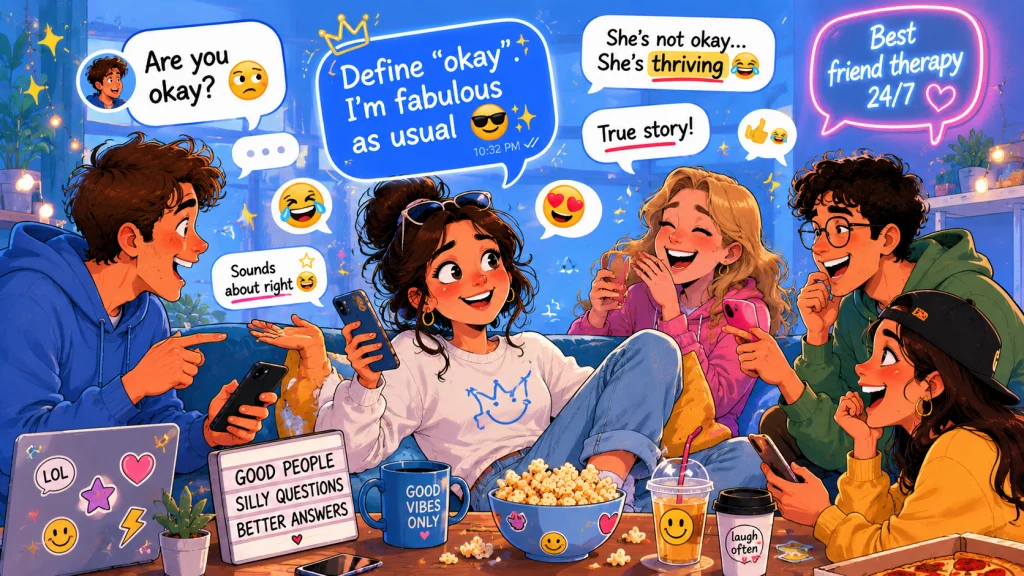
This is the easier version of the question. When someone asks “are you okay” because you just made a questionable decision, sent something chaotic to the group chat, or they are simply enjoying the moment at your expense, the reassurance can be minimal. They already know you are fine. You can skip the runway and go straight to the personality.
The one thing worth watching is being accurate about your read. A reply that plays perfectly when someone is obviously teasing you can land very badly if they were actually concerned and you misjudged it. When there is any real ambiguity, lean toward a little more reassurance. But when the tone is clearly light, these replies have real room to work.
- “Never been better. Why?”
- “Define okay.”
- “By whose standards?”
- “Depends on what you heard.”
- “That is a complicated question and I am choosing not to answer it right now.”
- “Absolutely not. But I am having fun.”
- “I am thriving. This is what thriving looks like for me.”
- “Okay is a spectrum and I am somewhere on it.”
- “Totally fine. The chaos is on purpose.”
- “Yes. The bad decisions were calculated.”
In-Person Replies and Why Deadpan Can Backfire
In-person replies come with a variable that text does not have: your face. A line that works perfectly in a message can read as evasive or even distressed in person, depending on what your expression is doing while you deliver it. I have watched someone say what should have been a perfectly dry comeback in person and have the other person go more worried, not less, because something in the delivery did not match the words. The joke was right. The execution had a gap in it.
The fix is not abandoning the humor. It is making sure your face and tone carry the same energy as the line. Deadpan works in person only when it is fully committed. If you want to come across as genuinely fine with a light joke on top, let a small smile or a relaxed posture land before or with the words. The replies below work out loud, but the delivery is doing at least half the work.
- “I was fine until you asked, and now I feel like I should be worried about something.”
- “I am always okay. I am deeply, consistently okay.” (flat delivery, hold eye contact)
- “Yes. What gave you the impression I wasn’t?”
- “Okay enough to be standing here. That is where we are.”
- “I’m fine. I just gave my face the day off.”
- “I’ve been better. I’ve also been worse. Currently somewhere in the middle and trending upward.”
- “I am fine. You can stop looking at me like that.”

When You Are Not Okay but Not Ready to Talk About It
This is the section most people skip when they go looking for funny replies, because it seems like a contradiction. If you are not okay, what exactly is the joke? But there is a real category here, and it is not the same as funny. Not ready to talk is not the same as not functional, and a warm deflection can close the door on the conversation without making the person who asked feel like they made a mistake by reaching out. These replies acknowledge the check-in without opening a conversation you are not ready for, and they do it without making the asker feel shut out.
None of these are light or dry in the way the other sections are. They are warm and honest and they set a boundary without creating pressure in either direction. If you are looking for something to say when “fine” does not feel accurate but you are also not ready to go into it, there is a separate set of options for what to say instead of I’m fine that covers the middle ground in more depth.
- “Not entirely, but I’m working on it. Thanks for asking.”
- “Working on being okay. Getting there.”
- “Not my best day. I don’t want to talk about it just yet. I’ll let you know when I do.”
- “I’ll be okay. Just need a little time.”
- “Complicated answer. Short version: not quite, but it is not urgent.”
- “I’m in the process of being okay. The project is ongoing.”
- “Ask me again next week. I think the answer will be better by then.”
- “Not really, but not in a way you can help right now. I’ll reach out when I can.”
- “Not totally. But knowing you asked already helps a little.”
- “Working on it. Still deciding how much of the story I want to tell.”
What Not to Say
There are a few replies that feel funny in the moment and land badly in practice. I am naming them not to add a disclaimer nobody asked for, but because they come up in real conversations more often than you would expect, and knowing why they go wrong is more useful than just being told to avoid them.
The first category is alarming jokes. Anything in the range of “no, I’m dying” or “three more days” or “this is my last text” might feel like obvious sarcasm from where you are sitting, but those jokes depend entirely on the other person already knowing you are fine. When the text came from someone who was not sure, that certainty is exactly what they do not have. The punchline has no floor to land on, and the result tends to be more concern, not less. The funnier you make it, the worse it gets.
The second is dismissive single-word answers with no warmth behind them. “Fine” with a period can read as genuinely fine, or it can read as “I do not want to talk to you.” In text, that ambiguity almost always resolves toward the harder interpretation, especially when the person asking already sensed something was off. Add a word or two, or adjust the punctuation. The difference between “Fine.” and “Fine! Thanks for asking” is small to type and significant to read.
- Jokes that depend on the other person already knowing you are safe, before you have told them that
- Self-harm references used as humor, even lightly, even as obvious jokes
- Replies that make the concern feel like an imposition: “why would I not be okay” said flatly tends to make the asker regret having asked
- Single-word answers with nothing to soften them
- Anything that confuses rather than reassures, especially with someone who was already worried
Making concern feel stupid is the last one worth naming on its own. If you want someone to keep checking in on you, the reply that settles the question while leaving the relationship intact is always the better move, even when you are fine and the worry felt like a little much.
Final Thoughts: The Rule Under All Sixty
Sixty replies is a lot of options, but the logic underneath all of them is the same. Let the other person breathe before the joke arrives. The reassurance does not need to be long or earnest or serious. A single word, a quick “I’m okay but…” and then whatever comes after. What matters is that it gets there first, so the humor lands in air that has already been cleared.
The trickier situations, the genuinely worried asker, the in-person delivery, the not-ready-to-talk deflection, ask a bit more of the reply. Not because they require serious answers, but because they need to do a little more work before they earn the lightness. When you get it right, the funny reply in those situations lands better than it would have in an easier one, because the other person already knows you are okay and can actually enjoy the joke.
If this is one corner of a bigger picture, the full range of funny text replies covers more situations than any single type of message can.
FAQs
💬 What is a good funny reply to an are you okay text when you actually are fine?
Something short and slightly dry tends to work best. “Alive and operational” or “Physically yes, emotionally we are figuring it out” both land well. The key is getting a quick yes in first so the humor has somewhere to stand.
🤔 What do I say if I am not okay but do not want to get into it?
Keep it honest and brief. “Working on it” or “Not totally, but I am not ready to talk yet” lets the person know they were heard without opening the whole conversation. It closes the door without making them feel shut out.
😅 Why does a deadpan reply not always work when someone is genuinely worried?
Because the joke assumes the other person already knows you are fine. If they are not sure, the punchline has no ground to land on. One word of reassurance first fixes this almost every time.
📱 Should I reassure first or joke first when someone texts are you okay?
Reassure first, every time. The joke lands better when they already know you are okay. Skipping the reassurance tends to read as deflection, which usually makes a worried person more worried, not less.
😂 What if the person is clearly just teasing me, not genuinely worried?
Then you have more room. Skip the reassurance and go straight for the deadpan. Just make sure your read on the situation is accurate before you treat it that way. Getting that wrong is where things tend to go sideways.
🙃 What is a funny in-person reply to are you okay?
“I was fine until you asked” lands well in person, but watch your delivery. Deadpan works only when your face and tone match the line. If there is a gap between your expression and your words, the concern tends to go up rather than down.
😶 What should I say when someone texts are you okay after I have been quiet for a while?
Acknowledge it briefly. “I know I have been quiet, just working through something small, thanks for checking” closes the concern without turning it into more than you want to handle. It lets them feel good about asking without opening a door you are not ready to walk through.