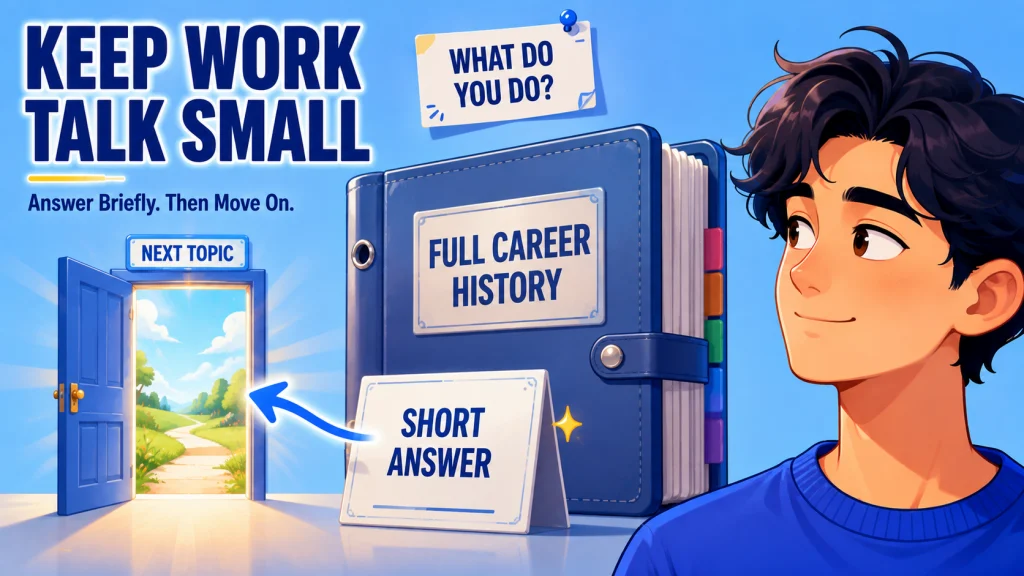
Getting asked what you do for a living can be harmless small talk, but the question can suddenly make a relaxed conversation feel like an interview. The easiest way to keep it light is to answer briefly, add one playful detail if it fits, and give the other person somewhere better to take the conversation. You do not need an impressive job, a fake backstory, or a rehearsed speech to make the moment less awkward. A small joke works best when it opens the conversation instead of turning your work into the entire conversation.
Why this question can feel like a tiny interview
Funny responses to the question “what do you do for a living?” work best when they take the pressure out of the moment without treating the asker like they did something wrong. Most people are reaching for an easy opener, not requesting your employment history, but the wording can still make you feel as if you are supposed to present a polished version of yourself. That is where people often overthink the answer and start explaining far more than the moment needs. A short line with a little personality usually gives the conversation more room to breathe.
In nine years behind a bar, I watched this question arrive early in conversations between people who had barely learned each other’s names. The people who handled it best rarely had the cleverest jobs or the sharpest jokes. They simply answered in a way that gave the other person something human to respond to. If the question feels more personal than casual, these witty responses to personal questions cover the broader problem without turning every curious person into an enemy. Here, the goal is smaller: keep the exchange social, not evaluative.
Quick funny replies that do not need a setup
The safest joke is usually one the other person understands before you finish saying it. A funny reply about work does not need a fictional biography, a long pause for dramatic effect, or a punchline that makes the asker defend the question. You are trying to loosen the moment, not win it. If the room is casual, one of these can do the job and then get out of the way.
- “Mostly emails, with occasional evidence of productivity.”
- “I turn coffee into completed tasks.”
- “I solve problems and accidentally create sequel problems.”
- “I attend meetings so future meetings can be scheduled.”
- “I make things look under control from a reasonable distance.”
- “I do a surprisingly legal amount of staring at screens.”
These lines work because they sound like jokes, not evasions dressed as mysteries. I would use them when the asker seems friendly and you are happy to talk about work after the laugh, or when you want to give a quick answer and move on naturally. If the person actually wants to know what you do, follow the joke with the plain answer instead of making them extract it from you. The joke should lower the effort of the conversation, not increase it.
Them: “So, what do you do for a living?”
You: “Mostly emails with a side of pretending my calendar is reasonable.”
Them: “Okay, but what do you actually do?”
You: “I work in operations. Much less mysterious than the calendar suggests.”

Fake job-title jokes that clearly stay jokes
Fake titles can be funny, but only when nobody has to wonder whether you are serious. The mistake is choosing something plausible enough that the other person starts asking follow-up questions about a job you invented three seconds ago. That turns a quick laugh into administrative work. Make the title absurd, keep it short, and be ready to give the real answer if the conversation continues.
- “Senior director of finding the charger everyone else lost.”
- “Regional manager of making it up as I go.”
- “Head of unnecessary spreadsheet beautification.”
- “Assistant to the person who actually knows what is happening.”
- “Chief officer of checking whether that meeting could have been an email.”
I like fake titles best when they exaggerate something ordinary about the real job instead of pretending to have status you do not have. A project coordinator can joke about professionally chasing people for updates, while a designer can joke about moving things two pixels until everyone agrees. That keeps the joke attached to reality, so the next sentence can become an actual conversation instead of a confession that you made the whole thing up. The jokes that last longest are usually the ones with a little truth hiding inside them.
Them: “What do you do for work?”
You: “I’m the senior director of asking whether anyone read the email.”
Them: “That sounds painfully real.”
You: “It is. I manage client projects.”
Give the truthful answer, then add one funny detail
You do not have to choose between being funny and answering the question. One of the cleanest approaches is to say what you actually do, then add the part that makes the job sound like a life rather than a label. That detail can be a recurring annoyance, a harmless stereotype about your own work, or the strange task you never expected to spend so much time doing. It gives the other person something easier to respond to than a job title alone.
- “I’m an accountant, so I spend a lot of time asking numbers to explain themselves.”
- “I’m a teacher, which means I repeat important things with increasingly creative optimism.”
- “I work in marketing, so I have very serious opinions about buttons.”
- “I’m a freelancer, which means my boss is demanding and unfortunately knows where I live.”
This is also where witty responses about jobs stop sounding like prepared material and start sounding like you. I have seen people get a better conversation from one odd detail than from five minutes of describing responsibilities, because the detail gives the listener a handle. If they are interested, they can ask about it, and if they are not, the conversation can move without anyone feeling trapped. That is a much better outcome than reciting a miniature resume at someone holding a drink.
Them: “What do you do?”
You: “I’m a graphic designer. I spend an unreasonable amount of my life moving things slightly to the left.”
Them: “People really ask for that?”
You: “Constantly, and somehow they are often right.”

If your work is hard to explain, describe the useful part
Some jobs become awkward only because the official title means nothing outside the workplace. If you need three acronyms and an organizational chart to explain what you do, skip the title at first and describe the result in plain English. You can still make it funny, but let the listener understand the basic shape of the work before you decorate it. Clarity gives the joke somewhere to land.
Instead of saying you are a specialist in a narrow internal function, you might say, “I help companies stop losing track of expensive things, which is more exciting than the software makes it sound.” Someone in a highly technical role might say, “I make complicated systems behave, usually after they have chosen violence.” The exact wording matters less than giving the other person one picture they can hold onto. When people ask what you do for work, they usually need enough context to keep talking, not the language from your job description.
Them: “What do you do for work?”
You: “I help hospitals keep their scheduling software from becoming everyone’s second problem.”
Them: “So you work in tech?”
You: “Exactly. The useful answer is much shorter than my actual title.”
If you are studying, between jobs, or do not want work to define the conversation
You are allowed to answer the question without presenting a career identity. If you are studying, between jobs, taking care of family, figuring out your next move, or simply not interested in making work the headline, say the useful truth and stop before it becomes an explanation you never wanted to give. Humor can soften the edge if that feels natural, but it should not make you mock your own situation for someone else’s comfort. A calm answer is enough.
- “I’m studying right now, which means I currently specialize in deadlines.”
- “I’m between jobs, so my calendar and I are renegotiating our relationship.”
- “Work is in transition. My hobbies have been enjoying the extra publicity.”
- “I do a few things, but I promise none of them are interesting enough for a quarterly review.”
People commonly get this part wrong by trying to prove that their current situation is respectable before the other person has even judged it. I understand the impulse, because a job question can feel bigger when you are unsure how your answer will be received, but a defensive speech often makes the moment feel heavier than it was. Give the amount of truth you actually want to give, then move the conversation toward something you would rather discuss. A casual work question is not a test of how impressive your life sounds.

Redirect to a better topic without sounding defensive
A redirect lands better when you answer something before you change lanes. If you dodge the question completely, a friendly asker may think they touched a nerve and start apologizing, which creates exactly the awkwardness you were trying to avoid. Give them a small answer, then offer a better doorway. The move should feel like conversation, not a boundary announcement unless you actually need a boundary.
- “I work in logistics, but I would rather hear how you know everyone here.”
- “I’m in finance. More importantly, what have you been doing for fun lately?”
- “I freelance, so the answer changes a little. What are you into when nobody is paying you?”
- “I work in healthcare. I am off duty from work talk, though, so tell me something better.”
I have watched plenty of conversations improve the second somebody stopped treating the first question as a contract to stay on that subject. A good redirect gives the other person a clear next move, which is kinder than a dead-end joke that forces them to invent another opener from scratch. If you want more options for these everyday moments, I keep a broader set of funny replies for everyday conversations that use the same small-response principle. The best redirect does not reject the asker. It just chooses a more interesting road.
What not to say when the joke creates more work than it saves
Some answers are funny only until the other person believes them. Fake credentials, invented employers, exaggerated income, or a serious-sounding profession you do not actually have can turn a harmless opener into a lie you now have to maintain. That is not sharper banter. It is just extra paperwork with eye contact. Keep fictional job titles obviously ridiculous, and keep real claims real.
I would also skip jokes that sneer at the asker for asking a common small-talk question. “Why do you care?” can be a fair response if someone is prying, but as a default it makes a neutral person pay for a problem they may not have created. The same goes for launching into career advice, salary complaints, or a speech about why work should never matter to anyone, because none of those answers match the size of the moment. If the conversation is really about a personal detail rather than work itself, the same light touch applies to funny responses to how old are you without turning curiosity into a confrontation. If the person keeps pushing after a clear answer or redirect, then you can be firmer, but you do not need to start there.
Final thoughts: keep the joke smaller than the conversation
The question “what do you do for a living?” does not require a perfect line. A quick joke can loosen the moment, a truthful answer with one funny detail can make you easier to talk to, and a clean redirect can keep work from becoming the whole subject. Pick the version that matches how much you actually want to share. You are answering a person, not filling out a form.
The lines I trust most are the ones that leave room for the next sentence. If the joke needs a long explanation, it was probably too complicated for small talk, and if the redirect sounds like a rebuke, it probably moved too hard. Give them enough to understand you, then give the conversation somewhere useful to go. That is all this question really needs from you.
FAQs
The same work question can feel completely different depending on who asks it and how much you want to share. That is why there is no single clever answer that wins every version of the moment. I would choose based on whether you want to keep talking about work, make one joke, or move somewhere else. Short answers give you the most control over what happens next.
These are the questions people tend to ask once they realize the problem is not finding the funniest possible occupation. The useful part is deciding how truthful, playful, or redirecting you want to be. You can change your answer with the setting without becoming inconsistent. Different rooms earn different amounts of detail.
💬 What is a funny answer when someone asks what you do for work?
Try a short exaggeration tied to ordinary work, such as “I solve problems and create exciting new ones.” If they seem genuinely curious, follow it with your real job so the joke stays an opener rather than a dodge.
😄 How can I answer without making up a fake job?
Say the real job, then add one funny detail about what it actually feels like. “I’m in marketing, so I have stronger opinions about button wording than any adult should” gives them both truth and personality.
🎓 What do I say if I am still studying?
Keep it plain unless you want to joke: “I’m studying right now, so deadlines are basically my coworkers.” You can name the subject if you want, but you do not owe anyone a five-year career plan in casual conversation.
🔄 How do I change the subject after answering?
Give one brief answer first, then ask about something you would rather discuss. “I work in logistics. What do you do when you are not working?” moves the conversation without making the asker feel dismissed.
🧊 What if I do not want to talk about work at all?
You can say that lightly and redirect: “Work is fine, but I am happily off duty from that topic.” If the person keeps pushing, you can make the boundary clearer without turning it into a debate.