Being asked why you are so quiet can turn a perfectly normal silence into a public performance. The best response depends less on how clever you can sound and more on why the person asked: concern deserves reassurance, casual curiosity can take a joke, and repeated intrusion can take a boundary. I like replies that keep the moment small instead of forcing you to explain your whole personality. Below are 70 ways to answer without treating quietness like a problem that needs fixing.
Quick funny replies
Being asked why you are so quiet can feel less like a question and more like someone suddenly turning a spotlight on you. The awkward part is often not the silence itself, but the expectation that you now have to explain it in front of whoever is listening. Behind a bar, I saw that shift happen constantly: one person points out the quiet one, heads turn, and a normal pause becomes a performance. A short, well-timed answer gives the room somewhere else to go.
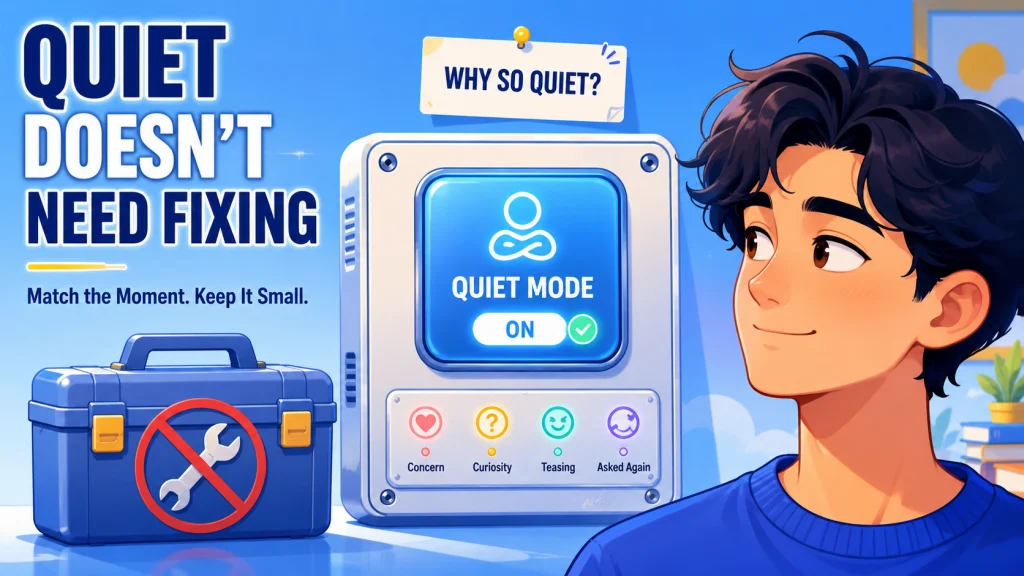
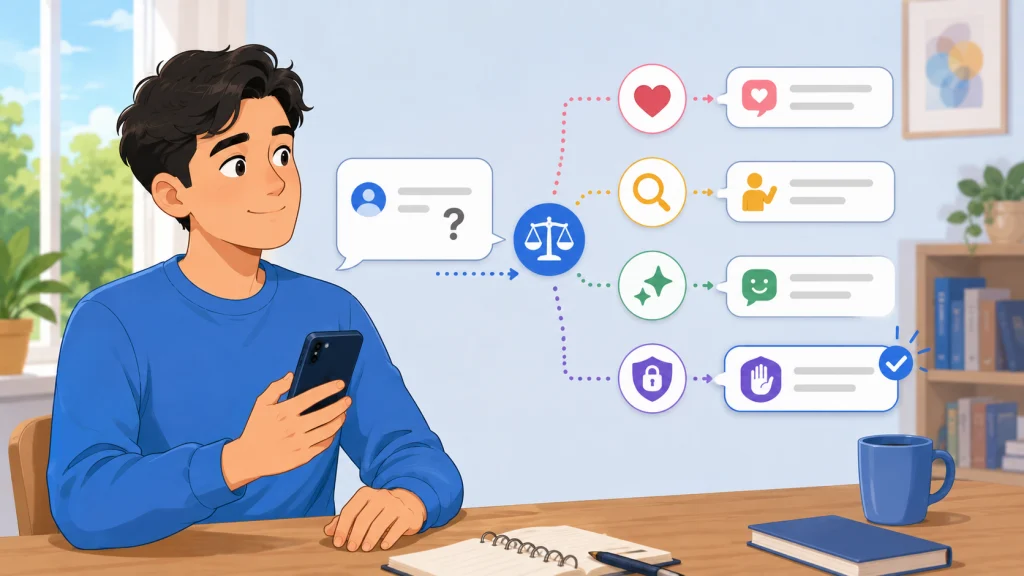
I have watched people answer the words while completely missing the motive behind them. Someone checking whether you are okay is not asking the same question as a friend teasing you, and neither is the same as a repeat asker trying to make your silence their business. That is why I prefer witty responses to personal questions that match the temperature of the room instead of trying to win it. Read the motive first, then choose the line.
| What the asker seems to mean | Best response style |
|---|---|
| Concerned | Reassure them briefly, then move on. |
| Curious | Use a light answer that does not invite a full explanation. |
| Teasing | Return a little playful energy without making it personal. |
| Intrusive | Keep the answer short and make the boundary obvious. |
If you are unsure what the asker means, start lighter than your irritation is telling you to start. You can always get firmer if they keep pushing, but it is harder to pull back a needlessly sharp line once the room has heard it. The point is not to prove that you are allowed to be quiet. It is to answer the moment without turning your personality into the evening’s main topic.
When the question is casual, humor works best if the answer is quick enough to end the exchange in one beat. These are the lines I would use with a coworker I get along with, someone at a casual gathering, or a person who sounds amused rather than judgmental. The strongest options feel like a shrug with timing, not a prepared speech. Say the line, let it land, and give the conversation room to move.
Do not reach for the sharpest comeback just because the question annoyed you. A rehearsed-sounding answer can turn a tiny social moment into a competition nobody asked for. I would rather make the asker laugh and change the subject than defend silence for three minutes. Pick something that sounds like you would actually say it out loud.
- “I’m saving my best material.”
- “My commentary track is buffering.”
- “I’m on low-volume mode.”
- “I already used my words.”
- “I’m letting the room breathe.”
- “Someone has to handle the listening.”
- “I’m waiting for the plot to improve.”
- “I charge extra for narration.”
- “I’m giving everyone else a head start.”
- “I’m in my limited-edition quiet phase.”
- “I thought we had enough sound already.”
- “I’m keeping the suspense alive.”
- “My thoughts are in a staff meeting.”
- “I’m between sentences.”
- “I like a little mystery.”
- “I was enjoying the silence until it got noticed.”
The best line is the one you can deliver without changing your whole demeanor. If your face says furious while your words say playful, the joke becomes a warning with a punchline attached. Choose the reply that fits your normal voice, not the one that looks funniest on a screen. Delivery still does half the work.

When the asker is genuinely concerned
When someone sounds genuinely worried, the best answer is often barely a comeback at all. If they lower their voice, check in privately, or clearly seem concerned, a joke can still work, but it should answer the concern before it dodges the question. You do not have to disclose anything personal to reassure someone that they do not need to fix the moment. A clean “I’m good” with a little personality is usually enough.
This is where people sometimes get tripped up by trying to be funny too quickly. A caring friend may hear a very dry answer as proof that something is wrong, which creates the exact follow-up conversation you were trying to avoid. I keep the first half clear and let the second half carry the joke. That way the person gets an answer without getting your entire internal weather report.
- “I’m good, just running quietly today.”
- “Nothing’s wrong, I’m just listening.”
- “I’m fine, my social volume is just down a notch.”
- “All good, I’m having a quiet minute.”
- “I’m okay, I just don’t have a speech prepared.”
- “Nothing dramatic, promise. I’m just being quiet.”
- “I’m good, just letting my brain catch up.”
- “I’m fine. You haven’t missed a secret announcement.”
If they accept that answer, let the conversation move on. If they keep checking after you have already reassured them, you can shorten the next response instead of producing more proof that you are okay. Concern deserves kindness, but kindness does not require an endless explanation. A calm repeat often lands better than a brand-new excuse.
When they are just filling silence
Sometimes the question is not really about you at all. The other person feels a pause, notices you are not filling it, and tosses out the first thing that comes to mind. That does not make the question less awkward, but it does mean you probably do not need a defensive answer. Give them a soft joke and let the conversation find a new subject.
I have seen people make this harder by answering with a long explanation about how they have always been quiet, what their family says about it, and why they prefer listening. By the time they finish, the person who asked has usually forgotten why they asked in the first place. A better move is one line that acknowledges the pause without turning it into your biography. Silence does not need a backstory every time it appears.
- “I was giving that silence a chance.”
- “I didn’t know we were taking attendance for sentences.”
- “I was waiting to see who blinked first.”
- “I thought that pause was doing pretty well on its own.”
- “I didn’t want to interrupt the quiet.”
- “I was seeing how long we could make it.”
- “I was enjoying the commercial break.”
- “I figured the conversation needed a loading screen.”
- “I was leaving room for a better topic.”
- “I had nothing to add, which felt refreshingly efficient.”
These work because they make the pause the joke instead of making either person the target. That distinction matters when the asker has not actually done anything rude beyond being a little uncomfortable with silence. You can keep your answer light without promising to become more talkative for their benefit. Then ask a new question if you want the conversation to continue, or simply let the pause return.
Funny replies for friends and group settings
Friends usually give you more room to be playful because there is already history in the room. A line that would sound cold with a stranger can sound completely normal when everyone knows you are teasing back. The same rule shows up in funny replies to age questions: the relationship decides how far the joke can safely travel. For broader situations, funny replies for awkward questions work best when the punchline stays on the situation instead of turning into a personal attack.
Group settings add one complication: everyone hears the comeback. If you embarrass the asker too hard, you may turn a throwaway comment into a miniature contest, and then the room starts choosing sides for no good reason. I like lines that give the group a laugh while leaving the door open for the conversation to continue. Think playful return, not public execution.
- “I’m taking notes on all of you.”
- “You all seemed committed to the talking.”
- “I was waiting for my cue.”
- “I’m the audience tonight.”
- “I speak when the group earns new dialogue.”
- “I was hoping someone would eventually ask me an easy question.”
- “I’m conserving energy for the group photo.”
- “I like to let the louder departments handle opening remarks.”
- “I’m here for quality control.”
- “I was listening. Weird hobby, I know.”
- “I’m pacing myself. This group has stamina.”
- “I’m waiting for the recap before I comment.”
If your friend laughs and moves on, you nailed the scale of the moment. If they look embarrassed, do not keep stacking jokes just because the first one got a reaction from everyone else. One line is enough. The funniest response usually knows when to stop.

When someone calls you quiet in public
Public callouts are different because the real pressure comes from suddenly having an audience. You may not mind the question itself, but now five people are looking at you while you decide how much of yourself to explain. This is the moment when I would keep the reply especially compact. The longer you talk, the more the spotlight stays where you did not ask for it.
A useful public answer does two jobs at once: it gives the asker something to accept and signals to everyone else that the moment is over. That is why I avoid lines that invite a debate about whether quiet people are better or worse than talkative people. Nobody needs a personality referendum at lunch, in a meeting, or around a crowded table. A small joke can close the door without slamming it.
- “I’m good, just not running a live broadcast.”
- “I didn’t realize my silence had an audience.”
- “I’m fine. The room just has plenty of speakers already.”
- “I was listening until I became the topic.”
- “I’m okay, I just wasn’t scheduled for a Q and A.”
- “I promise I’m still participating internally.”
- “I’m here. I just came without commentary.”
- “Everything’s fine, I was simply minding my business professionally.”
- “I’m good. Please return your attention to the regular programming.”
- “Nothing’s wrong. I was just having a pleasantly uneventful moment.”
After the line, look back at the original conversation instead of waiting for people to judge your answer. That small physical shift helps the group understand that the subject has changed. You do not need to perform confidence with a bigger joke or a louder voice. Sometimes the cleanest response is the one that makes your quietness boring again.
Firm boundaries for people who keep asking
The tone changes when someone keeps asking after you have already answered. At that point, you are no longer trying to make one awkward question funny; you are trying to stop a repeat pattern without opening a larger argument. Humor can still help, but the boundary has to be easier to hear than the punchline. If they miss the joke, they should not miss the limit.
I would not keep inventing new excuses for a person who treats every answer as an invitation to investigate. Repetition often works better: “I’m fine, just quiet” can be less satisfying to say, but it gives them almost nothing to grab. If you want a firmer version, make it about the question rather than attacking the asker for being loud. You are ending the topic, not starting a new one.
- “Still quiet. Same answer.”
- “I’m good, and I don’t need to explain it again.”
- “Nothing’s wrong. Let’s retire this question.”
- “I’m fine. My quietness does not need troubleshooting.”
- “I answered you already, so I’m leaving it there.”
- “I’m comfortable. You don’t need to solve the silence.”
- “I’m not looking to make my quietness a group topic.”
- “I’m okay with being quiet. Let’s move on.”
There is no prize for making the boundary cleverer on the third round. Once the other person knows you do not want to keep discussing it, plain language is usually stronger than another joke. If they respect that, the conversation can recover quickly. If they do not, you are allowed to stop participating in that particular exchange.
What not to say: diagnoses, dark jokes, and personal attacks
The easiest way to make this question worse is to answer with something much heavier than the moment called for. Jokes about hurting people, threatening the asker, or making your silence sound ominous may look edgy in a list, but they can land badly when someone hears them without the tone you imagined. I also would not invent a diagnosis for yourself or anyone else just to make the line sound more serious. You can be private without turning a social question into a medical explanation.
The other common mistake is flipping the insult straight back: “Why are you so loud?” or “Why do you talk so much?” can feel satisfying, especially if you were already irritated. The problem is that it changes the subject from your boundary to their personality, which gives them something new to argue about. If you want the exchange to end, attack the repetition or the awkwardness of the question, not the person. That keeps the line cleaner and easier to defend.
- Instead of a threat: “Relax, I’m just quiet.”
- Instead of a dark joke: “Nothing mysterious, I just wasn’t talking.”
- Instead of a diagnosis: “No big explanation. I’m just having a quiet moment.”
- Instead of “Why are you so loud?”: “We clearly have different volume settings.”
- Instead of “You talk too much”: “You’ve got the talking covered.”
- Instead of a personal attack: “The question is getting more attention than my silence was.”
Those swaps keep the humor pointed at the moment rather than at something personal, threatening, or clinical. They also leave you more room to get serious later if the person keeps pushing. A clean joke is easy to walk away from. A needlessly dark line can become the new problem in the room.
Final thoughts
You do not need a perfect comeback every time someone notices you are quiet. Figure out whether they are concerned, curious, teasing, or pushing past a limit, then match that with the smallest reply that works. A joke, a reassurance, or a boundary can all be right in different rooms. The useful response is the one that fits this room.
If I had to keep one rule from watching awkward moments recover, it would be this: do not make the exchange bigger unless the other person keeps making it bigger. Light curiosity can take a light joke, real concern can take a simple reassurance, and repeated pressure can take plain language. Quiet does not need a defense speech. Sometimes four words and a steady tone are plenty.
FAQs
These are the questions people tend to ask once the first awkward moment is over. The useful answer is usually shorter than the explanation people feel pressured to give in real time. I would treat each one as a tone decision, not a test of whether you are being quiet for the “right” reason. You can answer the social moment without putting your whole inner life on display.
The wording also matters less than whether it fits the relationship. A line that is funny with a close friend may sound chilly with a new coworker, while a plain boundary can be exactly right with someone who will not let the subject go. If you are unsure, start neutral and adjust only if they keep pushing. That leaves you room to be warmer or firmer without overcorrecting.
💬 What is a funny response when someone asks why I am so quiet?
Try something small like, “I’m saving my best material.” It answers the moment without turning your silence into a serious discussion.
🙂 What should I say if they are actually worried about me?
Reassure them first: “I’m good, just quiet today.” You can keep it light without giving details you do not want to share.
👥 How do I answer when someone calls me quiet in front of a group?
Use a short line that closes the spotlight, such as, “I didn’t realize my silence had an audience.” Then turn your attention back to the original conversation.
🛑 What if the same person keeps asking why I am quiet?
Stop trying to make every answer funnier. Say, “I’m fine, and I don’t need to explain it again,” then leave the topic there.
🎭 Is it rude to ask them why they are so loud?
It can turn the exchange into a personal jab and give them something new to argue about. If you want the moment over, target the repeated question instead of their personality.