Passive aggressive texts are built to make you look dramatic if you answer the tone instead of the words. I have watched this exact trap close on people behind a bar for years, the eye roll typed out as “no worries lol” while everyone in the room knows there are worries. This is where I keep the passive aggressive text comebacks that actually work, sorted by what you are trying to do: name the tone, push for a straight answer, set a boundary, or just not feed the bait at all. None of them require you to match the energy you were just handed. By the end you will have a reply ready for the next “fine.” that clearly is not.
Why Passive Aggressive Texts Are Harder Than a Direct Insult
A rude text is easy. Someone says something ugly, you know exactly what you are dealing with, and you can respond to the actual words. A passive aggressive text is built differently. It hands you a tone without confirming it, so if you respond to the tone, you are suddenly the one who “took it the wrong way.” That is the exact problem these replies are meant to solve: the sender gets to keep deniability while you do the emotional labor of decoding “no it’s fine” at eleven at night.
I spent nine years behind a bar watching this play out in real time, mostly over phones people thought no one else could see. Someone would read a text twice, get quiet, then type “haha okay” because saying what they actually felt risked sounding dramatic over something that was, on paper, just three words and a period. The tone was unmistakable. The proof was nonexistent. That gap is where most people freeze, and it is exactly what this is for.
Savage Replies to Passive Aggressive Texts That Hit Without Yelling
Sometimes the move is not to clarify anything. Sometimes you just want a line sharp enough that the other person knows you caught the tone and you are not going to pretend you didn’t. These work best when the relationship can take a little heat, a sibling, a friend, someone who will not spiral if you push back with an edge. They are not for a boss or someone fragile, and they are not built to start a fight. They are built to end one before it starts a second round.
The trick with a savage reply is restraint. One line, no follow-up paragraph defending why you said it. The moment you over-explain a savage comeback, it stops being savage and starts being an argument you are now responsible for.
- “Oh, was that comment supposed to land? It tripped on the way out.”
- “Say it with your chest next time. I can take it.”
- “Funny, I didn’t realize a fortune cookie could sound that bitter.”
- “If you’re going to throw shade, at least aim better.”
- “I heard the tone. I’m choosing to respond to the words instead.”
- “Cute. Try saying it without the wink next time.”
- “I’m not playing detective with your mood today.”
- “Thanks for the subtext. I’ll pass.”
- “You could have just said that. Bold of you not to.”
- “I’m flattered you put that much thought into a jab.”
- “If that’s your best shot, I’ve had worse from strangers.”
- “Save the riddles, I only answer plain English.”
There is one I almost did not hand to a friend because it felt too sharp for what she was dealing with. She used the fortune cookie line on a coworker who had been “just kidding” at her for two weeks. She told me later it was the first time the digs stopped completely. Sometimes the savage replies to passive aggressive texts are not about escalation at all. They are about making it clear the game has an audience now.
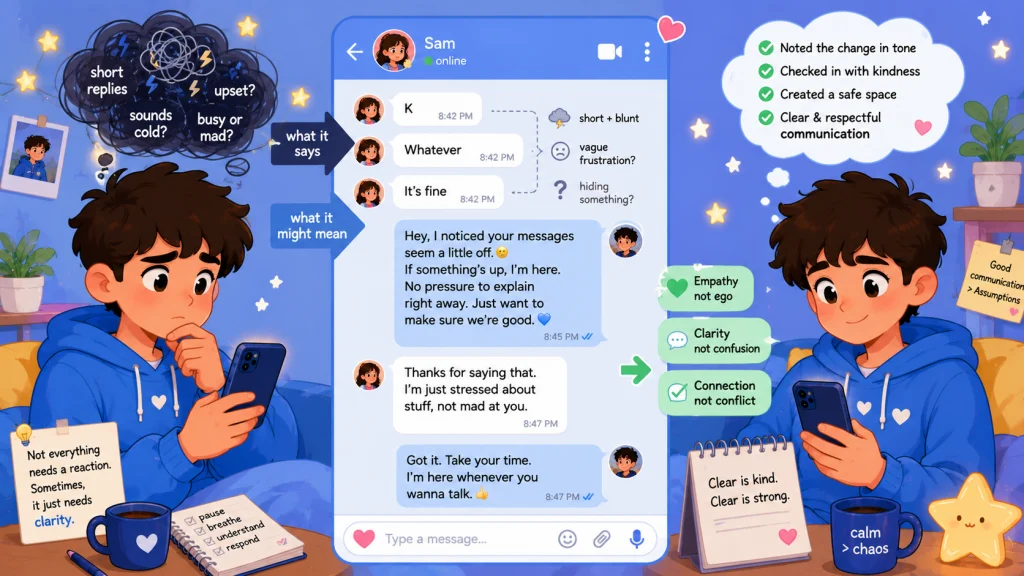
Calm Callouts That Name the Tone Once
Not every situation calls for a blade. Sometimes the relationship matters too much to risk an edge, or you genuinely do not know yet whether something is wrong versus whether you are reading into a short text after a long day. A calm callout names the tone exactly once, without accusing anyone of anything, and leaves room for the other person to either explain themselves or drop the act.
What makes this work is that you are not asking permission to notice the tone. You already noticed it. You are just saying so out loud instead of pretending you did not, which is usually the part people skip because it feels confrontational. It is not. It is the opposite of escalation.
- “That sounded a little sharp. Want to just say what’s actually bothering you?”
- “I’m noticing some tension in that message. What’s going on?”
- “That came across passive aggressive. I’d rather just talk it through.”
- “I felt the edge in that text. Can we talk plainly?”
- “That landed a bit off. Mind clarifying what you mean?”
- “I sense there’s more here than what you typed.”
- “That tone is new. Did something happen?”
- “I’d rather you just tell me directly than hint at it.”
- “That message felt loaded. What’s really on your mind?”
I have sent versions of these myself more times than I would like to admit, usually to someone I cared about enough not to want to guess wrong. Most of the time, naming the tone once is enough to end it. The other person either says what is actually going on, or they back off because the deniability just disappeared.
Clarifying Replies That Make Them Say the Quiet Part
This is the category people overthink the most, and the irony is that the shorter version almost always wins. You do not need a paragraph explaining why you suspect something is off. You need one short question that puts the burden of clarity back where it belongs, on the person who sent a loaded text in the first place.
What I have noticed, more times than I can count, is that people draft long, careful messages trying to gently coax an honest answer out of someone, when a four-word question does the same job in a fraction of the time and without sounding rehearsed.
- “What do you actually mean by that?”
- “Say that again, but without the ‘fine.'”
- “Are you upset about something? Just tell me.”
- “I can’t respond to a feeling I can’t see. Spell it out.”
- “If something’s wrong, I’d rather hear it straight.”
- “You don’t have to hint. I’m listening.”
- “What’s the actual issue here?”
- “I won’t guess. What happened?”
- “Tell me plainly so I’m not reading between the lines.”
This is where people usually soften the question too much. They assume asking directly will sound accusatory, so they soften it into something so vague it accidentally invites another vague answer back. A clean, direct question is not rude. It is the fastest way out of a conversation neither of you actually wants to keep having in code.
Short Comebacks for When You Don’t Want to Write a Paragraph
Sometimes the smartest passive aggressive text response is barely a response at all. A loaded “k.” deserves something flat and unbothered back, not a defense of your character. The shorter your reply, the less material there is for the other person to twist into a second round, and that is the entire point.
These are not meant to sound cold for the sake of it. They are meant to sound like someone who is not available to play along, which is usually more disarming than anything clever you could type instead.
- “Noted.”
- “Okay.”
- “Got it.”
- “Sure thing.”
- “Cool cool.”
- “Heard.”
- “Loud and clear.”
- “Message received.”
- “Mm, okay.”
- “Will do.”
- “Appreciate the tone.”
- “Thanks for sharing.”
“Appreciate the tone” is the one people text me about most. It works because it is technically polite and impossible to argue with, while quietly confirming you absolutely caught the subtext. Read it twice and you will see why it lands harder than something twice as long.
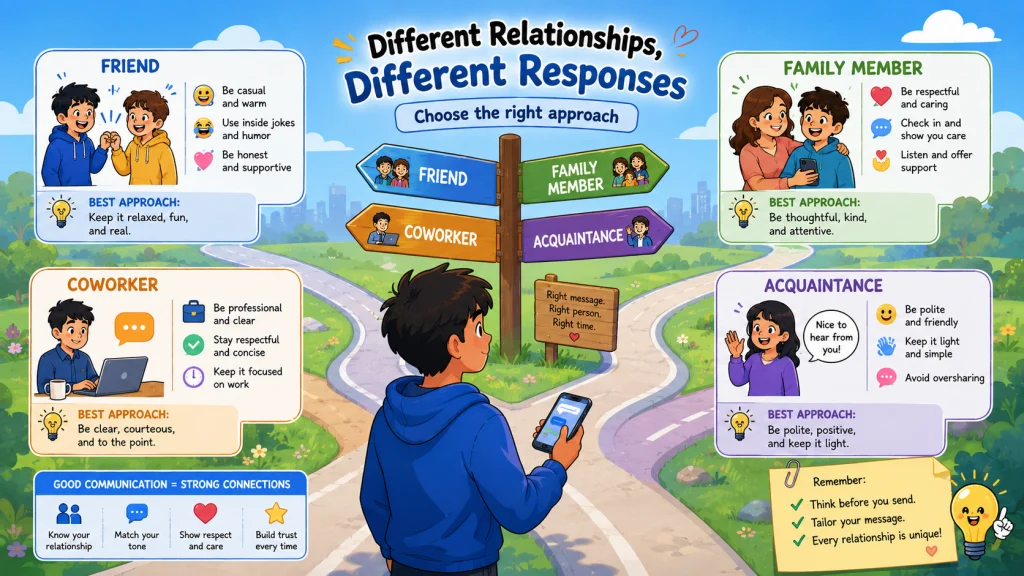
Matching the Reply to the Relationship
Not every passive aggressive text comes from the same place, and the right reply changes depending on who sent it and what you actually need from them afterward. A coworker requires more restraint than a sibling. A parent requires more patience than a friend who is clearly testing you. Here is a quick way to sort it before you start typing.
| Who Texted You | What You Actually Need | Best Type of Reply |
|---|---|---|
| Close friend or sibling | Honesty without a fight | Savage or calm callout |
| Coworker or manager | Professionalism on record | Work-safe version |
| Parent or older relative | De-escalation without retreat | Family-safe version or short comeback |
| Someone testing you for a reaction | No reaction at all | No-engagement reply |
| Someone you actually need to fix things with | A real conversation | Clarifying reply |
Once you know which column you are in, the right reply usually picks itself. The mistake most people make is reaching for a savage line on a coworker or a clarifying question on someone who was never going to answer it honestly anyway.
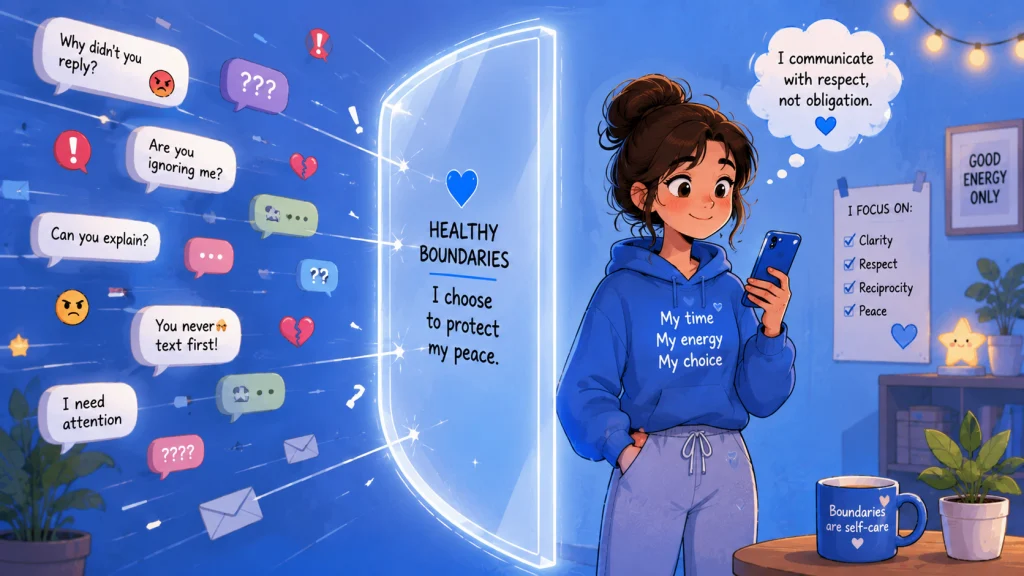
Boundary Replies to Stop the Drip-Feed
Some people do not send one passive aggressive text. They send a slow drip of them over hours or days, each one small enough to seem deniable on its own, but adding up to something exhausting. A boundary reply is not about winning that exchange. It is about refusing to keep playing a game where you are always one step behind, decoding tone instead of having an actual conversation.
This is where I tell people to stop responding to each individual jab and instead address the pattern itself. It feels riskier than firing back at one text, because it forces the issue into the open. It also tends to be the only thing that actually stops the drip.
- “I’m not going to keep guessing what’s wrong. Tell me directly or let’s talk later.”
- “If you’re upset, I want to know. I don’t want to keep getting jabs.”
- “I’m open to a real conversation, not a string of digs.”
- “Let’s talk when you’re ready to say it straight.”
- “I’m stepping back from this conversation until it’s a direct one.”
- “I’m not going to respond to every comment. Say it once, clearly.”
- “If there’s a real issue, I’m here. If it’s just digs, I’m out.”
- “I’d rather pause this than keep trading one-liners.”
- “Let me know when you want to actually talk.”
If the drip-feed is coming from someone whose texts are starting to feel less like passive aggression and more like ongoing harassment or control, that is no longer something a reply fixes, no matter how well worded. That belongs to a conversation with someone who actually knows your situation, not a line typed back into the same phone.
Work and Family-Safe Versions, Controlled and Printable
A coworker’s loaded “per my last email” energy or a parent’s pointed “must be nice” cannot be met with the same line you would send a friend. These situations need replies that stay calm on the surface no matter who reads the thread later, while still making it obvious you caught what was actually said.
These work because they give nothing away. They are polite enough to forward to HR without explanation, and flat enough that the sender knows you are not playing along, even if they cannot prove it.
- “Thanks for the input, I’ll take it into account.”
- “Got it, appreciate you flagging that.”
- “Understood. Let me know if there’s more context I should have.”
- “Noted, thank you.”
- “I hear you. Let’s circle back if needed.”
- “Appreciate you letting me know.”
- “Thanks, I’ll keep that in mind.”
- “Good to know, thank you.”
Family versions of this work the same way. The goal at a holiday table or in a sibling group chat is not to win the exchange, it is to leave it without giving anyone material to bring up again next year.
No-Engagement Replies for When the Bait Is Obvious
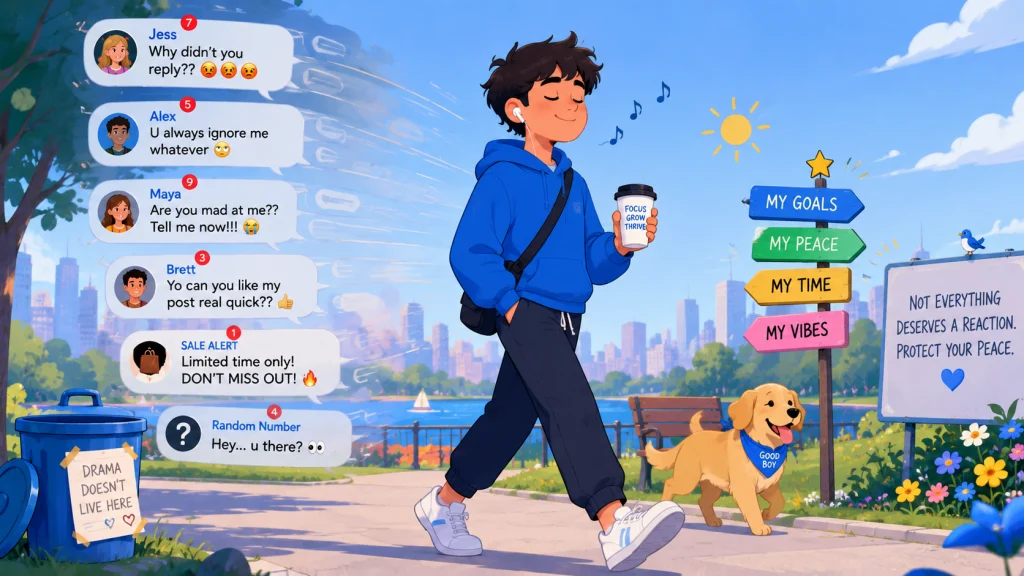
Some passive aggressive texts are not actually fishing for a fight. They are fishing for a reaction, any reaction, because a reaction is proof they got under your skin. The single most effective move in that case is the one people resist the most, because it feels like letting someone get away with something.
It is not letting them get away with anything. It is refusing to give them the one thing they were actually after.
- “👍”
- “Okay.”
- “Got it, thanks.”
- “Noted.”
- “Sounds good.”
- “Appreciate the heads up.”
This is the part most people get wrong without realizing it. They assume a flat, short reply will be read as weakness, so they add an extra sentence trying to prove they are unbothered, which is the exact opposite of unbothered. The thumbs up alone says more than a paragraph defending your calm ever could.
What Not to Text Back
There are a few moves that feel satisfying in the moment and almost always make things worse. Matching their passive aggression with your own just turns one vague text into two, and now nobody involved actually knows what is wrong, including the two people texting each other.
A wall of sarcasm does the same thing from a different angle. It reads as proof you are rattled, which hands the other person exactly the reaction they were hoping for. And screenshotting a text to a group chat while you are still angry rarely ages well, even when the original message was genuinely out of line. None of these get you closer to an actual answer. They just add more rounds to a conversation you were trying to end.
Final Thoughts
None of these passive aggressive replies are magic. The right line does not guarantee the other person suddenly tells you the truth, and it does not promise the tension disappears the second you hit send. What it can do is take you out of the guessing game and put the conversation back on terms you actually control, calm if you want calm, sharp if the moment earns it, or completely closed off if the bait was never worth taking.
If you want more on handling the texts that are direct instead of coded, the comebacks for openly rude texts cover that ground. And if passive aggression is just one corner of a bigger pattern you are dealing with, the full breakdown of savage replies to text messages and the wider collection of savage comebacks for every kind of rude moment go a lot deeper than tone alone.
FAQs
💬 What do you say back to a passive aggressive text?
Name the tone once and ask them to just say what they mean, or keep your reply short and flat if you do not want to engage further. Both work. The wrong move is matching their tone with your own.
🎯 How do you respond to passive aggression without sounding petty?
Keep it short, calm, and free of sarcasm. The second you add an extra jab, you are no longer calling out the tone, you are matching it, and that is what reads as petty.
🧊 What is a calm way to call out passive aggressive texting?
Something like “that came across a little sharp, want to just say what’s going on” names the tone without accusing anyone of anything. It leaves the door open instead of slamming it.
🚫 Should you ignore a passive aggressive text completely?
Sometimes. If the message is obvious bait for a reaction, a short flat reply or no reply at all can do more than a clever comeback would. Ignoring it is not the same as losing.
🏢 How do you respond to passive aggressive coworkers over text?
Stay polite, stay brief, and keep it on record. Something like “got it, appreciate you flagging that” gives them nothing to escalate while making clear you are not rattled.
🗣️ How do you make someone say what they actually mean over text?
Ask directly. “What do you actually mean by that?” works better than a long, careful message trying to coax it out gently. Short and direct beats soft and vague almost every time.