Being told you are overreacting can pull a conversation away from what actually happened and turn it into a debate about your reaction instead. The useful move is not to prove that every part of your reaction was perfect, but to ask for specifics, own any heat that is real, and bring the conversation back to the original point. Sometimes the other person has fair feedback about your delivery, and sometimes the phrase is just an easier argument than the issue itself. The replies below help you tell the difference without turning one dismissive line into a bigger fight.
Quick responses when you want to stay on topic
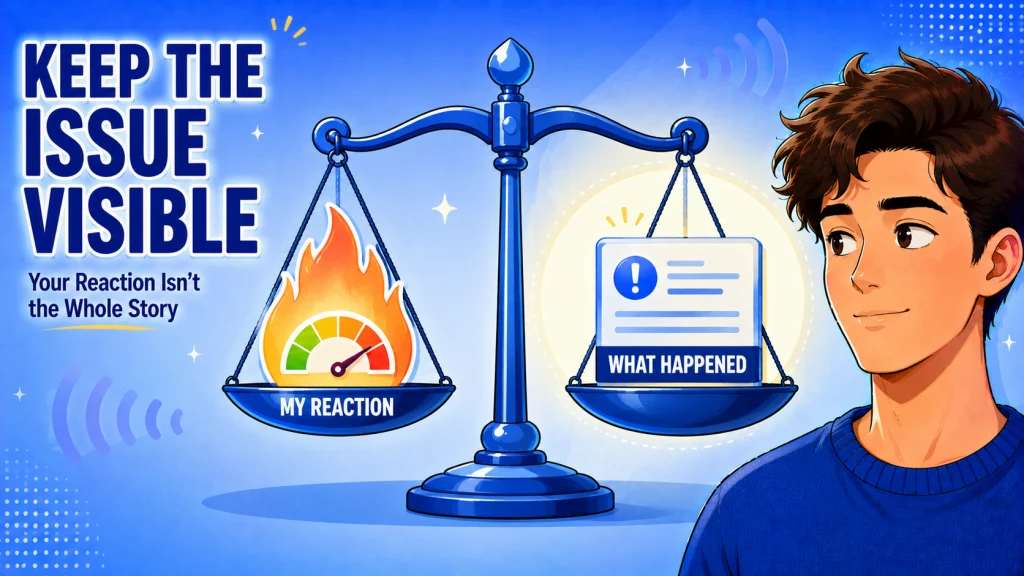
If you are trying to figure out how to respond to “you’re overreacting,” start by refusing the false choice hidden inside the moment. You can have reacted strongly and still have a real point underneath that reaction. I have watched conversations stall because one person starts defending the volume, tone, or timing of their response while the thing that caused it quietly disappears. Once that happens, the argument is no longer about what occurred, it is about whether you were allowed to react that much.
The cleanest reply usually leaves room for both possibilities. Maybe you were heated, maybe your voice got sharper than you wanted, or maybe you sent three texts when one would have done the job. None of that automatically settles the original issue. A line like “Maybe I came in hot, but I still want to talk about what happened” does more work than ten sentences proving you were perfectly calm.
The best responses to overreacting comments are usually short enough that they do not create a second argument. You are not trying to win a trial about your emotional range. You are trying to keep the original subject visible long enough to actually discuss it. That is why a compact reply works better than a paragraph explaining every reason you reacted the way you did.
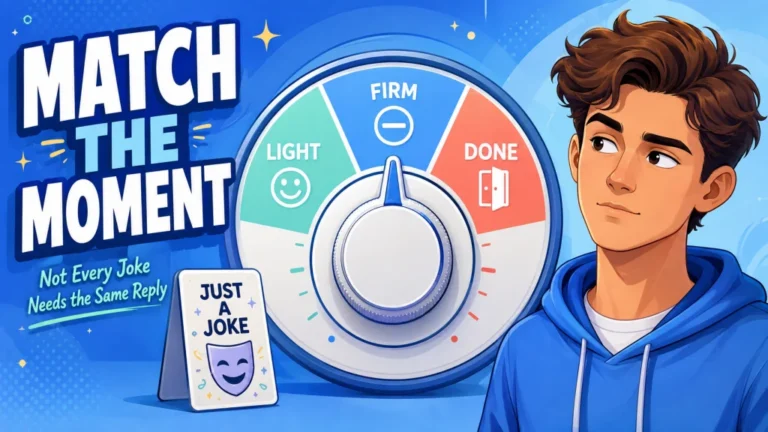
I would sort the useful lines by what you need next: clarification, acknowledgment, redirection, or an exit. The categories matter because the same sentence does not fit every version of this exchange. A friend who genuinely thinks your reaction was bigger than the event is different from someone who keeps using the phrase every time you raise a specific problem. Pick the job first, then pick the line.
| What you need | What to say |
|---|---|
| Clarify | “What part feels like an overreaction to you?” |
| Acknowledge | “I may be heated, but the point still matters.” |
| Redirect | “We can talk about my reaction after we talk about what happened.” |
| Exit | “If this is only going to be about my reaction, I am done for now.” |
Most people overthink this part because a short reply can feel too simple for a charged moment. Simple is exactly what keeps you from getting pulled sideways. If you want a broader set of replies to dismissive comments, the same principle holds: answer the conversational move without giving it more weight than it deserves. The line should make room for the next useful sentence, not become the entire event.
Ask what specifically seems excessive
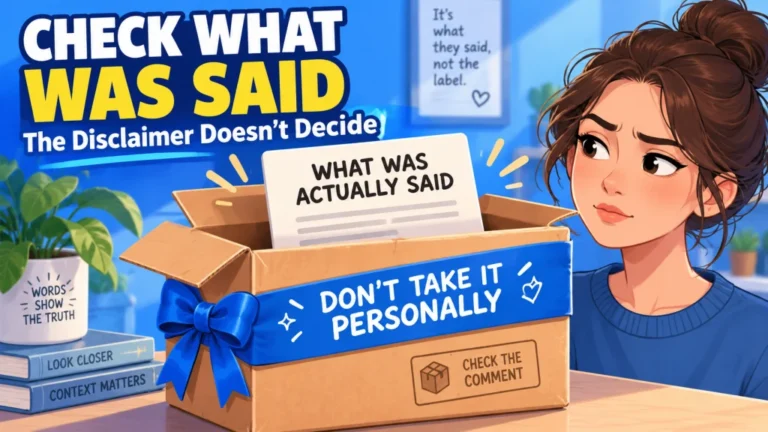
“You’re overreacting” sounds specific until you ask what it actually refers to. Do they mean your volume, the number of messages, the fact that you brought the issue up at all, or the conclusion you jumped to? Those are different complaints, and each deserves a different response. Asking for the exact part forces the conversation out of the vague label and back into something you can answer.
This is especially useful when you are not sure whether the other person has a point. Suppose a friend cancels at the last minute and you send a sharp reply, then they tell you that you are overreacting. “Do you mean I sounded too harsh, or that I should not be annoyed about the cancellation?” separates delivery from substance without pretending you already know the answer. If they can name the part they think was excessive, you finally have something concrete to discuss.
- “What part of my reaction feels too big to you?”
- “Are you talking about my tone or the actual point I made?”
- “What would a proportionate reaction have looked like to you?”
- “Be specific, because ‘overreacting’ covers a lot.”
Notice that none of those lines claims the other person is wrong before they explain themselves. That matters. If you instantly answer with a comeback, you may miss useful feedback about how you delivered the point. Clarification is not surrender, it is how you find out what argument you are actually having.

If you know your delivery got heated
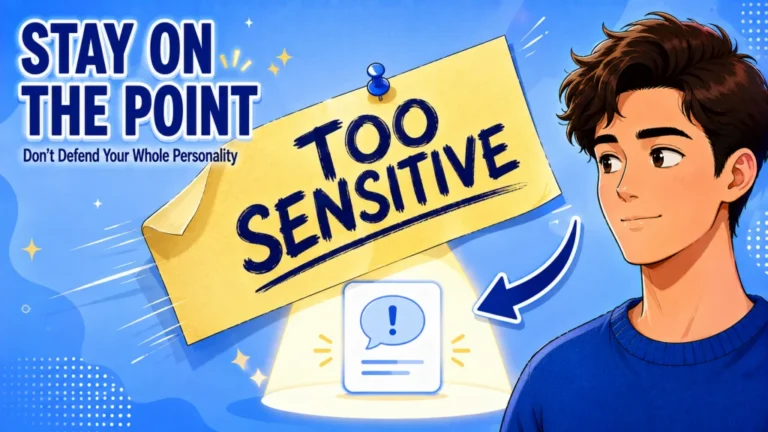
There is a weird pressure in these moments to defend every part of your reaction, as if admitting you got heated means the other person wins. It does not. If you raised your voice, piled on extra accusations, or sent more messages than the situation needed, owning that part can make your actual point harder to dodge. “I was too sharp, and I still mean what I said about the issue” is stronger than pretending your delivery was flawless when both of you know it was not.
I learned to respect this distinction because tone can swallow content fast. Once somebody has a real example of your delivery going sideways, they can keep pointing at that example while neither of you deals with what started the exchange. A brief acknowledgment takes that easy distraction off the table. Then you can return to the part that still needs an answer.
If you came looking for comebacks for being called dramatic, this is the section where I would resist the clever line. A dramatic comeback can be satisfying for five seconds and still make the original issue harder to reach. Try something plain instead: “My delivery was intense, but I do not want that to erase the point.” You are not apologizing for having a concern, you are separating the concern from the way you expressed it.
If the phrase is being used to avoid the original point
Sometimes you ask for specifics and get none. The person just repeats that you are overreacting, says you are making a big deal out of nothing, or keeps grading your tone without answering what you brought up. At that point, another defense of your reaction usually sends you deeper into the same loop. The cleaner move is to name the detour once and return to the event.
Imagine you tell a roommate that using your things without asking needs to stop, and the reply is, “You’re seriously overreacting.” You do not need to prove that your irritation sits at the objectively correct level. “You can think my reaction is too strong, but I am still asking you not to use my stuff without asking” keeps the boundary of the conversation concrete. The issue is now visible again, and the other person can respond to it or choose not to.
- “You can disagree with my reaction and still answer the point.”
- “We are talking about what happened, not grading my feelings.”
- “Maybe you think it is small. I still want an answer to what I asked.”
- “Calling it an overreaction does not answer the actual issue.”
These are not magic lines, and they do not force someone to engage honestly. They just stop you from doing all the work of defending yourself while the original question sits untouched. If the conversation keeps circling after that, the useful choice may be to stop rather than produce a sharper version of the same redirect. You do not need a new argument every time the same detour comes back.

Calm versus overreacting: why these are neighboring but different phrases
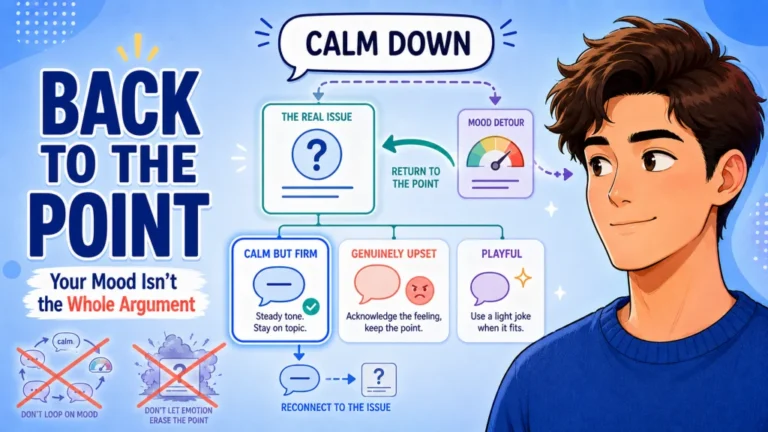
“Calm down” and “you’re overreacting” often arrive in the same kind of argument, but they do different things. “Calm down” usually comments on your current level of intensity, while “you’re overreacting” makes a judgment about whether that intensity fits the situation. That difference changes the reply. If the first phrase is the one you are dealing with, these responses to calm down focus on that specific move rather than treating the two phrases as interchangeable.
If somebody says “calm down” while you are talking over them, the most useful response may be to slow down and keep speaking. If they say “you’re overreacting” after you calmly state a problem, asking for specifics makes more sense. The overlap is real, but treating the phrases as identical can give you the wrong line for the moment. Knowing what to say when someone calls you dramatic follows the same rule: find out whether they are describing your delivery, dismissing the issue, or doing a little of both.
| Phrase | What it usually targets | Useful next move |
|---|---|---|
| “Calm down” | Current intensity or delivery | Lower the heat if needed, then continue |
| “You’re overreacting” | Whether the reaction fits the event | Ask what seems disproportionate, then return to the issue |
The point is not to perform perfect calm so nobody can criticize you. It is to know what you are answering. A reply lands better when it matches the actual conversational move instead of firing the same comeback at every dismissive phrase. Precision beats intensity here.
Exit lines when the conversation becomes a trial of your emotions
You do not have to keep defending the exact size of your reaction forever. If you have asked for specifics, acknowledged any part you genuinely own, and returned to the issue, repeating the loop rarely improves it. This is where an exit line does more than another argument. You are ending the current exchange because it stopped being useful, not because silence proves either person right.
In group chats especially, I have noticed how quickly a simple disagreement can turn into a performance once other people start reacting to the reaction. A longer defense gives the room more material to debate. A clean exit cuts off that supply. If you want broader savage comebacks for rude moments, save them for situations where edge actually helps, because this one often benefits from less theater, not more.
- “We are going in circles, so I am leaving it here.”
- “I have explained the point. I am not debating my reaction all night.”
- “If we cannot talk about what happened, this conversation is done for now.”
- “You do not have to agree with me, but I am not continuing this version of the argument.”
The important part is not to tack on one last insult after the exit. That turns the door you just closed into another opening. Say the line, stop explaining, and let the conversation end where you said it would. An exit only works if you actually exit.
What not to say when you are called an overreactor
The easiest mistake is to answer a broad label with a broader one. Calling the other person a narcissist, gaslighter, manipulator, or anything else you cannot actually establish from one exchange does not bring the conversation back to the issue. It gives both of you a new label to fight about. Keep the language tied to what was said and what happened in front of you.
The second mistake is denying any possibility that your reaction could have been too strong. Sometimes it was. You can still have a valid complaint about the original event while deciding that your delivery was not your best work. Refusing that possibility can make you defend behavior you would rather change just because you do not want to give the other person a point.
The third mistake is threatening escalation just to prove you are serious. “You think this is an overreaction? I’ll show you one” may feel sharp in your head, but it moves the conversation toward intimidation instead of clarity. Good replies to dismissive comments do not need to sound dangerous to hold their ground. If the situation already feels unsafe or abusive, skip the comeback entirely and get distance or support from someone you trust.

Final thoughts: keep the issue visible
Being told you are overreacting does not require you to prove you reacted perfectly. Ask what specifically seems excessive, acknowledge any heat you genuinely own, and then put the original issue back in the center. That keeps you open to fair feedback without letting the entire conversation become a referendum on your feelings. The strongest line is often the one that leaves the least room for a pointless side argument.
If the other person can get specific, you have something real to answer. If they cannot get past the label, you are allowed to stop feeding the loop. The goal is not to win a verdict about who was the most reasonable person in the room. It is to say what needs saying clearly enough that the actual issue either gets addressed or you know the conversation has run its course.
Frequently asked questions
Most questions about this phrase come down to the same tension: should you defend yourself, admit you were heated, or stop talking altogether? There is no single line that fits every relationship or every argument. The useful answer depends on whether the other person can name something specific and whether the original issue is still getting discussed. Start there before deciding how sharp or soft your reply should be.
The answers below stay practical on purpose. They are meant for ordinary social conflict, not for diagnosing a person or explaining a whole relationship from one sentence. If the exchange has crossed into threats, abuse, or a situation where you feel unsafe, a comeback is not the priority. In normal disagreements, though, a short line that separates delivery from substance is usually enough to show where you stand.
💬 What do you say when someone tells you that you are overreacting?
Ask what part of your reaction they think was excessive, then return to the original issue. “What part feels like too much to you?” is simple and gives them something specific to answer.
🎯 How do you respond without sounding defensive?
Leave room for the possibility that your delivery was strong. “Maybe I was heated, but I still want to talk about what happened” sounds steadier than trying to prove you did everything perfectly.
🧭 What if they keep saying you are overreacting instead of answering the issue?
Redirect once: “You can think that and still answer the point.” If they keep circling back to your reaction, ending the conversation may be more useful than repeating yourself.
🪞 Should you admit it if you really did overreact?
Yes, if that is your read of the situation. Owning an overly sharp delivery does not require you to drop the underlying concern, so keep those two things separate.
🚪 When is it better not to reply?
Do not keep replying just because you feel pressured to defend yourself. If the exchange is only looping, escalating, or feels unsafe, disengaging is a reasonable choice.