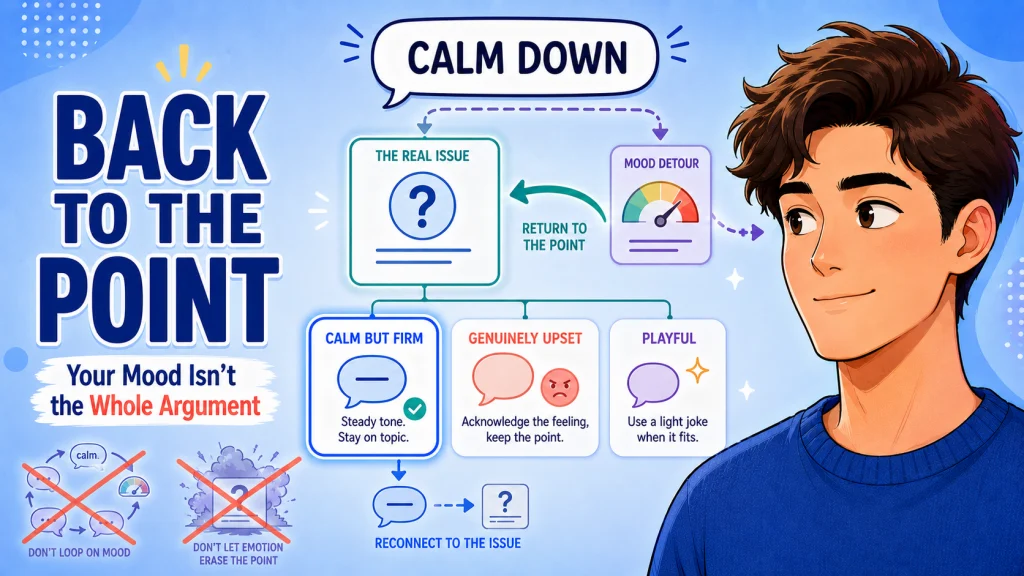
Being told “calm down” can turn a small disagreement into an argument about whether you look angry, sound angry, or are allowed to keep making your point. The cleanest response depends on which of three situations you are actually in: calm but firm, genuinely upset, or obviously joking around. I usually keep the reply short, name the state only if it helps, then move the conversation back to the thing that mattered before those two words arrived. You do not have to prove perfect calm before you are allowed to finish a sentence.
Why “calm down” can become the whole argument
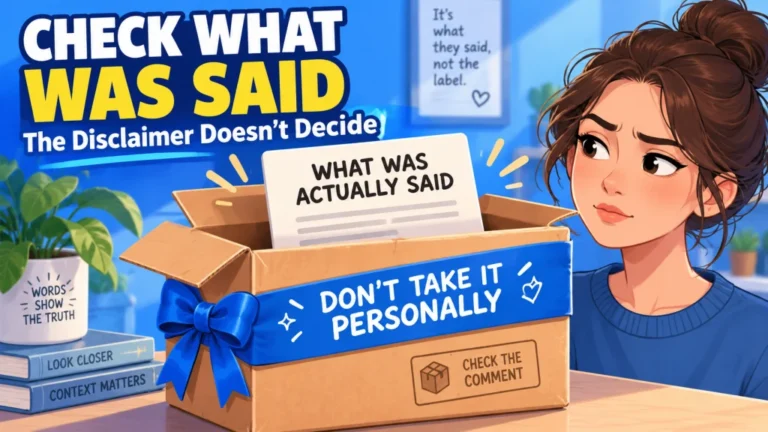
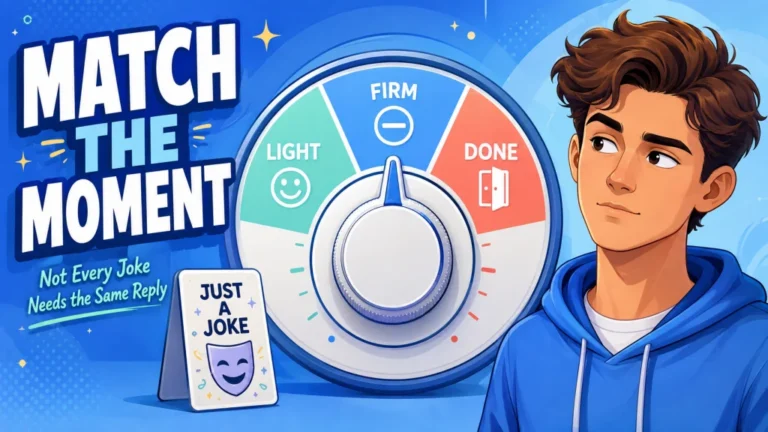
“Calm down.” “I am calm.” Now the argument is somehow about your tone instead of the issue you were discussing. If you are wondering how to respond when someone says “calm down” without feeding that detour, start by deciding whether you are actually calm, genuinely upset, or clearly in a playful exchange. The best reply is the one that fits that state and gets you to the next useful beat instead of forcing you to defend your entire emotional condition.
I have watched this two-line loop happen more times than I can count, and the mistake is usually the same: someone spends five sentences proving how calm they are. By sentence three, nobody is talking about the original point anymore. Nine years behind a bar taught me that conversational temperature matters, but so does refusing to let a throwaway phrase become the only subject in the room. A short correction leaves more room for the real topic.
| Your actual state | Best direction | Example line |
|---|---|---|
| Calm but firm | Correct the assumption once, then return to the point | “I am calm. I am still asking the same question.” |
| Genuinely upset | Own the emotion without giving up the issue | “I am upset, and I still want to finish this conversation.” |
| Playful | Match the joke with a small joke | “This is my calm face.” |
That three-state split is more useful than trying to guess what the other person secretly meant by the phrase. Sometimes “calm down” is teasing, sometimes it is clumsy, and sometimes it becomes a way to dodge the point. You do not need a theory about motive before you reply. Match the line to what is actually happening in front of you.
Quick replies when you are not angry
When you are calm already, the temptation is to prove it with a long explanation, which is exactly what makes the moment feel more heated. A short reply works better because it corrects the label without turning the correction into a second argument. If you are deciding what to say when someone tells you to calm down, start with plain language before reaching for sarcasm. You want the sentence to sound easy enough that you could say it without changing your voice.
The most useful lines also leave somewhere for the conversation to go next. “I am calm” is fine, but “I am calm, and I still need an answer” is often better because it closes one door and reopens the original one. That distinction matters when the phrase showed up right after you asked a direct question or disagreed with something. You are not asking the other person to certify your mood, you are reminding them what the conversation was actually about.
- “I am calm. I just disagree.”
- “I am calm. Can we stay on the point?”
- “I am not upset, I am being direct.”
- “I am fine. I still want an answer.”
- “No problem. Back to what I asked.”
These are not dramatic comebacks, and that is the point. If the phrase was casual, a compact answer gives the other person room to move on. If it was dismissive, the same answer gives them less material to argue with. Either way, you keep control of your wording without auditioning for the role of “calmest person in the room.”
If you actually are upset but still want to stay on the issue
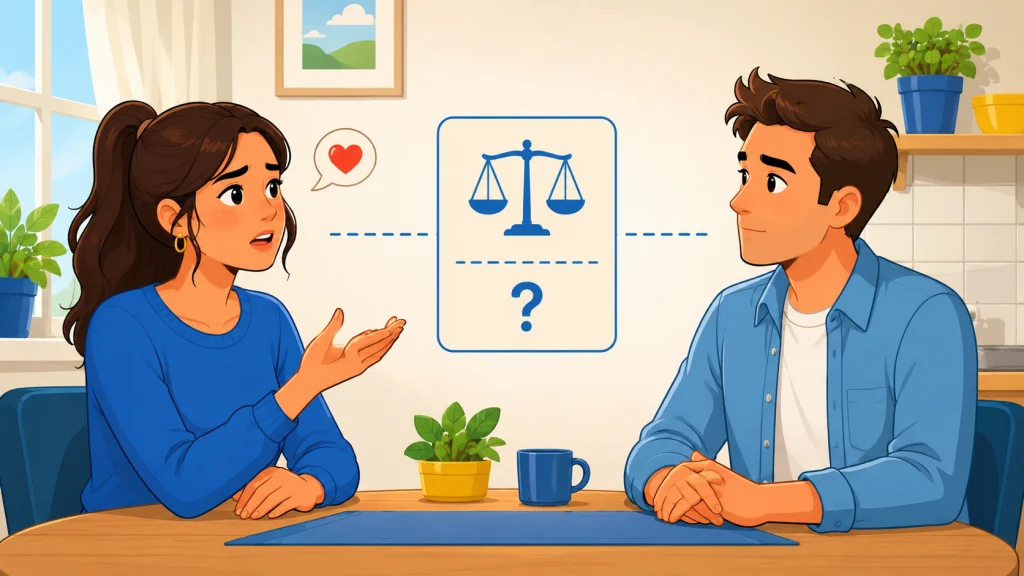
Sometimes the annoying part is that the phrase is not completely wrong. You are upset, your voice may be sharper than usual, and you still have a point worth finishing. In that situation, pretending to be perfectly calm can make the reply sound more defensive than simply owning what is obvious. A better move is to separate your emotion from the substance: yes, you are upset, and no, that does not automatically end the conversation.
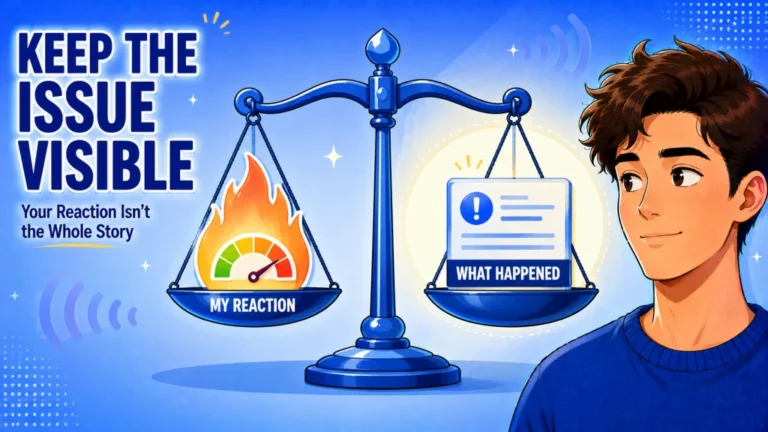
I have seen people lose a strong point because they suddenly treated “not being upset” as the new goal. They started defending their tone, apologizing for every raised syllable, and never got back to the thing that had bothered them in the first place. You do not need to deny your state to keep the issue visible. You can say, “I am upset, but I am still talking about what happened,” and leave the sentence there.
That kind of answer removes the easiest side argument. There is nothing to prove once you have acknowledged the obvious part. From there, the same logic applies to other replies to dismissive comments: keep the label from replacing the issue. The goal is not to win a mood inspection, it is to keep the actual point visible.
Funny responses when the phrase is playful
Not every “calm down” is a dismissal. A friend can say it because you are getting ridiculously excited about a game, a story, a crush, or a minor inconvenience that has become funny precisely because nobody is taking it seriously. In that setting, a funny response should match the size of the joke. You do not need a savage line when the other person is already smiling.
For funny responses when told to calm down, delivery matters more than cleverness. A flat “absolutely not” can be funnier than a paragraph full of metaphors if the room already knows you are kidding. I have watched good jokes die because someone kept adding to them after the laugh had already landed. Say the thing, enjoy the beat, then let the conversation move.
- “Absolutely not.”
- “This is the calm version.”
- “I have reduced the drama by at least three percent.”
- “Please respect my commitment to unnecessary intensity.”
- “I will consider it and get back to you.”
The relationship has to support the joke. A line that sounds playful with a sibling or close friend can sound needling with someone who is already irritated or does not know your tone well. That is why I would rather use a small joke that leaves an exit than a “funny” insult that quietly starts a new fight. If the laughter is not already there, do not force it into the room.
Firm redirects when “calm down” is being used to dismiss your point
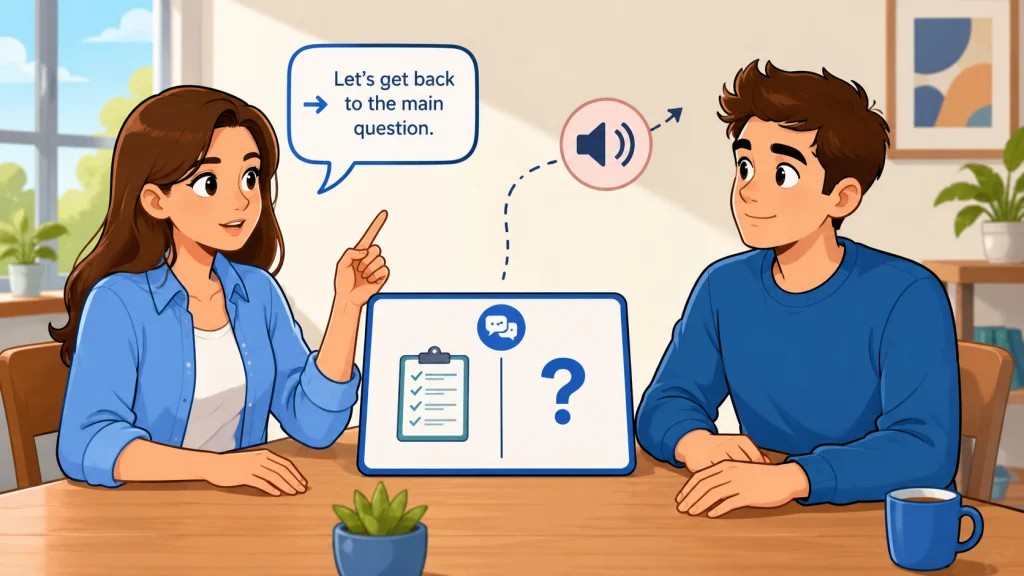
If the phrase arrives right after you raise a specific concern, you can redirect without arguing over the label. The cleanest firm response is usually one sentence that names the derailment and one sentence that returns to the issue. You do not have to accuse the other person of a tactic you cannot prove. You can simply refuse to follow the conversation away from the question you asked.
Firm replies when told to calm down can be as plain as “My tone is not the question, this is,” or “We can talk about my tone after you answer the point.” Those replies are firm without pretending you know the other person’s hidden motive. They also give you a useful test: if the person answers the issue, the conversation can continue, and if they keep circling back to your emotional state, you have learned something about whether the exchange is going anywhere. That is more useful than escalating just to show you cannot be dismissed.
There is a place for sharper language, but sharp is not the same as hostile. The strongest savage comebacks land once and stop instead of turning every disagreement into a verbal cage match. Here, the better move is usually refusing to abandon the original topic. You can be direct without handing the other person a brand-new argument about your wording.
Ask for specifics instead of debating your tone
Sometimes “calm down” is vague enough that the fastest way forward is to ask what the person is reacting to. “What did I say that sounded angry?” is different from “Why are you calling me angry?” because the first question asks for something concrete. If they can point to a specific phrase, volume, or interruption, you have information you can actually use. If they cannot, you do not have to keep defending yourself against a foggy label.
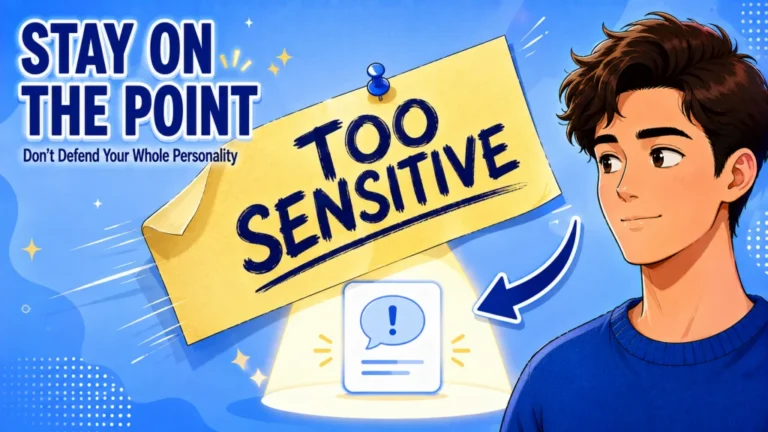
This sounds obvious, but people skip it because being misread feels personal. The instinct is to say, “I am not angry, you are imagining things,” which invites another round of competing interpretations. Asking for specifics gives both people something concrete to work with. The same move helps with responses to being told you are overreacting, where a broad label can otherwise replace the actual point.
Good questions are short enough that they cannot be mistaken for a cross-examination. “Which part sounded heated?” or “Was it my wording or my volume?” gives the other person a narrow lane to answer. If they offer something useful, you can respond to that specific thing without surrendering your point. If they only repeat “just calm down,” you have your answer about how useful the tone debate is likely to be.

When pausing the conversation is cleaner
A pause makes sense when the exchange has stopped producing anything except repeated comments about tone. You can be calm and still decide the conversation is going nowhere. You can also be upset and decide you do not want every new sentence turned into evidence about your mood. Stepping out is a conversational choice, not an admission that the other person was right.
Keep the exit plain. “We are not getting anywhere, so I am going to stop here” is cleaner than a dramatic final shot designed to make sure you win the doorway. The same is true over text: “I am done with this conversation for now” says exactly what is happening. You do not have to add a threat about what happens next.
There is also a difference between pausing and baiting someone into chasing you. If you say you are done, be done instead of sending one more paragraph five minutes later to prove the point again. That extra message is usually where a clean exit turns back into the same loop you were trying to leave. The power of the pause comes from actually letting the conversation stop.
If the situation feels unsafe or the other person is threatening, aggressive, or impossible to disengage from normally, the priority is getting out of the interaction rather than finding a clever reply. SlyLines is useful for words, not for making risky situations safer through wit. In that kind of moment, the best line may be no line at all. A comeback is optional, your ability to leave is not something you need to perform.
What not to say when “calm down” hits a nerve
The line I would cut first is any version of “you have not seen angry yet.” It sounds powerful in your head because it promises there is a bigger reaction available, but that promise immediately makes the conversation about the reaction instead of the original issue. Threats and intimidation do the same thing with higher stakes. If your goal was to stay on the point, those lines give it away and hand the other person a new thing to react to.
I would also skip amateur psychology. Telling someone they are projecting, insecure, triggered, unstable, or secretly afraid of you may feel like a neat explanation, but you do not know that from two words. It also opens a whole new argument that neither of you can settle in the moment. Describe what is happening in the conversation, not what you imagine is happening inside the other person’s head.
- Avoid threats about how angry you could become.
- Avoid diagnosing the other person’s motives or mental state.
- Avoid five-message defenses of how calm you are.
- Avoid insults that have nothing to do with the original issue.
- Avoid pretending you are calm when you plainly want to say you are upset.
People reach for these lines because being dismissed creates a strong urge to take back control fast. I get the impulse, but the sharper move is usually less theatrical. Name your actual state, ask for something specific, or end the exchange if it has stopped being useful. Those choices do more work than a threat ever will.

Final thoughts
“Calm down” does not require one universal comeback because the phrase can land in three completely different situations. If you are calm, correct the assumption once and return to the point. If you are upset, own that without letting your emotion erase the substance of what you are saying. If the exchange is playful, keep the joke small enough that it stays playful.
The response I trust most is usually the one that leaves the least mess behind. You do not need to prove your mood, diagnose the other person, or threaten a bigger reaction. A short line can protect the point you were making and show whether the other person is willing to keep talking about it. If they are not, you are allowed to stop giving the phrase more attention than it deserves.
FAQs
The questions below come up because “calm down” can mean very different things depending on tone, relationship, and what happened right before it. I would not choose a comeback from a list until I knew which version of the moment I was actually in. A friend teasing you does not need the same answer as someone repeatedly refusing to address your point. Keep the reply proportional to the situation.
There is also no prize for sounding maximally clever. The useful answer is the one you can actually say in your normal voice without creating a second problem you now have to manage. If a plain sentence works, use the plain sentence. Save the joke for a room that is already laughing.
💬 What do you say when someone tells you to calm down but you are already calm?
Say it once, then return to the point: “I am calm. I still need an answer to what I asked.” The second sentence matters because it stops your mood from becoming the whole conversation.
🎯 How do you respond to calm down without sounding defensive?
Keep the correction short and avoid proving your emotional state. “I am fine, can we stay on the issue?” sounds steadier than a paragraph explaining why you are not upset.
😄 What is a funny response to calm down?
With someone who is clearly joking, try “This is the calm version” or “Absolutely not.” If the other person is genuinely irritated, skip the joke and use a plain redirect instead.
🧭 What if I really am upset when someone tells me to calm down?
You can own it without giving up the topic: “I am upset, and I still want to finish this conversation.” You do not have to pretend to feel nothing before your point counts.
🔎 Should I ask why they think I need to calm down?
Ask for something specific instead of a theory about their motive. “Which part sounded angry?” gives you a concrete answer to work with, if they have one.
🚪 When is it better not to respond at all?
If the exchange is looping, escalating, or feels unsafe, you do not owe anyone a clever final line. Ending the conversation can be cleaner than winning one more round of it.