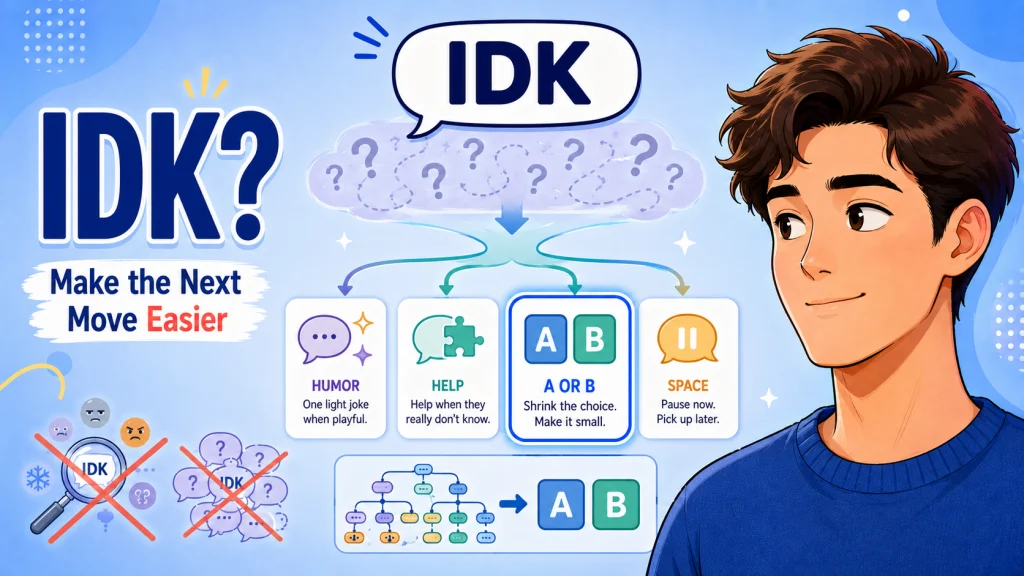
The best responses to IDK make the next move easier instead of trying to squeeze meaning out of three letters. I usually choose between humor, a smaller decision, a direct request for one useful preference, or simply giving the conversation more time. Below are 75 replies organized around what you actually need to happen next.
IDK can mean three very different things
The best responses to IDK start with the question that came before those three letters. Sometimes the person genuinely cannot answer because they do not know. Sometimes they have no preference and would be fine with either option. Sometimes they simply do not want to make the decision right now, which calls for a different next move than either of the first two.
Behind the bar, regulars would show me texts on their phones and ask what they should say back, so I learned quickly that a tiny reply only makes sense beside the message that prompted it. “IDK” after “where did I leave my keys?” is not the same moment as “IDK” after “where do you want to eat?” In the first case, you may need information, while in the second you may only need to narrow the choice. That sounds obvious when you read it slowly, but it is easy to forget when the reply arrives and you want an answer immediately.
Quick funny responses to IDK
When the stakes are low and the relationship can carry a little teasing, humor keeps IDK from becoming a dead stop. I like replies that poke at the tiny answer without turning the other person into the punchline. The joke should feel like a nudge, not a complaint wearing a smile. If they laugh and give you more, great, and if they do not, you have not created a second problem.
These replies to an IDK text work best with friends, siblings, group chats, or anyone who already understands your sense of humor. If you have to explain that you were joking, the line was probably doing too much. I would rather send four light words than a sarcastic paragraph that suddenly makes the conversation about manners. For a wider range of situations, I keep the same restraint in my funny replies for everyday texts.
- “Strong commitment to uncertainty.”
- “A decisive three letters.”
- “Excellent, mystery preserved.”
- “You have narrowed it down to everything.”
- “Bold answer. Very informative.”
- “I admire the confidence.”
- “Perfect, we know less now.”
- “A thrilling plot development.”
- “That clears up absolutely nothing.”
- “I see the investigation is going well.”
- “You really left no clues.”
- “Impressively noncommittal.”
- “I will alert the experts.”
- “So we are both detectives now.”
- “Beautiful. Back to square one.”
The safest funny replies make the moment lighter without demanding that the other person perform for you. I have watched people ruin a perfectly harmless exchange by stacking three more jokes after the first one got no reaction. Send one line, then see whether they give you anything back. Humor works better when it leaves room for the next person to speak.

If they genuinely do not know
Sometimes IDK is the whole truth, and trying to squeeze certainty out of it only makes the conversation harder. If the person is missing information, confused by the question, or honestly unsure, give them something easier to answer. A good response can ask for a guess, offer help, or remove the expectation that they should know immediately. The goal is not to reward vagueness. It is to find out whether there is actually an answer available.
I have seen people hear “I do not know” and instantly answer with “How can you not know?” That usually adds embarrassment without adding information. A smaller follow-up works better because it gives the other person a place to start. Ask for a guess, one known detail, or the part they are unsure about. You are simply making the next reply easier than the last one.
- “Fair. What is your best guess?”
- “No problem. What part are you unsure about?”
- “Want me to help you narrow it down?”
- “What do you know so far?”
- “Any direction you are leaning?”
- “Want a couple of options?”
- “We can figure out the missing piece.”
- “Take a guess. It does not have to be perfect.”
- “What would make this easier to answer?”
- “Do you want my take first?”
- “That is fine. We can work from what we know.”
- “Tell me the part you are sure about.”
These lines work because each one gives the other person a smaller job. They can offer a guess, name the missing piece, or let you know they want help. I would rather ask one useful question than keep repeating the original one with more pressure. If they want help, they now have an opening to take it.
If you need a decision, shrink it to A or B
Open questions are easy to answer with IDK because they make the other person create the options and choose among them. When the decision is ordinary and low stakes, I often cut the menu down to two clear choices. A broad “What do you want to do” becomes a simple “food or movie,” and suddenly there is something concrete to react to. The trick is making the choice smaller without pretending the decision matters more than it does.
This is especially useful for plans, timing, food, entertainment, and other everyday choices where either answer is acceptable. It is not a shortcut for medical, legal, financial, or other high-stakes decisions where someone may need real information or qualified advice. I also would not use it to corner someone into a yes or no they are clearly not ready to give. A/B is useful when the problem is too many options, not when the problem deserves more care.
| Situation | Shrink the choice to |
|---|---|
| Where to eat | “Tacos or burgers?” |
| What to watch | “Comedy or thriller?” |
| When to meet | “Earlier or later?” |
| What kind of plan | “Stay in or go out?” |
- “All right, A or B?”
- “Make it easy: this one or that one?”
- “Want me to give you two choices?”
- “Pick one: stay in or go out?”
- “Early or late?”
- “Food first or plans first?”
- “Do you want the easy option or the fun option?”
- “Want to choose, or should I?”
- “Give me a yes or no on this part.”
- “Which one sounds less annoying?”
- “You get one veto. Which option goes?”
- “I will narrow it down. You make the final pick.”
The A/B move works because it changes the job, not because it forces a better attitude. Instead of asking someone to invent a plan from nothing, you give them two doors and let them point. If they still say IDK, that is useful information too, because the problem probably is not the size of the menu anymore. At that point, I stop shrinking and decide whether to choose myself or leave it for later.
If the chat is casual and IDK feels dry
A dry IDK can tempt you to either overperform or retaliate with an even drier reply. Neither is necessary. If the conversation is casual, you can keep your answer small, change the subject, or offer one easy opening without trying to drag energy out of someone. I pay more attention to whether I am carrying the whole exchange than to whether one short message sounds enthusiastic.
If every answer in the exchange has been clipped and you are doing all the lifting, matching the size of the moment can save you a lot of unnecessary typing. That does not mean punishing them with silence or trying to make them chase you. It just means you stop turning one-word replies into five-question interviews. If this is part of a broader texting pattern, these funny responses to dry texts use the same proportional approach, while a clipped “sure” calls for the slightly different options in how to respond to sure.
- “Fair enough.”
- “Got it.”
- “No worries.”
- “All right, moving on.”
- “We can leave it there.”
- “Cool, I will let you know.”
- “That works for me.”
- “No stress.”
- “Okay, different question.”
- “Fair. Anyway…”
- “I will take that as undecided.”
- “All good. We can circle back.”
Most people overthink this part because they feel responsible for rescuing a conversation that has gone flat. You do not have to do that with a bigger joke, a sharper comeback, or another round of questions. I prefer one proportional reply and then enough room for the other person to bring some energy back. If the conversation picks up later, you can meet it there.

If they keep handing every choice back to you
One IDK is ordinary, but a whole string of them can leave you doing every bit of planning. If you ask where to eat, when to meet, and what to do, and each answer comes back as IDK, you do not need a sharper comeback. You need a cleaner division of effort. I usually either make the choice myself or ask for one specific contribution so the conversation stops bouncing the same decision back and forth.
This is where frustration makes people send lines like “Do you care about anything?” when what they really mean is “I cannot keep choosing everything.” Say the smaller truth. It is clearer, less insulting, and much easier for the other person to answer. You can be direct without turning indecision into a character flaw.
- “I can pick this one, but you get the next choice.”
- “I have chosen the place. You pick the time.”
- “Give me one preference and I will handle the rest.”
- “If you truly do not care, I will choose.”
- “I need one vote from you.”
- “Pick the part you care about most.”
- “I can decide, but tell me what you definitely do not want.”
- “No preference is fine. I am choosing, then.”
- “You choose the day, I will choose the plan.”
- “Give me one yes and one no.”
- “I am happy to pick, but I need your availability.”
- “Tell me your one dealbreaker and I will take it from there.”
The useful distinction here is practical: can the other person contribute one small piece of the plan when you ask for it? Giving them one concrete job makes that easy to find out without starting a fight. If they participate, the planning moves. If they do not, you can decide how much more effort you want to spend.

When to postpone instead of pushing
Not every uncertainty needs to be solved in the same text exchange. Sometimes the person needs more information, more time, or simply a break from choosing. If the answer does not have to happen now, taking pressure off can be more useful than finding a cleverer question. I have learned that timing fixes some conversations that wording cannot.
The key is postponing without turning the delay into a threat. “Fine, tell me whenever you finally know” is not giving space. It is irritation with a nicer coat on. A clean postponement says the decision can wait and makes it clear what happens next. That gives both people permission to stop circling the same question.
- “No rush. Tell me when you know.”
- “We can decide later.”
- “Think about it and get back to me.”
- “Let us leave it for now.”
- “We do not need to solve this tonight.”
- “Take some time. I can wait.”
- “We can revisit it when you have a preference.”
- “No pressure. We will pick this up later.”
- “Let us pause the decision, not the whole conversation.”
- “You do not have to answer right now.”
- “We can make the call when we have more information.”
- “Message me when you have a clearer answer.”
Postponing is especially useful when you notice yourself asking the same question in three different ways. That usually means the conversation is not missing another clever prompt. It is missing time or information. Once you see that, the strongest reply may be the one that stops pushing.
What not to send after IDK
The worst replies turn uncertainty into contempt or pressure. “You never care,” “You are impossible,” and “So you are not interested” all escalate a small exchange instead of solving the immediate problem. That can turn a tiny answer into a much bigger argument. I would rather name what I need next, such as one preference, a yes or no, or more time.
Pressure can also hide inside jokes, especially when you keep sending them after the other person stops playing along. One teasing line may be fine with someone who knows your tone, but a pile of sarcastic messages starts to feel like punishment. The same goes for rapid-fire questions that all ask for the same answer. If the person genuinely does not know, repetition will not manufacture certainty.
- Avoid: “You never know anything.” Better: “What part can you answer?”
- Avoid: “Do you even care?” Better: “Do you have a preference, or should I choose?”
- Avoid: “Whatever, forget it.” Better: “We can leave it for now.”
- Avoid: “So you are not interested.” Better: “I will take that as undecided.”
- Avoid: “Why are you being like this?” Better: “Do you want more time?”
The common mistake is answering frustration instead of the actual decision in front of you. If you need clarity, ask for the specific piece of clarity that lets you move forward. If the answer can wait, say that instead of sending a line designed to make the other person feel bad for being unsure. Cleaner questions produce cleaner choices, and they leave much less mess behind if the answer is still IDK.

Final thoughts: make the next move easier
IDK is not a challenge you have to defeat. Sometimes the best answer is funny, sometimes it is an A/B choice, and sometimes it is simply permission to decide later. I look at what the conversation needs next, not at how clever I can make my reply. That keeps a three-letter text from becoming a twenty-message problem.
If you want one rule to remember, use the smallest response that actually moves the moment forward. Joke when the tone is already playful, narrow the choice when the decision is too broad, and stop pushing when there is nothing useful to gain from another question. You do not need to decode a hidden motive to reply well. You just need to decide whether the next move is humor, help, a choice, or space.
Frequently asked questions
Most questions about IDK come down to the same practical issue: what do you send without sounding annoyed or doing all the conversational work yourself? I keep the answer tied to the immediate situation rather than guessing at hidden meaning. If you need an answer, make the choice easier. If you do not, keep the reply small and let the conversation show you what comes next.
The questions below cover the moments people usually get stuck on after receiving IDK. None of them requires a speech, and most of them get better when you remove pressure instead of adding it. I would rather give someone one clean next step than six different ways to ask the same thing. That is usually enough to find out whether the conversation has somewhere to go.
💬 What is the best response to IDK?
Use the reply that matches what you need next. Try humor for a low-stakes joke, an A/B choice for a decision, or “No rush, tell me when you know” when the answer can wait.
🤔 How do you respond to IDK without sounding annoyed?
Keep the wording neutral and specific. “What are you leaning toward?” or “Want two options?” asks for more without turning uncertainty into a complaint.
🧭 What to say after IDK when I actually need an answer?
Shrink the decision instead of repeating the same broad question. Give two realistic choices, or ask for the one piece of information you need to move forward.
😅 Should I send a funny response to IDK?
Yes, if the conversation is already playful and the stakes are low. Keep the joke aimed at the tiny reply, not at the person, and do not keep piling on if they do not play back.
📱 What should I do if someone keeps replying IDK?
Stop asking the same question in new words. Either make the choice yourself, ask for one specific preference, or postpone the decision if it does not need to happen now.