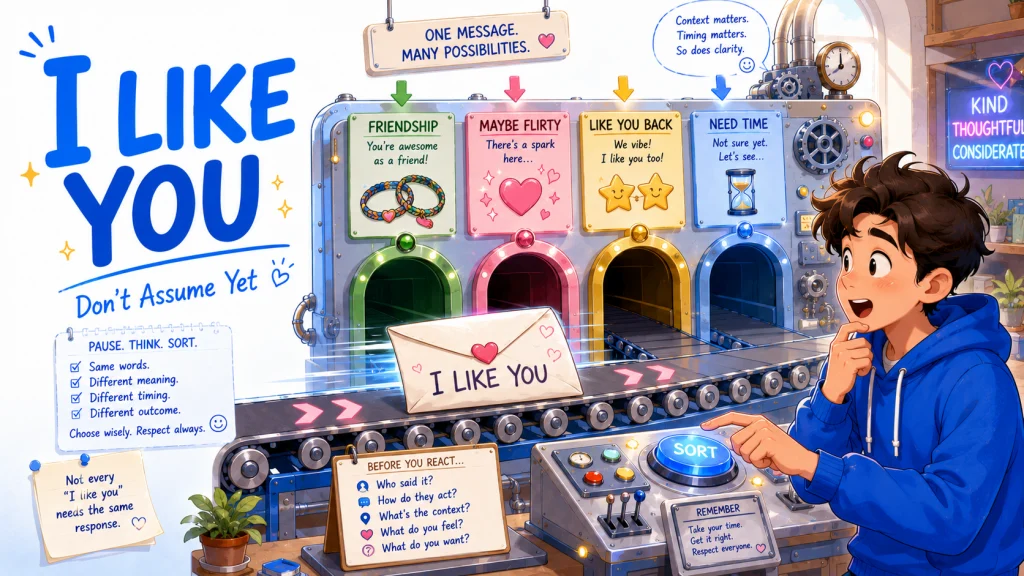
“I like you” can mean several different things depending on who says it, and most people freeze because they do not know which one they just heard. Funny replies when someone says they like you give you a way to respond without assuming romance, without rejecting someone by accident, and without committing to feelings you have not sorted out yet. Below are lines for the friendly version, the maybe-flirty version, the one where you like them back, and the one you are not sure about, plus what never to say no matter how tempting the joke feels.
Why “I Like You” Is the Hardest Three Words to Answer
I have watched this exact moment freeze more people than almost any other line, and it is never because the words are complicated. It is because “I like you” can mean four or five completely different things, and the person hearing it usually has about two seconds to figure out which one they just heard before the silence starts feeling like an answer on its own. Friendship, admiration, flirting, a real confession, they all use the same three words, and the wrong guess in either direction causes a problem.
Guess romance when they meant friendship, and you have made things weird for no reason. Brush off a real confession as a joke, and you have just rejected someone without meaning to, which stings worse than an honest no would have. The replies below are built around that uncertainty instead of pretending it does not exist, because pretending is exactly what gets people into trouble here.

If It Sounds Friendly: Playful Acceptance Without Drama
Sometimes “I like you” really is just that. A friend says it after a good hangout, a coworker says it after you covered their shift, and there is nothing underneath it except genuine appreciation. The mistake people make here is overanalyzing a simple compliment until it becomes a whole production, when the other person just wanted to say something nice and move on with their day.
I have seen someone turn a casual “I like you, you’re good people” into a ten-minute spiral about what it might mean, when the friend who said it had already forgotten and moved on to ordering food. Matching their energy, light and quick, is almost always the right call when the context gives you no real reason to think otherwise.
- “I know, I’m easy to like.”
- “Right back at you, glad we’re stuck with each other.”
- “This is the start of a beautiful friendship.”
- “Took you long enough to figure that out.”
- “Same. Should we get matching friendship bracelets now?”
- “Obviously. I’ve been carrying this friendship for a while.”
- “Aw, careful, I’ll start expecting compliments regularly.”
- “I like you too, in the most uncomplicated way possible.”
If It Might Be Flirty: Lines That Buy You Time
This is the trickiest version, because the words alone will not tell you which direction it is leaning. Maybe there has been some lingering tension. Maybe they have been a little more attentive lately. Maybe you genuinely cannot tell, and you do not want to commit to either interpretation before you actually know. A funny reply here works as a bridge, not a final answer.
What I have noticed is that people overthink the need to decide everything in one text. You do not. A line that is warm enough to not shut the door, but light enough to not promise anything, buys you the time to figure out what is actually happening before you respond with something you cannot take back.
- “Oh? Tell me more about this development.”
- “Noted. I’ll be sitting with that information.”
- “That’s a bold move for a Tuesday.”
- “Interesting. Keep talking.”
- “Well, this conversation just got a lot more interesting.”
- “I’m going to need a follow-up text to clarify that.”
- “Bold of you to drop that without warning.”
- “I’m choosing to take that as a compliment, more details welcome.”

If You Like Them Back but Feel Nervous
This is the situation where the joke is doing the least amount of work for you, because the goal is not deflection, it is letting them know without sounding like you rehearsed it forty times. Funny still has a place here, but it has to carry warmth in it, not just wit, or it can come across as deflecting feelings you actually want them to know about.
A line like “good, because I’ve been hoping you’d say that” lets the humor soften the nerves without hiding the actual answer underneath it. The honest version sometimes lands harder than anything clever could, and there is nothing wrong with letting a little nervousness show through the joke. That is not a weakness here, it is what makes the moment feel real instead of performed.
- “Good, because I’ve been hoping you’d say that.”
- “Took you long enough, I was about to say something first.”
- “I like you too, there, I said it before you could tease me about it.”
- “Well, that’s a relief, I was starting to think I imagined it.”
- “Same, and I’m a little nervous admitting it too.”
- “I’ve been hoping you’d bring this up first.”
- “Okay, good, now I don’t have to figure out how to say it.”
- “I like you back, and yes, my hands are a little shaky typing this.”
If You’re Not Sure: Graceful Deflection That Doesn’t Humiliate Them
This is the version that needs the most care, because someone just took a real risk saying it, even if they wrapped it in a casual tone. A reply that is too dismissive can feel like rejection dressed up as a joke, and that lands worse than a straightforward no ever would. The goal is to buy yourself honest thinking time without making them feel foolish for speaking up.
I told a friend once who panicked after getting this exact text that the safest move is acknowledging it without pretending you already know how you feel. “That means a lot, give me a second to actually sit with it” does more good than a deflecting joke that leaves them wondering if you took it seriously at all. If you already know the answer is no, kindness matters more here than cleverness, and a gentle, honest reply will always serve both of you better than a punchline.
- “That means a lot, give me a second to actually sit with it.”
- “I wasn’t expecting that, in a good way, let me think.”
- “Okay, I did not see that coming, but I’m glad you said it.”
- “I need a beat before I can give you the answer you deserve.”
- “Thank you for telling me, I want to actually think this through.”
- “That took guts to say, give me a moment to be honest with myself.”
- “I’m flattered, and I want to answer that for real, not just react.”
- “I don’t want to give you a half answer, let me sit with this first.”
Short Versions for an Actual Phone Screen
Every line above works in a text, but some moments call for something even shorter, the kind of reply that fits a real phone screen without making the other person scroll through a paragraph waiting to find out where they stand. Brevity does a lot of the emotional work on its own here, since a short reply reads as confident rather than rushed when the tone is right.
I have noticed the shortest replies tend to be the ones people remember longest, probably because there is nothing in them to overanalyze. A long explanation invites a long conversation about what every word meant, while a short one just moves things forward.
- “Noted 👀”
- “Good to know.”
- “I like you too, there, said it.”
- “Give me a sec, that deserves a real answer.”
- “Oh okay 👀”
- “That’s a whole conversation, not a one-line answer.”
- “Same, more on this later.”
- “Wasn’t expecting that today.”

Awkward but Funny Replies for When You Just Freeze
Sometimes the honest reaction is not smooth at all, it is closer to a full system reboot, and pretending otherwise just adds pressure you do not need. Leaning into that awkwardness, instead of fighting it, can actually be the funniest and most disarming option on the table. It tells the other person you took the moment seriously enough to short circuit a little, which reads as more genuine than a perfectly smooth line ever could.
I have watched people apologize for freezing up after a line like this, when the freeze itself was the most honest part of the whole exchange. Naming the awkwardness out loud usually gets a laugh and breaks the tension faster than trying to recover with something polished.
- “Give me a second, my brain just buffered.”
- “I had a whole response planned and it just left.”
- “Okay wow, did not prepare a face for this.”
- “I’m going to need a minute and possibly a glass of water.”
- “This is me, visibly recalculating.”
- “I blinked twice and forgot how words work.”
- “Error 404, smooth response not found.”
- “That sentence just rebooted my entire brain.”
Confident Replies That Still Stay Light
Not everyone freezes. Some people hear “I like you” and feel completely fine owning the moment, even without knowing exactly where it is headed. A confident reply does not have to be a serious one. It can still carry humor while making clear you are not rattled by what was just said.
The trick with confident lines is keeping them playful instead of smug, since the difference between charming and arrogant is usually just a matter of tone. A line that teases yourself a little alongside the confidence tends to land better than one that sounds like you expected this all along.
- “I know, my charm has been working overtime lately.”
- “Took everyone else long enough, glad you caught on.”
- “I’m not surprised, but I am flattered.”
- “Finally, someone with good taste.”
- “I accept this compliment with the grace it deserves.”
- “Well, I do try.”
- “I was wondering when you’d notice.”
- “Add it to the list, I’m keeping count.”
Cute but Not Too Serious Replies
Between purely funny and fully sincere, there is a middle lane that lets a little warmth through without committing to a big emotional moment. This works well when you like the idea of where things might go, but you are not ready to make a declaration out of one text. It keeps things sweet without raising the stakes higher than either of you is ready for.
These lines work because they hint at something real underneath the joke, without forcing the conversation to become more serious than it needs to be right now. The warmth is there if the other person wants to notice it, and the lightness gives both of you room to keep things easy.
- “That’s a nice thing to hear, I won’t lie.”
- “You’re making it very hard to play it cool right now.”
- “I might be smiling a little too much at my phone.”
- “Okay, that actually made my day a bit better.”
- “I’m not going to pretend that didn’t make me happy.”
- “That’s sweet, and also very distracting.”
- “I’m choosing to be charmed instead of weird about it.”
- “You’re lucky I like you too, then.”
Replies for When They Say It in a Group Chat
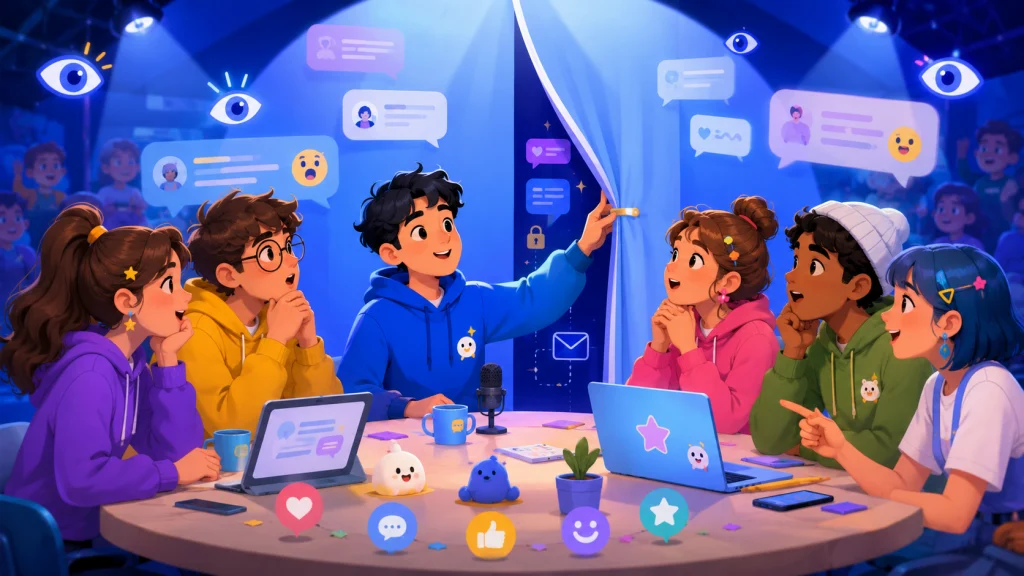
A group chat changes the math completely. What works one on one can feel exposed in front of an audience, and the other person likely knows that too, which means it was either a joke meant to land publicly or a slip they are already regretting. Either way, the safest move is keeping your reply light enough that nobody in the chat reads too much into it.
I have seen group chats turn a harmless line into a whole inside joke that follows someone around for months, simply because the reply that followed it made too big a deal out of nothing. Treat it as a public moment, not a private one, and save anything real for a direct message instead.
- “Careful, the group chat has eyes.”
- “Noted, we’ll discuss this further offline 👀”
- “Everyone, please ignore this, nothing to see here.”
- “I’m flattered, and also aware everyone here can read this.”
- “Saving this confession for later use.”
- “This chat just became a courtroom and I’m not ready.”
When You Need to Ask “Like Me or Like-Like Me?”
Sometimes the honest move is not picking a tone at all, it is asking what they actually meant before you respond to the wrong version of the message. There is nothing awkward about wanting clarity, and a light way of asking keeps it from feeling like an interrogation. It also protects both of you from a reply that answers a question nobody actually asked.
I have told more than one person that asking directly, with a little humor attached, almost always gets a clearer answer than guessing ever does. People tend to appreciate being asked plainly more than they appreciate being met with a vague joke that dodges the actual question.
- “Wait, like me, or like-like me? I need the details.”
- “Asking for a friend, which kind of like is this?”
- “I need a follow-up question before I can answer that properly.”
- “Clarify, because my response changes depending on the answer.”
- “Is this a friendship like or a something-more like?”
- “I’ll answer honestly once I know which version I’m responding to.”

What Not to Say, Even When the Joke Is Tempting
Some lines feel clever in the moment and land terribly once they are out. A cruel joke aimed at someone who just made themselves vulnerable is never worth the laugh it might get from anyone watching, and it tends to be the kind of moment people remember for years, not minutes. Fake flirting to soften a rejection is another trap, since it usually confuses the other person more than a clear answer would have.
And if this conversation is happening anywhere public, a group chat, a comment section, or in front of friends, resist the urge to perform a reply for an audience. Someone just told you something real, even if they wrapped it in humor to protect themselves. Embarrassing them publicly, even unintentionally, is the one mistake on this list that genuinely cannot be walked back.
Final Thoughts on Answering Without Assuming
None of this works as a script you memorize and deploy the same way every time. The whole point is reading what kind of “I like you” you actually received before reaching for a reply, because the friendly version, the flirty version, the one where you like them back, and the real confession all deserve different answers, not the same clever line recycled three ways.
What matters most is that nobody walks away feeling foolish for saying it out loud, including you. If you are looking for more ways to handle compliments that carry this same kind of ambiguity, there is more on funny compliment responses for moments when thank you feels too small, and if you are after a wider set of options for whatever just caught you off guard, you can find that in funny replies for catching the moment that throws you off. And if what you just read was not ambiguous at all, if you already know you like them back and you are ready to lean into it, the cute replies for when you like them back will fit that moment better than anything funny-first ever could.
FAQs
😅 What’s a funny response to “I like you” when I’m not sure what they mean?
Something that buys time without committing either way works best. “Oh? Tell me more about this development” keeps it playful while you figure out the actual context.
💬 How do I respond if I think they mean it as friends?
Match their light tone instead of overanalyzing it. “Right back at you, glad we’re stuck with each other” treats it as the simple compliment it probably was.
🙅 How do I let someone down without humiliating them?
Acknowledge what they said before you give your real answer. A line like “that means a lot, give me a second to sit with it” respects the moment without forcing a decision you have not made yet.
😬 What should I never say back to “I like you”?
Avoid cruel jokes, fake flirting just to soften things, or anything said in front of other people. Someone just took a risk, and a public or mean reply turns that risk into embarrassment they will remember.
📱 What’s a short text reply that doesn’t sound rushed?
“Good to know” or “noted 👀” both read as confident rather than dismissive, as long as the tone leading up to it was already warm.