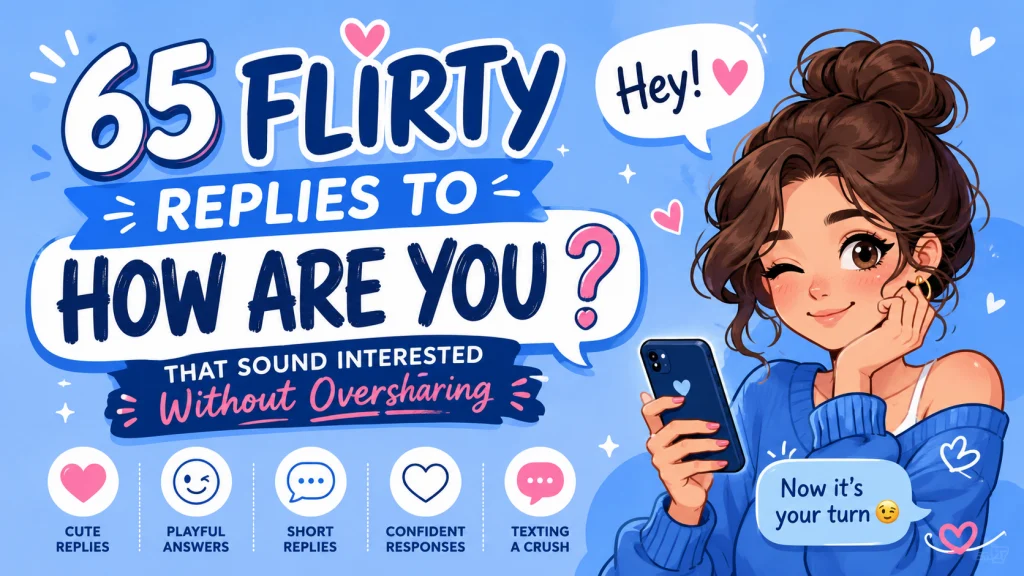
“How are you” is technically a question about your wellbeing, but between two people with any kind of spark, it is usually something else. It is an opener, a check-in, a door nudged slightly ajar. How you answer decides whether it stays polite or becomes personal. These 65 flirty replies to how are you are sorted by how much interest you actually want to show, from soft warmth all the way to a confident signal, so you can pick the one that fits where you actually are with this person without underselling it or oversharing too soon.
How to Turn a Polite Check-In Into Something More
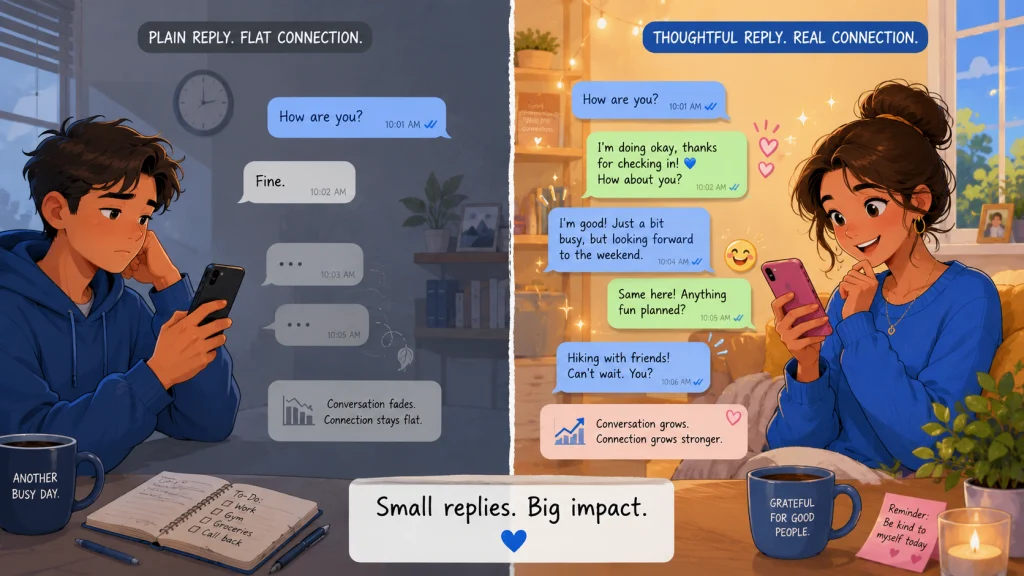
The honest answer to “how are you” is almost never what we send. Most people say fine, good, busy, or some combination of those three words, and the conversation stays exactly where it was: friendly but flat. That is not wrong. But if there is something between you and the person asking, there is usually a better answer available, one that is still true but a little more interesting than fine.
The mistake I have watched people make most often is going in one of two wrong directions. The first is staying so flat that any flirt in the question gets swallowed whole, and the other person is left wondering if you even noticed they reached out. The second is doing too much: the fake dramatic answer, the overshare about your actual day, the premature vulnerability that makes a simple check-in feel like a lot to manage. The sweet spot is smaller than both of those. A real answer with a small tilt toward them. That is all it takes to move “how are you” from polite to personal.
How much you tilt depends on where you actually are with this person. That is what the sections below are sorted by, not just tone, but how much you want to show. Start with the one that feels honest for today.
Soft Replies: Warm Without Obvious Flirting
These are for early days, or for when you want to be genuinely warm without tipping your hand too much. Soft replies do not announce that you are flirting. They just make the other person feel like their question landed somewhere, which is its own kind of signal.
The thing about soft replies is they work in almost any dynamic because they do not require the other person to already know you are interested. They can be read as friendly by someone who is not sure, and read as more by someone who is paying attention. That flexibility is actually the point.
- Better now that you asked, honestly.
- Good. A little better now that I’m talking to you.
- Doing well. You have a way of showing up at the right time.
- Pretty good. This conversation is already the highlight of my day.
- Honestly? I was just thinking about you, so the timing is kind of perfect.
- Good, thanks for asking. I like that you check in.
- Doing fine. Your message helped.
- Decent. Better, now.
- Good. There’s something about hearing from you that makes things feel a little lighter.
- I’m well. But how are you, actually? I want to know.
- Good. I like hearing from you more than I expected to.
Notice that none of these say anything aggressively flirty, but every one of them tells the person something real: that their reaching out mattered. That is the quiet version of interest, and it reads better than any line that tries too hard to announce itself.
Playful Replies: A Little Tease Plus a Real Answer
Playful replies do two things at once. They answer the question, at least partially, and they give the other person something to smile at. The balance matters. A pure deflection that never actually answers feels evasive. A pure answer with no texture feels like you missed the opportunity. The good ones give a real answer and a small twist at the same time.
Someone texted me once asking what to say back to a “how are you” from a person she had been low-key hoping would reach out for two weeks. She wanted to sound like she had not been waiting. I gave her “Tired, happy, and slightly distracted. You’re partially responsible for one of those.” She told me it turned into a two-hour conversation. That is what playful can do when it feels actual and not performed.
- Doing well, and now slightly better for this interruption.
- Honestly, I was getting bored. Perfect timing.
- Good! Although I’ve been thinking about you, which makes it hard to focus.
- Tired, happy, and slightly distracted. You’re partially responsible for one of those.
- Not bad. You have a habit of showing up right when I needed a reason to smile.
- Fine, mostly. A little distracted by certain people texting me.
- I’m well, but my day got considerably more interesting about thirty seconds ago.
- Good! I’ll be better once you tell me how you are.
- Doing okay. You always ask that like you actually want to know, which I appreciate.
- Running at about a seven out of ten. Your text just bumped it up.
- Surviving. You checking in definitely helps the cause.
- Pretty good. Suspiciously better since you appeared.
The line “You always ask that like you actually want to know” is one I like particularly for the way it flips the question back while still complimenting. It is not dramatic, it is just specific, and specific is almost always more effective than clever.

Confident Replies: Show Interest Without Dressing It Up
Confident replies say what is true without flinching. There is no joke to hide behind, no playful deflection, just an honest signal delivered calmly. These sound easy to write, but most people find them the hardest to send because they require actually saying something real without the safety net of humor.
After years of watching these conversations play out, I can tell you that confident is almost always more attractive than clever. Clever is performing. Confident is just knowing where you stand and saying it. Most people respond better to being told directly that their text was a good surprise than to being given a punch line about it.
- Good. Better for having heard from you, if I’m being honest.
- Doing well. Genuinely glad you reached out.
- Fine, and a little happy to see your name on my phone.
- I’m good. I like when you check in. It says something.
- Well, thanks. Your timing is always somehow right.
- Doing pretty well. Talking to you tends to help with that.
- Good. I think about you more than you probably know, so this is a nice surprise.
- I’m well. You always seem to reach out at exactly the right moment.
- Doing great, honestly. This just made my day a little better than it had any right to be.
- Good. I was going to say fine, but the truth is your text made me smile.
- Good. I always like when the conversation starts with you.
That last one is the kind of reply that works because it is visibly honest. You are not trying to hide the fact that their message mattered. You are saying it simply, and that kind of calm directness often lands better than something carefully dressed up as a joke.
Texting-a-Crush Replies: Enough Signal Without the Panic
These are for the specific situation of replying to someone you actually like when your brain is doing too many things at once. The goal here is a reply that feels natural, signals interest, and does not betray the fact that you have been staring at your phone for the last four minutes trying to decide what to type.
The most common mistake in this category is trying too hard to sound casual. A reply that is working very hard to sound effortless reads exactly like that: effortful. Pick something that sounds like you and send it before the second-guessing kicks in. If you need somewhere to start, the flirty text openers that work in early conversations tend to follow the same logic: simple, warm, and a little personal.
- Good! I wasn’t expecting to hear from you today, which makes this even better.
- Honestly, better now. You have that effect.
- Doing well! Although I’ll be real, your name popping up made my day.
- I’m fine. A little nervous now that you asked, but fine.
- Good. And I was just going to reach out to you, so this is convenient.
- Doing okay. You checking in is honestly exactly what I needed today.
- Pretty good. You have a tendency to show up in my thoughts before you show up in my messages.
- Fine! Although now I’m wondering if you can tell I was hoping you’d text. 😏
- I’m well. And now a little flustered, but in a good way.
- Good. I wasn’t sure you’d reach out, so I’m glad you did.
“I wasn’t sure you’d reach out, so I’m glad you did” is the one I would reach for when you want to say something that is completely real and a little brave without making it dramatic. It is one sentence and it says everything without overcommitting to anything.
Conversation-Extending Replies: Answer and Invite Them In
These are for when you want to do more than just answer the question. You want to actually start something. A conversation-extending reply answers “how are you” and gives the other person somewhere to go, whether that is a question back, a detail that invites a follow-up, or something that opens a door to the next exchange.
The reason most “how are you” conversations die is that both people answer and then stop. Nobody asks anything. Nobody offers anything. The loop closes on itself. These replies break that loop by giving the other person a handle to grab. For similar openers that need the same kind of follow-through, having a few solid flirty what’s up replies nearby helps when the conversation pivots naturally.
- Doing well! Actually, I have something I want to ask you. What’s the best thing that happened to you this week?
- Good. A little scattered today, but talking to you tends to help me focus. How are you doing?
- Fine. Although I have been thinking about something and you seem like the right person to ask about it.
- Honestly, pretty good. I’ve been looking forward to this conversation without fully knowing it was coming.
- Good, and a little curious what made you reach out today specifically. What’s going on with you?
- Doing well. You always ask in a way that makes me actually want to answer. What about you?
- Fine, maybe better than fine. Tell me something good from your day. I want to know.
- I’m good! I have a theory about why you texted. But I’d rather hear your version first.
- Doing okay. You caught me in the middle of something, which is honestly a good distraction. What’s on your mind?
- Good. I feel like we always start with how are you and end up somewhere much more interesting. Let’s skip ahead.
- Doing well. But now I’m curious, were you just checking in or starting something?
“Let’s skip ahead” is one of my favorite endings to that kind of reply because it names what is actually happening. You are both doing the polite version of the conversation when what you actually want is the real one. Saying that out loud can make the conversation feel less like small talk and more like a shared secret.
Short Replies: When One Good Line Is Enough
Not every “how are you” needs a full response. Sometimes you want to say something warm or a little charged and then leave space for them to come back. Short replies work especially well when the dynamic between you is already established, because a small line carries more weight when the person reading it already has context for what you mean.
The broader category of flirty replies that land most reliably are almost always shorter than people expect. A single honest line, sent without over-editing, beats a paragraph that took ten minutes to write almost every time.
- Better now. 😊
- Good. Better for this.
- Fine, mostly. You help.
- Well. You?
- Good. I was just thinking about you.
- Honestly? Happy you asked.
- Fine. Your timing is always good.
- Good. You have a way of knowing when to check in.
- Well. Today got better about a minute ago.
- Good. Smiling now, so.
“Good. Smiling now, so.” works because the unfinished feeling does exactly what a short flirty reply should do: say enough to communicate something real, and stop before it has to explain itself.
What Not to Send: The Answers That Close the Door
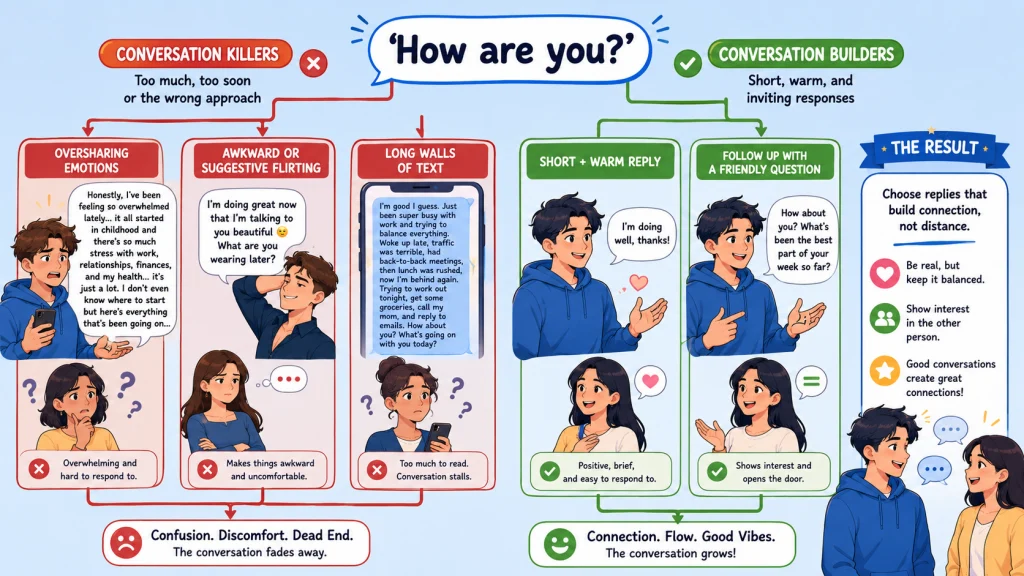
There are a few categories of “how are you” reply that kill the energy before it has a chance to go anywhere, and they are worth naming because they are genuinely common.
The first is fake drama. “Ugh, terrible day honestly, don’t ask” is not a flirty reply, it is an emotional load dropped at the door of a conversation that was just getting started. The other person asked a polite question. They did not sign up for the detailed breakdown of your afternoon, especially before the conversation has any warmth in it yet. Save the real stuff for later, when there is enough between you to hold it.
The second is the sexual pivot too early. If the vibe is light and early and someone asks how you are, a reply that immediately goes somewhere suggestive lands as either uncomfortable or try-hard, depending on the person. Flirty and sexual are not the same thing. The former reads as confident and interested. The latter, out of context, reads as someone who skipped several steps.
The third is the full diary entry. Someone asked how you are, not what happened from seven a.m. to now. A detailed answer about your actual day is not warm, it is a lot. Even if everything in it is genuinely interesting, an unprompted paragraph about your schedule makes the other person feel like they have to read your update rather than talk to you.
| What to avoid | Why it backfires | What works instead |
|---|---|---|
| Fake or exaggerated drama (“don’t ask, terrible”) | Drops weight into a conversation that just started | A real answer with a small positive tilt toward them |
| Sexual reply if the vibe is still early | Reads as skipping too many steps at once | Playful or confident replies that hint without leaping |
| Long detailed day recap | Feels like a report, not a conversation | One or two sentences, then a question back |
| Just “fine” with no follow-through | Ends the conversation before it begins | Anything from the soft or short sections |
| Vulnerability that is too real too fast | Puts the other person in an unexpected position | Save genuine heavy sharing for when trust exists |
The common thread in all of these is calibration. Flirting with a “how are you” is about tilting just past friendly without tipping over into something the moment cannot hold yet. When in doubt, go warmer and shorter, not heavier and longer.
Final Thoughts: The Answer Decides the Direction
Nobody is going to remember exactly what you said to “how are you.” But they will remember how it felt to hear back from you. Whether they put their phone down smiling. Whether the conversation went somewhere or stayed flat. Whether your reply felt like you were actually there or just filling in the polite response.
That is really what a flirty “how are you” reply is doing. It is not a trick. It is not a line designed to manipulate someone into liking you. It is just choosing to be present in a small moment instead of letting it go by. Most of the time, the honest version of “better for hearing from you” will do more than any clever answer you could spend ten minutes writing.
Pick the reply that sounds like you at your most relaxed. Send it. See where the conversation goes from there. That is all this ever needs to be.
FAQs
💬 What’s a good flirty reply to how are you from a crush?
Something honest with a small tilt toward them. “Good. A little better now that I’m talking to you.” is light enough for early days but real enough to land as a signal. You do not need a clever line. You need a true one, delivered without overthinking it.
😏 How do you answer how are you in a flirty way without being too obvious?
Use a soft or playful reply that could be read as friendly by someone not paying attention and as flirty by someone who is. “Better now that you asked, honestly” does that. It is warm without announcing itself, which is usually better than something that is obviously trying to flirt.
🤔 Is it weird to give a flirty answer to how are you?
Not if it matches the dynamic. A reply like “Good. Your timing is always right” reads as warm and charming in a conversation with some energy to it, and reads as a little much in a first message from someone you barely know. Read the room first, then pick your level.
⚡ What do you say to how are you to keep the conversation going?
Answer the question briefly and then give them somewhere to go. “Fine, although I’ve been thinking about something and you seem like the right person to ask” answers the question and opens a door at the same time. The follow-up question or detail is what keeps conversations alive, not the opener.
👀 Should I say “better now that you texted” to my crush?
Yes, if you mean it. It works because it is direct without being heavy. It tells them their text mattered without making a production of it. If it feels too on-the-nose, try “Good. A little better now that I’m talking to you” which lands the same way with slightly less intensity.
⏳ What if I don’t want to come across as too eager when answering how are you?
Stick to one warm line and stop. “Good. Glad you asked.” is enough. The mistake people make is adding to a reply that already said everything it needed to say. Say the thing, flip the question back to them if you want, and let it land. Short and genuine reads as confident, not eager.