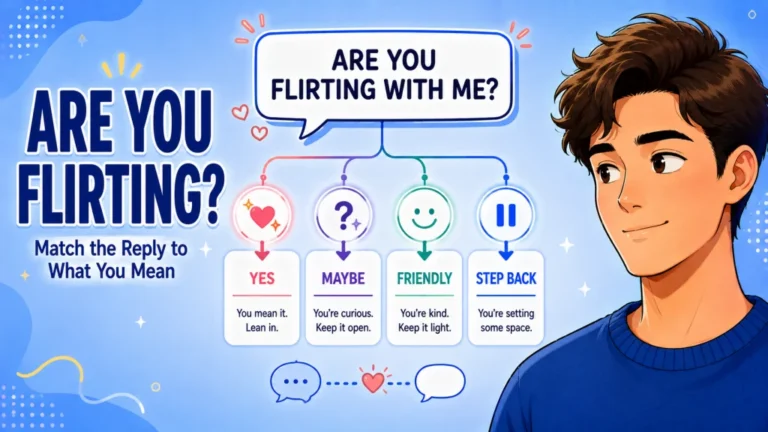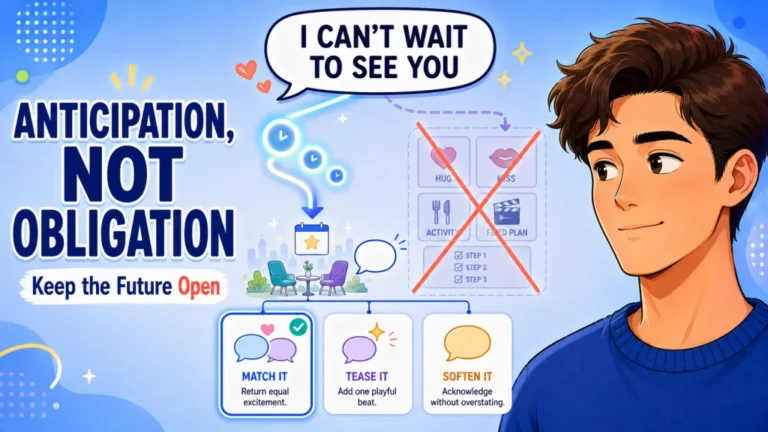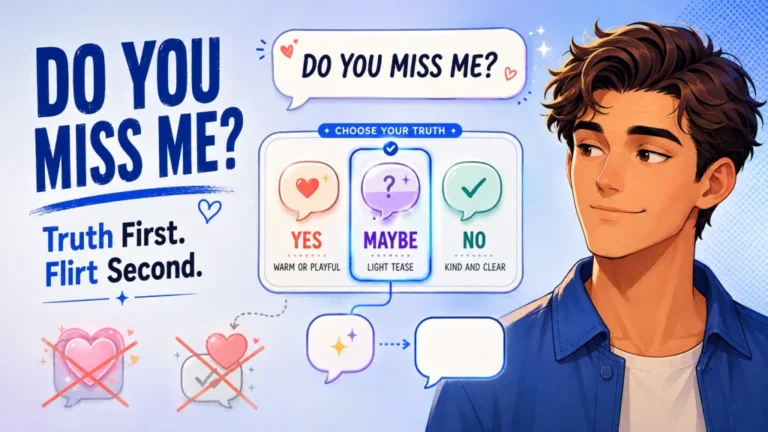
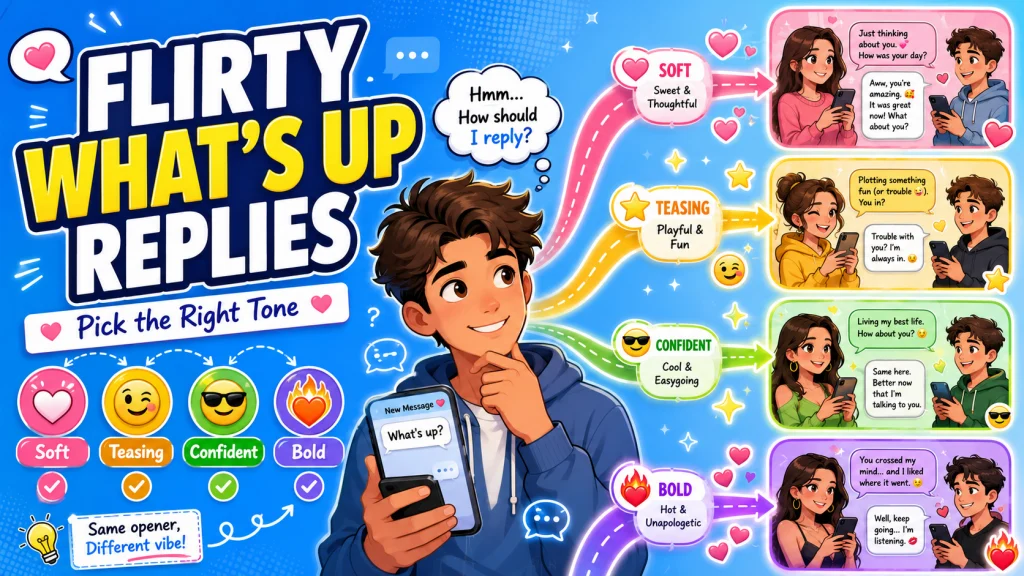
What’s up shows up everywhere, casual, flirty, half-asleep, and most replies to it fall flat because the person answering tries to be too clever or too careful at the same time. I have watched this exact opener kill more potential than almost any other line, mostly because two words do not deserve the three-paragraph response they sometimes get back. What actually works is matching the energy on purpose, soft when you want easy momentum, teasing when you want them to work a little, confident when the interest is already mutual, and something sharper for when chemistry has already done most of the talking. By the end you will have real lines for every one of those moods, plus a few that hand the ball back to someone who keeps sending lazy openers your way.
What’s Up Asks for Almost Nothing, Which Is the Whole Problem
What’s up is the text equivalent of someone shrugging at you from across a bar. It is not rude, it is not interesting, and it is definitely not asking you to perform. The good news is that flirty what’s up replies do not need to do much work to land, they just need to know which lane they are in before you hit send. The reply only fails when someone treats two lazy words like they deserve a full paragraph back.
What follows covers every tone a flirty answer to what’s up can take. Short lines that barely lift a finger, one-liners with enough cheek to get a reaction, playful options built for a steady back and forth, and a couple of confident answers for when you already know where this is heading. None of it is complicated. It is sorted by how much heat you actually want to bring, and how much work you are willing to make the other person do in return.
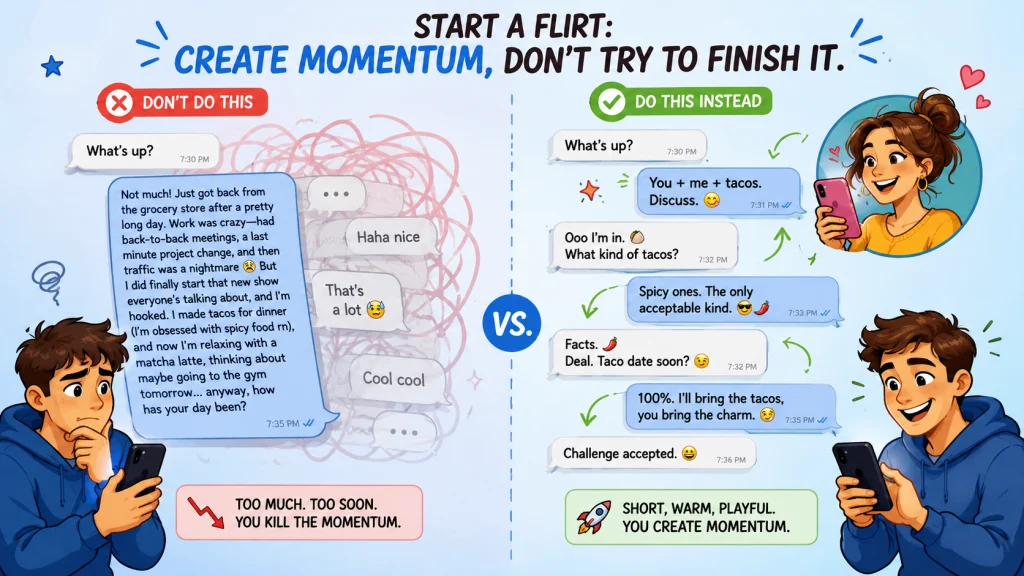
Starting a Flirt Is Not the Same Job as Finishing One
The biggest mistake I see with a what’s up flirty reply is someone trying to do both jobs in one sentence. They want the line to open something and wrap it up at the same time, so it comes out either too long or like it is trying too hard, and the conversation stalls right where it started. A reply that opens momentum just needs to be light enough to invite a response. A reply that tries to close the loop, land the joke, and confirm interest all in four words almost never survives contact with a real person on the other end.
I had a regular show me a reply once that he was convinced was clever. It hit on three different jokes in one message, referenced something from earlier in the week, and ended with a question mark that was clearly meant to seal the deal. She did not answer for two hours, and when she did, it was one word. He had tried to finish a flirt that had barely started. The lines below are split by exactly this distinction, because knowing whether you are opening a door or trying to walk through it changes everything about what you should actually send.
Soft Replies That Make It Easy to Keep Going
Soft is where most flirty what’s up replies should actually live, especially early on. The job here is simple, answer lightly, leave a little room, and make it effortless for them to send something back. This is not the place for a big swing. A soft reply works because it lowers the stakes for both people while still making it obvious you are not just answering out of politeness.
The trick with soft lines is restraint. One small detail, a touch of warmth, and a clear opening for them to ask something back. That is the whole formula, and it works better the less you try to add to it.
- “Not much, just thinking about texting you first.”
- “Nothing exciting, unless you count this conversation.”
- “Just sitting here, glad you beat me to it.”
- “Same old, better now that you texted.”
- “Honestly bored until two seconds ago.”
- “Just here, glad you made my afternoon slightly better.”
- “Nothing much, just smiling at my phone for no good reason.”
- “Not a lot, kind of hoping you’d ask that.”
- “Same as always, a little better now though.”
- “Just here, glad it’s you and not anyone else texting.”
- “Nothing important, unless this counts as something.”
- “A little bored, until you texted first for once.”
- “Honestly just killing time until you showed up in my messages.”
- “Not a thing, just glad my phone buzzed for you.”
- “Same boring day, slightly less boring now.”
- “Nothing exciting, but this conversation already is.”
- “Currently debating why it took you so long to text.”
- “Just thinking, and apparently you read my mind.”
- “Not a lot, but I’m glad you’re the one asking.”
- “Same old, except now I have a reason to smile.”
Any of those leaves an obvious next move for the other person without forcing it. That is what soft is supposed to do, hold the door open instead of walking through it for them.
Teasing Replies That Make Them Work a Little
A teasing reply to what’s up is for the moment you want them to put in slightly more effort without sounding annoyed about getting a lazy opener. The line should feel like light pressure, not a complaint. Done right, it reads as confident and a little playful instead of petty, which is the difference between a tease that lands and one that just sounds irritated.
What separates a good tease from a bad one is tone, not content. The same words delivered flat read as criticism. Delivered with a wink, they read as flirting. Since text strips out tone, the words themselves have to carry it, which means picking lines that are clearly playful on the page, not just in your head.
- “What’s up is doing a lot of heavy lifting for an opener.”
- “That’s it? I expected at least a little effort.”
- “Wow, really pulling out the classics today.”
- “You could have asked literally anything else.”
- “Not much, recovering from the excitement of that text.”
- “I’ll allow it, but next time bring something better.”
- “I see you went with the bare minimum today.”
- “Bold of you to lead with that one.”
- “I’ll let it slide, this time.”
- “Not much, surviving the thrill of that opener.”
- “You really used your one text on that?”
- “I expected more creativity from you, honestly.”
- “Cute attempt at an opener, try again.”
- “Not much, still recovering from your effort level.”
- “That’s the best you had saved up?”
- “I’ll answer, but you owe me a better question next time.”
- “Low effort, high confidence, I respect it a little.”
- “You could have at least pretended to think about that one.”
Each one hands a little work back without shutting the door, which is exactly the point of a tease that is actually flirting and not just a complaint with extra steps.

Confident Answers for When the Interest Is Already Mutual
Confident replies skip the warm-up because the warm-up already happened somewhere else, in a look, a previous conversation, or a pattern of texting that has made the interest obvious to both of you. These lines show interest directly instead of hiding it behind a joke, but they still stop short of giving a speech. A confident reply says something real in one or two lines and then lets the conversation breathe.
The mistake people make here is confusing confidence with volume. A confident reply is not longer or more intense than a soft one, it is just more direct. It names the interest instead of dancing around it, then gets out of the way.
- “Just hoping you’d text me, honestly.”
- “Better now that I’m talking to you.”
- “Thinking about how I still owe you a real conversation.”
- “Not much, kind of glad it’s you texting and not anyone else.”
- “Wishing this conversation was happening in person instead.”
- “Just glad you’re the one I’m talking to right now.”
- “Honestly hoping this turns into a longer conversation.”
- “Better now, you have a way of doing that.”
- “Thinking about you more than I probably should admit.”
- “Trying to look busy, but glad you actually reached out.”
- “Glad you texted, I was about to do the same.”
- “Wishing I could say this in person instead of through a screen.”
- “Just looking forward to whatever this conversation turns into.”
- “Better now that I know you were thinking about me too.”
Lines like these only work if the groundwork is already there. Send one of these too early and it reads as a lot, send it at the right moment and it reads as exactly what it is, someone who already knows what they want to say.
Bold Replies, Only When the Chemistry Is Already There
Bold is the riskiest lane, and it is the one I get asked about the most because it gets the most attention when it works. A bold flirty reply to what’s up names the tension outright instead of teasing around it. It only belongs in a conversation where flirting has already been established, not as a way to start one. Sent too early, it reads as forward in the wrong way. Sent at the right moment, it reads as someone who is finally just saying the thing out loud.
If you are not sure whether the chemistry is solid enough for bold, it usually is not yet. That uncertainty is the signal to drop down a lane, not push through it.
- “Not much, just trying to figure out when I get to see you.”
- “Thinking about you, which is becoming a problem.”
- “Nothing, except wondering if you’re free this weekend.”
- “Honestly just waiting for an excuse to text you first.”
- “Not much, just wondering when I get to see you again.”
- “Thinking about you more than I should probably admit out loud.”
- “Nothing, just trying to find a reason to ask you out already.”
- “Honestly hoping you’re free soon, because I’m done waiting for an excuse.”
None of those work as an opener cold. They only work because something earlier in the conversation already gave them permission to land that directly.
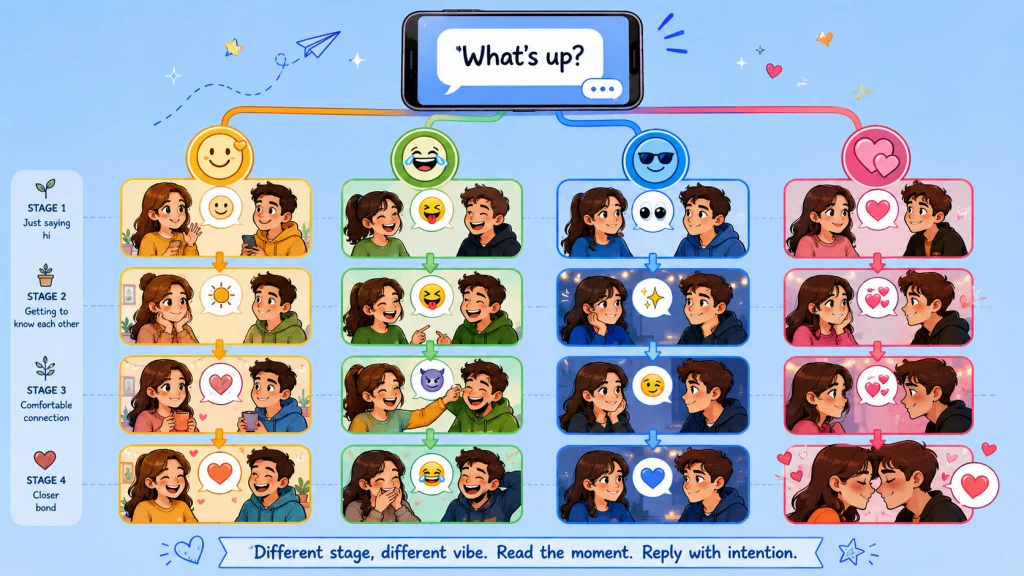
Which Lane Actually Fits the Conversation You’re In
If you are still deciding between the four lanes above, the deciding factor is almost never the words themselves, it is how much history already exists between you and the person texting. The table below is a fast way to check before you pick a line, since sending a bold reply into a conversation that has not earned it does more damage than sending nothing at all.
| Tone | When It Fits | Risk If You Get It Wrong |
|---|---|---|
| Soft | Early texting, unclear interest, first few exchanges | Low, worst case it reads as polite |
| Teasing | Some back and forth already happening | Medium, can read as annoyed if tone misses |
| Confident | Interest already obvious on both sides | Medium, can feel sudden if sent too soon |
| Bold | Established flirting, clear chemistry | High, reads as too much without that history |
Use this less as a rulebook and more as a gut check. If you are hesitating over whether a line fits, it usually means you are one lane too bold for where the conversation actually stands right now.
Lines for When What’s Up Is All You Ever Get
Some people only ever send what’s up, good morning, or hey, and never anything with more texture than that. If that is the pattern you are dealing with, a flirty reply to what’s up can do double duty by handing the laziness back without sounding bitter about it. These lines work as a soft test, does the other person actually put in effort once you make space for it, or are they happy to keep coasting on two-word texts forever.
This is also where it helps to recognize that what’s up is just one version of a wider habit. The same lazy energy shows up across other lazy flirty text openers, and the way you handle a flirty response to a flat hey runs on almost identical logic.
- “What’s up with you, since you clearly have more to say than that.”
- “Funny, I thought you’d have a better opener by now.”
- “You ask that a lot for someone with so much else going on.”
- “Not much, your turn to actually ask me something.”
- “Same as last time, but I’m still giving you a chance to upgrade the opener.”
- “Not much, but I feel like you have a better question in you.”
- “Funny, that’s your go-to every single time.”
- “Nothing new yet, unless you’re about to surprise me.”
- “Not much, I’m starting to expect more from you.”
- “Same answer as always, so maybe you owe me a better question.”
- “Not much, your turn to actually say something interesting.”
- “Nothing exciting, you’ve used that line before.”
- “Same old, but I’ll reward you if you ask something more interesting.”
- “Not much, I think you’ve got better questions in you somewhere.”
- “Funny, I was wondering when you’d send something more than that.”
If the pattern never changes after a line like that, you have your answer about how much effort is actually coming back your way. The reply already did its job either way, which is more than the original opener could say for itself.
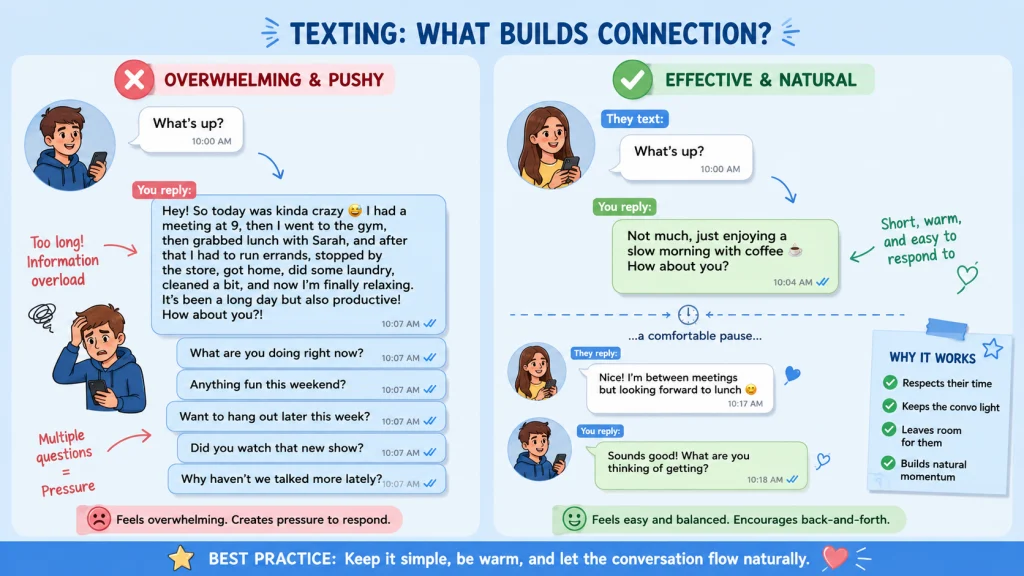
What Kills a Good Reply Before It Even Lands
The most common mistake is sending too much too soon, usually because the person replying is nervous and trying to prove interest fast instead of trusting the conversation to build on its own. A four-word opener does not need a six-sentence answer, no matter how much thought went into it behind the scenes. The longer reply almost always reads as more effort than the moment called for, and effort that outpaces the opener tends to make people pull back instead of leaning in.
The second mistake is turning the reply into an interrogation. Three questions stacked on top of each other in response to two lazy words feels like a job interview, not flirting. The third mistake is running a full flirt routine, joke, callback, and question mark, all in one message after barely anything was said first. I understand why people do all three. Silence feels risky, so the instinct is to fill it with as much as possible. The better move is almost always less, one clear line, one small opening, and then actually waiting to see what comes back.
Final Thoughts: Pick the Lane the Conversation Already Built
None of these lines do anything on their own. A soft reply, a tease, a confident line, or something bolder all depend on reading the conversation honestly before you hit send, not on the cleverness of the words themselves. What’s up is lazy by nature, but your reply does not have to inherit that laziness if you take five seconds to pick the right register first.
If the text you actually got was a flirty how are you instead of what’s up, the read is slightly different and worth handling on its own, here is how to send a flirty reply to how are you without overdoing it. And if you want the wider range beyond just this one opener, the full spread of flirty replies for nearly any text covers a lot more ground than four words can hold.
FAQs
💬 What’s a good flirty reply to what’s up?
Start soft if you are not sure where things stand. Something short and warm, like saying you are glad they texted first, leaves room for them to keep going without putting too much on the table early.
😏 How do you make what’s up sound flirty without trying too hard?
Keep it to one line and let a small detail do the flirting instead of a joke. A reply that sounds effortless almost always reads as more confident than one that is clearly working hard to be clever.
🙃 Is what’s up a bad opener to get?
It is lazy, not bad. The opener does not decide how the conversation goes, your reply does. Treat it as an open door rather than a weak start and it stops mattering much either way.
😅 What if I’m not sure they’re actually flirting?
Send something soft. It reads as friendly if there is no flirting happening yet, and it still leaves the door open if there is. Save the teasing and bolder lines for once the signal is clearer.
🔥 What’s a bold reply to what’s up if I already know they’re into it?
Say the thing directly instead of teasing around it, something like naming that you have been thinking about them. Bold only works with history already behind it, so skip it if the chemistry is still new.
🤐 What do I send if I just want to keep it short?
A soft one-line answer does the job without forcing anything. Short does not mean uninterested, it just means you are letting the conversation build instead of trying to finish it in one message.