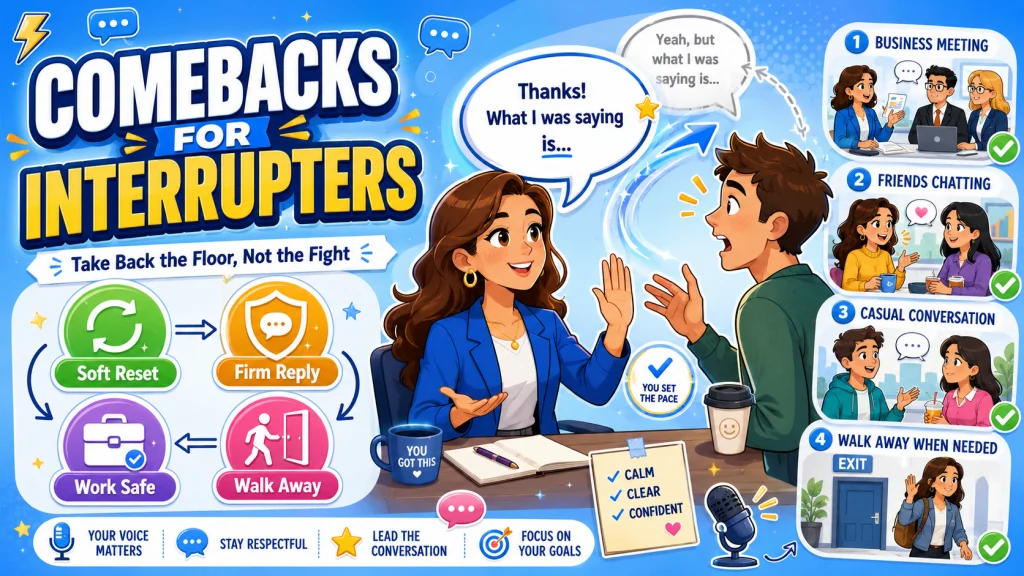
Being interrupted is not just annoying. It is a small, consistent message that your words are not worth waiting for, and most people either go quiet or go loud in response. These 55 comebacks for someone who interrupts you are sorted by what you are actually trying to do, because the line you need in a work meeting and the one you need with a friend who keeps finishing your sentences are not the same line. The goal is not to win an argument. It is to take back the floor without starting one.
Why Interrupting Works and Why Most Responses Don’t
Interrupting works because it puts the person being cut off in an impossible spot. Go quiet and you have handed over the floor. Raise your voice and talk over the interruption and you look reactive, the original point is lost, and now there are two things happening instead of one. Most people know this, at least in the moment, and that awareness is exactly what makes them freeze.
I watched this play out at the bar more times than I could count over nine years, and it followed the same script almost every time. Someone would be mid-sentence, get cut off, go quiet for half a second too long, and then either abandon the point entirely or try to pick it back up at double speed. Both moves broadcast the same thing: the interruption worked. The floor belongs to whoever took it.
What breaks that pattern is not volume. It is not a lecture about manners, and it is not a comeback so sharp that the conversation pivots to the comeback instead of the original point. What breaks it is a line that reclaims the floor without making the floor itself the subject of the conversation. The sections below are organized by situation and intent, because figuring out what to say when someone interrupts you depends entirely on where you are and what you still need from the exchange.
| Situation | What you’re trying to do | Lines to use |
|---|---|---|
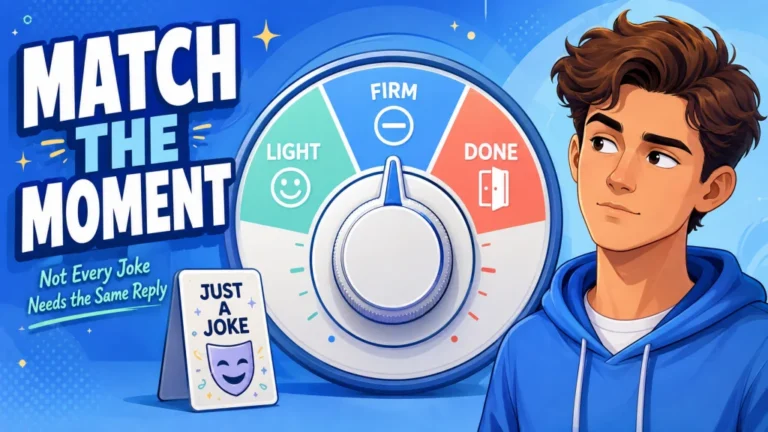
| One-off, probably not on purpose | Reset without making it a thing | Soft reset lines |
| Recurring pattern, likely deliberate | Name it without yelling | Firm floor-taking lines |
| Work meeting or professional setting | Reclaim without creating tension | Work and meeting lines |
| Friends or casual group | Call it out with a bit of edge | Friend-group lines |
| They keep doing it, conversation is going nowhere | Step back without ceding the point | Exit lines |
One thing worth naming before we get into the lines: if the person who keeps interrupting you also tends to treat your input as already settled before you have offered it, or turns every conversation into a demonstration of their own expertise, there is some overlap worth knowing about. The comebacks for know-it-alls on this site cover that specific flavor of not being heard. The lines here assume the problem is the interruption itself.
Soft Reset Lines: For When It Might Have Been an Accident
Not every interruption is a power move. Some people talk fast, lose track of when someone else is mid-sentence, or genuinely do not notice they cut you off until you signal it. These lines are for that version of the situation: no accusation, no friction, just a clear statement that you were not finished and would like to continue. They do not make a thing of it. They just push the door back open.
The mistake people make here is softening the line until it disappears. “Sorry, were you saying something?” is not a reclaim. It is a concession. You are asking permission to finish your own sentence. These lines do not ask. They state, quietly, that you had more to say.
- “Let me finish that thought.”
- “One second, I wasn’t done.”
- “Hold that thought, I’m still mid-sentence.”
- “Almost there, give me two more seconds.”
- “I’ll get to your point in a moment, let me land mine first.”
- “Just a beat, I had more to add.”
- “Let me get to the end of this.”
- “Stay with me, I’m almost there.”
- “I want to hear yours right after, but let me finish.”
- “Two more seconds, I promise.”
The softer half of this list works best one-on-one. In a group, something a little more audible helps, because you need the room to register that you still have the floor before someone else gets there first. “Let me finish that thought” lands in both settings. It is short enough to say without raising your voice and direct enough that it is hard to misread as an invitation for more input.
Firm Floor-Taking Lines: For When It’s a Pattern, Not a Slip
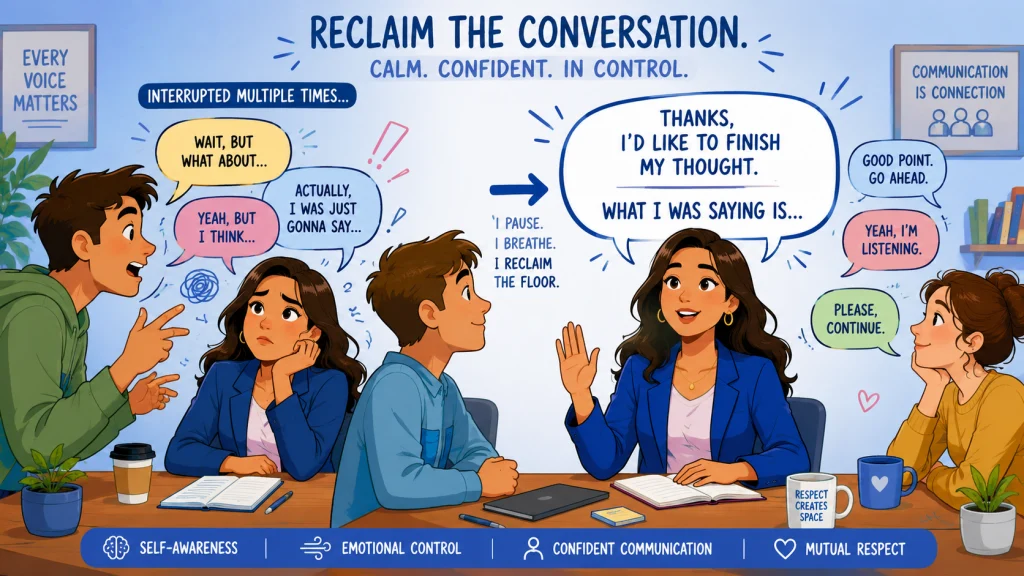
This is the version where the interruptions have moved from occasional to consistent. The soft resets have either been ignored or not noticed, and continuing to treat the interruption as accidental is no longer accurate. At this point the line has to do two things: reclaim the floor and name what just happened, without turning the whole conversation into a confrontation about manners.
The naming part matters more than most people expect. If you just plow back into your sentence without acknowledging the interruption, it tends to happen again inside of two minutes. Naming it briefly, once, directly, creates a small moment of friction that most people register and adjust to. You are not delivering a verdict. You are stating a fact and continuing.
- “You just cut me off.”
- “I wasn’t finished.”
- “That’s the second time you’ve done that.”
- “I was speaking.”
- “I’ll give you the floor when I’m done with mine.”
- “You started talking before I finished. I’d like to continue.”
- “I notice I keep losing my sentence. Let me find it again.”
- “I’m going to need you to let me finish.”
- “I haven’t landed my point yet. Can I do that first?”
- “I’m aware you have thoughts. So do I. Mine are still going.”
- “We can do this as a conversation or a competition. I’d prefer the first one.”
- “You’ll get a turn. I’m on mine.”
The line that surprised me most, for how well it works in practice, is the quiet one: “I notice I keep losing my sentence. Let me find it again.” It does not accuse, and it does not even sound like a comeback. It names the pattern in a way that is almost impossible to argue with, and it puts the recovery on the speaker rather than framing it as a failure of the person doing the interrupting. Someone I know used it on a coworker who had been talking over her in meetings for weeks. She told me he apologized without being asked and let her finish. That is not a guaranteed outcome. But it is worth having in rotation.
Whichever line you use here, say it evenly and then return directly to your original sentence. The line works best when it is a bridge back to your point, not the start of a new argument.
Work and Meeting Lines: Professional but Clear
The professional setting changes the math. You still want the floor back. You also want to keep the room on your side, avoid creating the kind of moment that gets replayed later, and not come across as the person who turned a status update into a standoff. These lines stay calm enough to survive a meeting recording and clear enough that the room understands what happened.
Being professional does not mean being invisible, and I want to name that directly. The habit of going quiet in a work context because the interruption came from someone senior, or because you did not want to seem difficult, is one of the most consistent patterns I hear about when people bring this situation to me. Staying quiet does not make you look gracious. It makes you look like someone who can be talked over. These lines fix that without making a scene.
- “I’ll circle back to your point after I finish mine.”
- “Let me complete this thought before we move on.”
- “I want to make sure I get the full context out before we respond to it.”
- “I’ll flag that point and come back to it. Let me wrap up what I was saying.”
- “I was mid-thought. Let me get there first.”
- “I’d like to finish before we pivot.”
- “That’s a fair point, and I’ll get to it. I’m not quite done yet.”
- “Can I finish the sentence before we take it in a new direction?”
- “I appreciate the input, and I want to finish what I started.”
- “Let me close this out and then it’s yours.”
- “I’m going to ask for thirty more seconds, and then I want to hear what you have.”
“I’ll circle back to your point after I finish mine” is the most versatile line in this set. It treats the interruption as a contribution worth returning to, which softens the reclaim, and it puts the interrupter in a position where they either let you finish or they have to actively object to their own point being acknowledged. Most people settle. It also signals to whoever is running the meeting that you still have the floor and you know it.

Friend-Group Lines: Playful but Effective
With people you actually like, the goal is usually not to make a formal statement about conversational norms. It is to flag the interruption in a way that lands as funny, maybe slightly pointed, and gets your sentence back. The right line in a group of friends says “I clocked what you just did” without making it heavy. Delivered well, it usually gets a laugh and the floor.
These lines work best when the interruption is a documented habit rather than a genuine slip, because the slight edge in most of them only reads correctly when everyone already knows the pattern. If someone genuinely just talked over you by accident, a softer reset is kinder. But if your friend has a record of not letting people finish their stories, these replies are built for exactly that situation.
- “Bold move cutting me off mid-story.”
- “Rude, but okay, go ahead.”
- “You really just did that.”
- “I had a punchline and you killed it.”
- “Noted. You do not care about endings.”
- “I’ll remember this when you have something to say.”
- “That was my favorite part of the sentence, thanks.”
- “Wow. Okay. I was going somewhere with that.”
- “Classic you.”
- “The disrespect in this room right now.” 😐
“I had a punchline and you killed it” is particularly effective when it is true, because now the group wants to know what the punchline was, which hands the floor back to you without you having to ask for it. Timing matters more here than anywhere else in this set. Dry delivery is everything. If you perform it, it sounds like you rehearsed a comeback, which is the thing you most want to avoid sounding like.
Exit Lines: When the Conversation Has No Room for Two People
There is a version of this situation where the other person is not going to let you finish no matter what you try. The floor reclaims have not worked. The naming has not worked. The conversation has become a series of interruptions with your attempts wedged in between them. At that point, continuing to fight for the floor is its own kind of loss. These lines are for stepping back without ceding the point entirely, because there is a real difference between choosing not to continue and being talked into silence.
If someone consistently shuts down your sentences, refuses to let you finish a thought, and does not adjust regardless of how you respond, that is not a communication style difference. That is a choice, and it may not be one you can talk your way out of. If the interrupting comes bundled with other patterns of dismissal or pressure, the what to say to a bully section covers the sharper end of this. The lines below assume you want to stop the current conversation cleanly, not that anything more serious is in play.
- “I don’t think you’re actually listening.”
- “We can talk when there’s room for two people in the conversation.”
- “I’ll wait until you’re done, and then I’ll try again.”
- “This isn’t working as a conversation. Let’s try again later.”
- “I’m going to stop here because you haven’t let me finish once.”
- “You’ve interrupted me three times in ten minutes. I’m done for now.”
- “I’ll write it down and send it to you. That way you can’t cut me off.”
- “It seems like you already know what you want to say. So I’ll let you say it.”
- “I’ve tried to finish that thought four times. I’ll let it go.”
- “You don’t want a conversation. You want an audience. I’m not that.”
- “I’m going to pause here because I don’t think either of us is getting anywhere.”
- “When you’re ready to listen, I’ll still have the same point.”
“You don’t want a conversation. You want an audience. I’m not that.” is the line I reach for when the pattern has been going on long enough that naming it once is no longer the move. It says exactly what is happening without turning it into a list of grievances, and it ends with something the other person has to sit with. Whether they do anything with it is not yours to manage. The point is that you named it and left cleanly.
What Not to Say: Three Moves That Almost Always Backfire
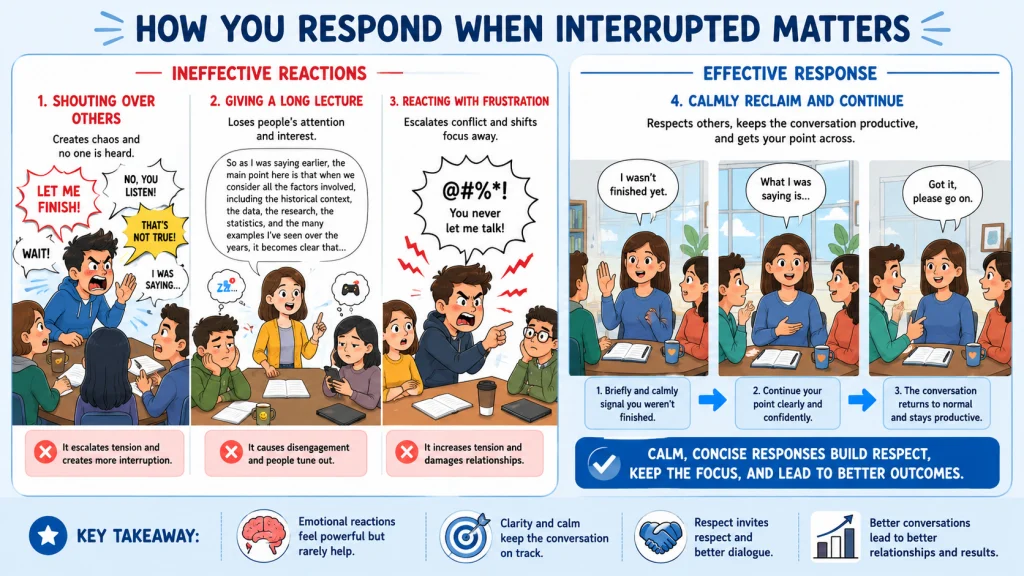
Most people who want to push back on an interruption reach for one of three things instinctively. All three tend to backfire, not because pushing back is wrong, but because these specific moves shift the conversation from the original point to the interruption itself, which is often the thing the interrupter wanted in the first place.
Talking Over Them at Full Volume
It feels like the most direct answer because you are literally reclaiming the sound of the room. The problem is that a volume competition is not a conversation, and once it becomes one, both people have lost the thread of what was actually being said. Winning a shouting match is not the same as being heard. The person who cut you off now gets to point to the noise as the reason nothing landed. Do not give them that.
A calm but audible “I wasn’t finished” does more than raising your voice. It names what happened without creating a second incident to manage. The original point stays on the table instead of getting buried under the argument about the interruption.
Delivering a Speech About Their Behavior
This is the move that feels satisfying to imagine and rarely lands the way you picture it. “You always do this. Every single time I try to say something, you just talk right over me.” The person who interrupts regularly has probably heard some version of this. And even if they have not, the speech makes the conversation about the history of the interrupting instead of the point you were actually trying to make. You wanted to finish your sentence. Now you are in a relationship autopsy.
Say one thing. Name it once. Move back to your point. That is the whole sequence. If there is a larger conversation worth having about the pattern, it belongs at a different time, in a different register, with more space around it than the middle of an interrupted thought.
Dropping an Insult to Shut It Down
The temptation is real, especially if the frustration has been building across multiple conversations. But an insult pulls focus entirely off your original point and onto the comeback. Nobody is thinking about what you were saying. Now the only question in the room is whether the insult was fair. Even if it was, you lost the point.
The broader set of comebacks for rude people covers situations where someone has crossed a line that warrants something sharper. In those cases, a harder line is justified. But if the goal is still to finish your sentence and have it heard, keep the response short, keep it pointed at the behavior, and get back to the point.
Final Thoughts: Getting the Floor Back Is Not the Same as Winning It
The frustration of being interrupted is rarely just about the sentence. Nine years of watching it happen in real time made that clear. It is about the cumulative effect of having your words treated as optional, as something that can be stepped on and moved past without consequence. One interruption is a slip. Five in an hour is a signal. These lines address the signal, not just the individual moment.
None of them are guaranteed to work. A line that lands cleanly with one person reads as aggressive with someone else saying the exact same words. Context is everything, which is why the sections above are sorted by situation and not by tone. Use what fits where you are. Adjust if it does not land the first time. Freezing in the moment is completely normal, and the whole point of having the line ready is that next time you will not have to find it on the spot.
If what you’re dealing with goes past a habit of interrupting and into something more consistent and deliberate, there is more worth reading in the savage comebacks section for situations that call for something sharper than a floor reclaim.
FAQs
🗣️ What do you say when someone keeps interrupting you?
Name it once and move back to your point. “That’s the second time you’ve done that. I wasn’t finished.” is enough. Anything longer becomes a lecture about the interrupting instead of a reclaim of the floor, and the lecture rarely changes the behavior.
💼 How do you handle being interrupted in a meeting without looking difficult?
“Let me complete this thought before we move on” is professional, calm, and leaves no room for misreading. You are not accusing anyone. You are stating that you are not done. Most rooms respect that if you say it without apology.
😤 Is it rude to call someone out for interrupting you?
No. Naming what happened is not rude. Interrupting is the rude thing. “I wasn’t finished” is a statement of fact, not an attack. You do not owe anyone silence while they talk over you.
🤷 What if they keep interrupting even after I say something?
That is a different problem than a single interruption. Use an exit line and table the conversation for now. “We can talk when there’s room for two people in the conversation” is a clean way to step back without an argument.
😂 How do you call out a friend for interrupting without making it weird?
Keep it light. “I had a punchline and you killed it” calls it out with enough humor that the friendship survives, and the group usually gives you the floor out of curiosity about what the punchline was going to be.
🔇 Is it ever better to just let the interruption go?
Sometimes. If it is a genuine one-off and the conversation is still moving in the right direction, letting it go is fine. These lines are for patterns and situations where going quiet is costing you something. Not every interruption needs a response.