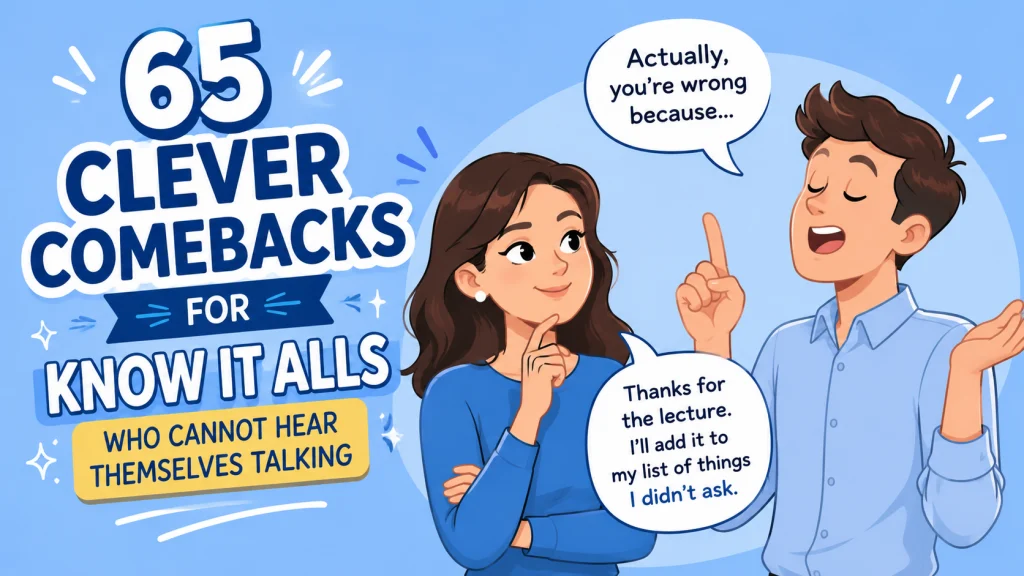
A know it all does not actually need more information. What they need is a pause button, something that interrupts the correction reflex before it turns a casual conversation into a lecture. This covers clever comebacks for know it alls, the people who jump in with the “well actually,” override what you already knew, and somehow make every topic the one they are most qualified to explain. None of these lines are about winning a fact war. They are about handing the floor back to yourself without making things worse than they need to be.
The Person Who Cannot Let a Sentence Finish Without Fixing It
I have stood behind a bar and watched the same scene play out more times than I can count. Someone tells a story, gets two sentences in, and a third person leans across the table to correct a minor detail nobody asked about. The story stops. The room shifts. And the person telling it either drops the thread entirely or spends the next minute defending a fact that was never the point in the first place.
Clever comebacks for know it alls are not about proving them wrong. Most of the time they are not entirely wrong, and chasing that argument is exactly the trap. What works instead is a line that names the pattern without making it personal, something dry enough to land and short enough that it does not invite round two. The goal is getting your sentence back, not winning a debate nobody wanted to have.
The mistake I see most often is treating this like an intelligence contest. It rarely is one. Someone who corrects constantly is usually chasing a feeling, not a fact. Comebacks that target the feeling, the need to be the one who knows, tend to land cleaner than comebacks that target the correction itself. That is also where this differs from someone who is just plain rude, since the best comebacks for rude people are built for a sharper, more deliberate kind of disrespect rather than someone who genuinely thinks they are being helpful.

Gentle Deflators for People You Still Want Around
Not every know it all needs to be shut down hard. Some of them are friends, coworkers you actually like, or family you are stuck with for the holidays. These lines deflate the moment without putting a dent in the relationship. They are the ones I reach for when the goal is moving the conversation along, not making a point.
- “Okay, professor.”
- “Thank you, I’ll add that to the file.”
- “Duly noted.”
- “Wow, didn’t know you minored in everything.”
- “I’ll allow it.”
- “Great, glad we got that cleared up.”
- “You really do know a little bit about everything, huh.”
- “Cool fact. Anyway.”
- “I appreciate the footnote.”
- “Noted for the record.”
- “Solid correction. Ten points.”
- “And we’re back to my story.”
- “I’ll take it under advisement.”
- “Appreciate the depth there.”
- “Thanks, that really changes everything.”
“Okay, professor” works because it is affectionate enough to land as a joke between people who already like each other, but it still names exactly what just happened. Said with the right tone, it tends to get a laugh even from the person it is aimed at, which is usually the best outcome when the relationship matters more than the moment.
Work-Safe Lines That Stop the Lecture Without Sounding Insubordinate
The office version of this problem is its own animal. You cannot say “Okay, professor” to someone in a meeting without it following you into your next review. Work-safe lines need to do the same job: stop the over-explaining while still sounding like something you would say in front of a manager.
- “Got it, thanks for clarifying.”
- “I think we’re saying the same thing, just different words.”
- “Noted, let’s keep moving.”
- “I’ll take that as a yes.”
- “Appreciate the context, I think we’re aligned.”
- “Good catch, let’s circle back if it matters later.”
- “I had it covered, but thank you.”
- “We can dig into that offline if needed.”
- “I think we’ve got it from here.”
- “Understood. Moving on.”
“I had it covered, but thank you” is the line I have recommended most often for the coworker who explains things you already said in the same meeting. It is polite enough to survive in front of anyone, and pointed enough that the person on the other end usually gets the message without needing it spelled out.
Friend-Group Replies That Make the Over-Explaining Obvious
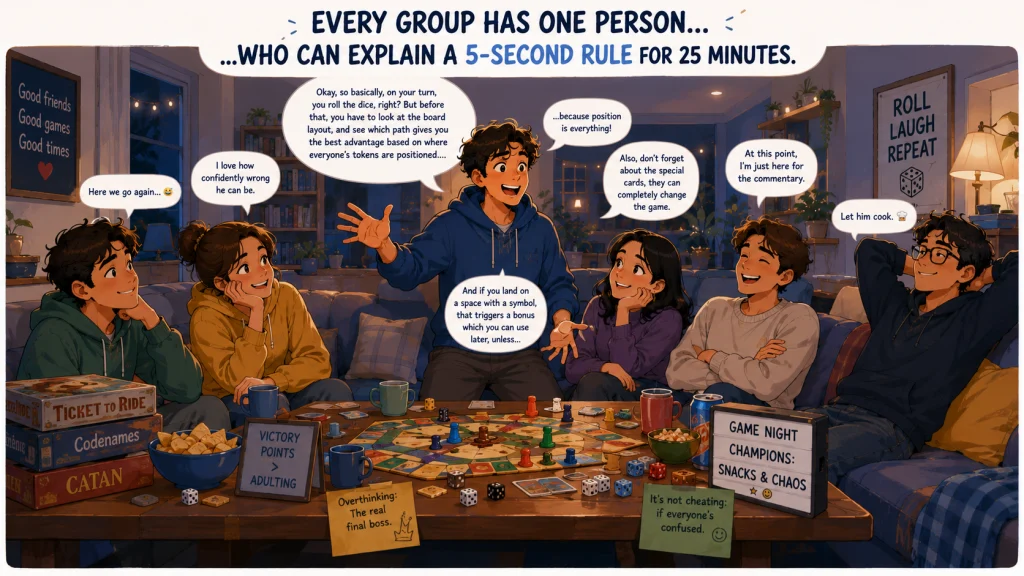
Among friends, the room can usually handle a sharper line, and sometimes the funniest move is just making the over-explaining visible to everyone else at the table. Witty comebacks for know it alls in this setting work best when they let the group see the pattern instead of arguing the actual fact.
- “Did the group ask, or did you just have a fact loaded?”
- “Someone start the clock on how long this explanation takes.”
- “We’re all very impressed, truly.”
- “Is this going to be a TED talk or can I finish my sentence?”
- “I love that you have a citation ready for literally anything.”
- “Can we get back to the part where nobody asked?”
- “You should really host trivia night.”
- “This explanation has a runtime now.”
- “Noted, archived, moving forward.”
- “I’m sure Wikipedia is very proud of you.”
There was a friend of mine who used “Is this going to be a TED talk or can I finish my sentence?” on someone mid-correction at a dinner table, and the whole group laughed before the guy even had a chance to respond. He laughed too, eventually. The line worked because it called out the behavior, not the person, and there is a real difference between the two.
Sarcastic One-Liners for When You’re Out of Patience
Some moments do not call for a deflector or a work-safe pivot. They call for something dry enough that it ends the explanation on impact. These are the ones I save for when the correction is small, the stakes are low, and the only goal is making the moment a little funnier than it deserved to be.
- “Groundbreaking. Truly.”
- “I’ll alert the media.”
- “What would I do without you.”
- “Incredible. A whole minute on that.”
- “You should write a book nobody asked for.”
- “I’m changing my entire worldview right now.”
- “Stop the presses.”
- “I genuinely could not have survived without that detail.”
- “Truly a defining moment for both of us.”
- “Wow. Anyway.”
The trick with this kind of line is delivery, not content. Said flat, “Groundbreaking. Truly.” reads as dry humor. Said with too much edge, it reads as an attack. The words barely change between the two. The tone does all the work.
When It Stops Being a One-Time Thing
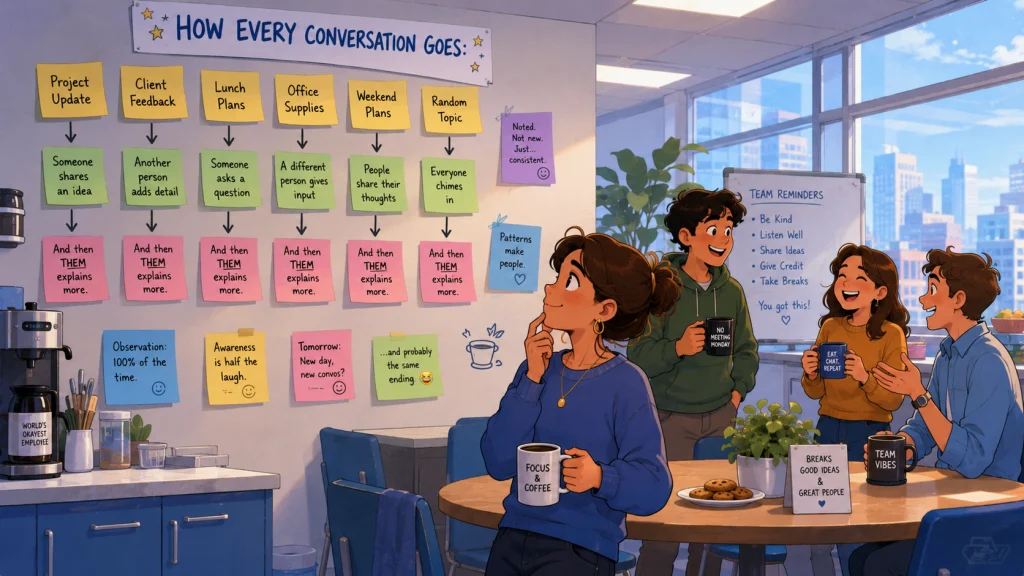
A single correction is a moment. A pattern is something else. If the same person interrupts every conversation to fix a detail or add unsolicited context, the lighter lines stop being enough, and the reply needs to address the habit directly without turning into a confrontation about their character.
- “You correct people a lot, you know that?”
- “I notice you do this in basically every conversation.”
- “You don’t have to fact-check everything I say.”
- “Sometimes I just want to finish a sentence.”
- “I’m not always looking for a correction, just so you know.”
- “This happens a lot. I’m just saying.”
- “You can let things go sometimes.”
- “Not everything needs your input.”
- “I’d love to finish a thought uninterrupted one of these days.”
- “You really do this every time, huh.”
Someone who interrupts mid-sentence to correct you and someone who corrects you constantly across an entire relationship are technically the same behavior at different volumes, and the lines for handling someone who never lets you finish a sentence in real time live in the comebacks for people who interrupt you if that is the sharper version of this problem you are actually dealing with.

Exit Lines That End the Debate Without Handing Out a Trophy
The hardest instinct to override here is the urge to have the last word. Know it alls thrive on the last word, on being the one who got the final fact in before the conversation moved on. The strongest exit lines do not argue the point at all. They just close the door on the conversation continuing.
- “Sure, you win.”
- “I’m not doing this anymore today.”
- “Great, glad that’s settled.”
- “I’m good, you can have this one.”
- “Anyway.”
- “I’m going to go ahead and not engage with that.”
- “We can agree to disagree.”
- “I’m done debating facts nobody is being graded on.”
- “I’ll let you have the last word.”
- “This conversation has officially ended for me.”
“I’ll let you have the last word” sounds like a concession. It is actually the opposite. Handing someone the last word on purpose removes the entire prize they were chasing, because the satisfaction only works if it was taken, not given. I have used that line more than once and watched the energy drain out of the moment almost immediately.
What Not to Say, and Why It Backfires
The temptation with a know it all is to attack the thing they are most proud of, their intelligence. It feels satisfying for about ten seconds. After that, the conversation usually becomes about whether you are smart enough to be making fun of them, and that is a fight you did not need to start.
| What people reach for | Why it backfires |
|---|---|
| “You don’t actually know what you’re talking about.” | Starts a fact war you now have to win publicly, even if you were right to begin with. |
| “Nobody cares how smart you think you are.” | Reads as insecure rather than composed. It hands them the higher ground. |
| Trying to one-up them with a bigger fact | Turns a small annoyance into a trivia contest that benefits the person who started it. |
| “Did anyone ask you?” | True, but it tends to humiliate rather than redirect, and humiliation invites a bigger reaction. |
| Going silent and seething | Solves nothing and the same correction shows up again next week. |
Comebacks for know it alls work best when they target the behavior, the constant need to correct, rather than the person’s actual intelligence. A line like “Cool fact. Anyway.” does more work than an insult ever could, because it dismisses the correction without dismissing the person. That distinction matters more than it might seem in the moment, and it is the same distinction that separates a genuinely sharp savage comeback from one that just sounds mean.
If the correction crosses into something that actually feels condescending, like someone explaining your own job back to you in a tone that talks down rather than adds on, that is a slightly different problem than simple over-explaining, and the angle shifts toward handling someone who is being outright rude rather than just thorough. The line between the two is usually about tone, not content.
Final Thoughts: You Do Not Need the Last Fact
A know it all is chasing a feeling, the sense of being the one who knew, the one who caught the detail, the one who had the answer ready. None of the lines here are built to take that feeling away through force. They are built to make it not worth chasing in your direction anymore.
The reader who handles this best is rarely the one with the sharpest comeback. It is the one who can let “Sure, you win” leave their mouth without it costing them anything, because they already know the difference between being right and needing to prove it. Sixty-five lines is a lot to choose from. Pick the one that matches the room you are actually standing in.
FAQs
🎓 What do you say to someone who always corrects you?
Keep it short and dry. “Noted for the record” or “Cool fact. Anyway” hands the moment back to you without starting an argument about who is actually right.
💼 How do you shut down a know it all at work without sounding rude?
Stick to neutral, professional phrasing. “Got it, thanks for clarifying” or “I think we’re aligned” closes the lecture without anything that could read as insubordinate in a meeting recap.
😏 What’s a funny comeback for someone who always has to be right?
“Is this going to be a TED talk or can I finish my sentence?” tends to land well in a group setting because it points out the pattern instead of arguing the fact itself.
🤝 Should I just let a know it all have the last word?
Often, yes. Handing them the last word on purpose removes the satisfaction of taking it. “I’ll let you have the last word” usually ends the exchange faster than continuing to argue.
🚫 Why does attacking someone’s intelligence usually backfire?
It shifts the conversation into a fact war about who is smarter, which rarely ends in your favor and makes you look just as invested in winning as they are.