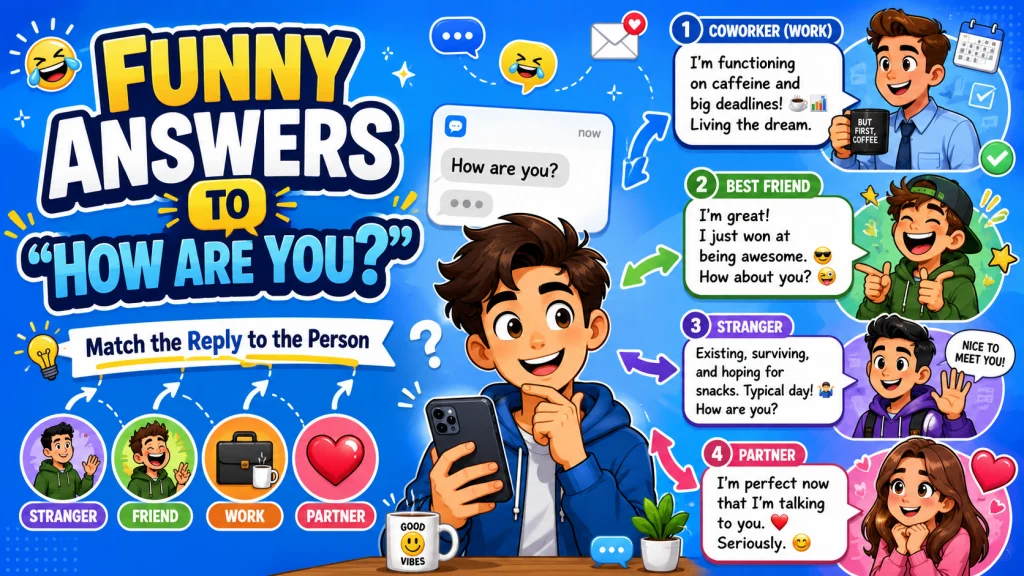
Someone asks how you are, and your brain goes blank exactly when you wanted to sound interesting. This breaks down funny answers to “How are you?” based on who’s actually asking, because the line that works on a close friend falls flat on a coworker, and the one that’s safe for a coworker reads as cold to someone who actually wants to hear from you. You will walk away with eighty options sorted by relationship, plus a sense of which lines invite more conversation and which ones quietly end it.
Why Your Brain Goes Blank on Command
I have watched this happen at the bar more times than I can count. Someone gets asked how they are, has plenty to say about their day if you caught them five minutes earlier in private, and then freezes the second it becomes a performance. Coming up with a funny answer to “How are you?” is not actually the hard part. The problem is that being funny on demand feels different from being funny by accident, and most people’s brains treat the two completely differently.
The fix isn’t a bigger stockpile of clever lines. It’s knowing who is asking and what they actually want back. A stranger making small talk wants something light that does not require follow-up. A close friend wants something that sounds like you, even if it is a little much. Sort the line by the relationship first, and the right answer gets a lot easier to land on without overthinking it.
Strangers and Acquaintances: Light, Quick, No Follow-Up Required
This is the category where most people overcorrect. Someone you barely know asks how you are, and there is a temptation to either go fully flat with “fine, thanks” or to swing too hard the other way with a joke that demands a reaction they were not prepared to give. Neither one lands well. What works here is something quick enough that it does not slow down whatever exchange you were already having, whether you are in a checkout line, an elevator, or making small talk before a meeting starts.
I have a soft spot for the ones that are funny without asking anything of the other person. They get to laugh or not, and the moment moves on either way. That low pressure is exactly the point with someone you do not know well enough to drag into a real conversation.
None of those need a comeback to land, which is the entire job when the person asking is not going to remember this exchange in an hour anyway.
Friends: Honest, A Little Chaotic, Built to Be Reused
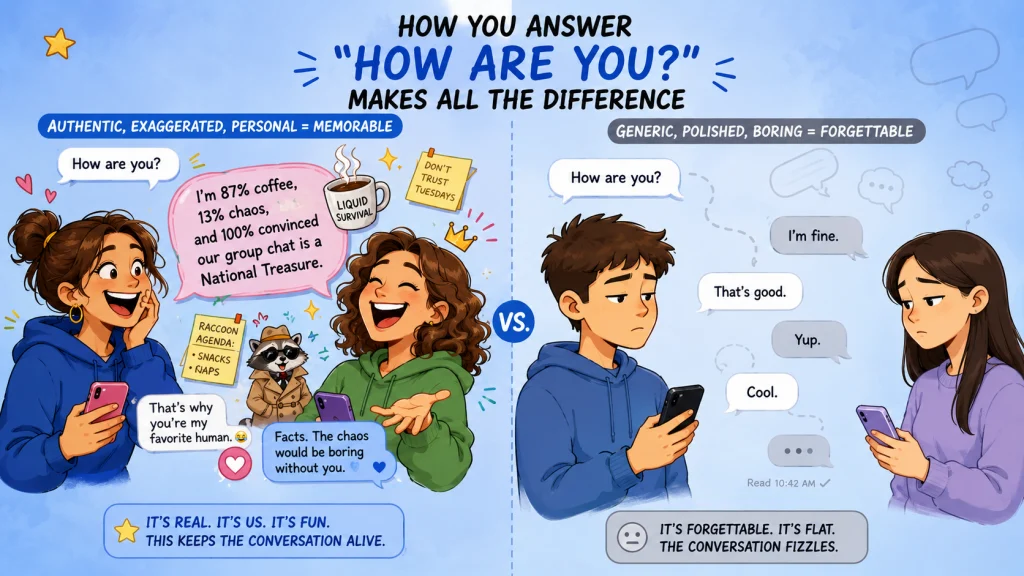
With friends, the rules flip. The funniest version of “How are you?” is usually the one that is actually true, just exaggerated enough to be funny. A friend asking does not want polish, they want something that sounds exactly like you on a normal day, the kind of line that gets reused so often it becomes a bit between you two.
I had a regular at the bar who texted the same dramatic line to her group chat every time someone asked how she was during finals season, “currently dissolving, will report back if anything survives,” and it became a running joke that outlasted the actual finals by years. That is the texture friend replies should have. A little unhinged, a little self-aware, and specific enough to your actual life that it could not have come from a list. 😅
The point isn’t the exact words, it’s the freedom to be a little much. Friends are the one audience where that almost always plays better than playing it safe.
Work-Safe Replies: Funny Without Sounding Burned Out
Work check-ins need their own category because the line between funny and concerning gets thin fast in a professional setting. A coworker or manager asking how you are does not want to hear something that sounds like you are one bad day from quitting on the spot, even as a joke, because that kind of line tends to get taken more literally than you meant it.
The best work-safe answers are funny about small, low-stakes things, the coffee machine, the meeting that ran long, the inbox that will not stop refilling. They keep the tone light without accidentally signaling that you are actually struggling, which matters more than people think in a setting where jokes get repeated to other people later.
If your workplace runs a little more relaxed, these can flex slightly funnier, but the safest version always keeps the joke pointed at something external, never at your actual state of mind.
Close People: Dramatic, Affectionate, A Little Extra
A partner, a best friend, family you are genuinely close with, this is the group that can handle the most theatrical version of an answer. There is room here for something dramatic that still reads as affectionate, because the closeness is exactly what makes the exaggeration funny instead of confusing.
What separates this category from the friend replies above is the warmth underneath the bit. The joke can be bigger, but it should still feel like it is coming from someone who actually wants to be talking to this person, not just performing for a crowd.
“I missed you more than I missed my phone charger this morning, and that’s saying something.”
These lines work because the person on the other end already knows you well enough to read the affection underneath the exaggeration. That is why these belong in close relationships, not casual exchanges.
Conversation-Extending Replies: Answer Plus a Hook Back
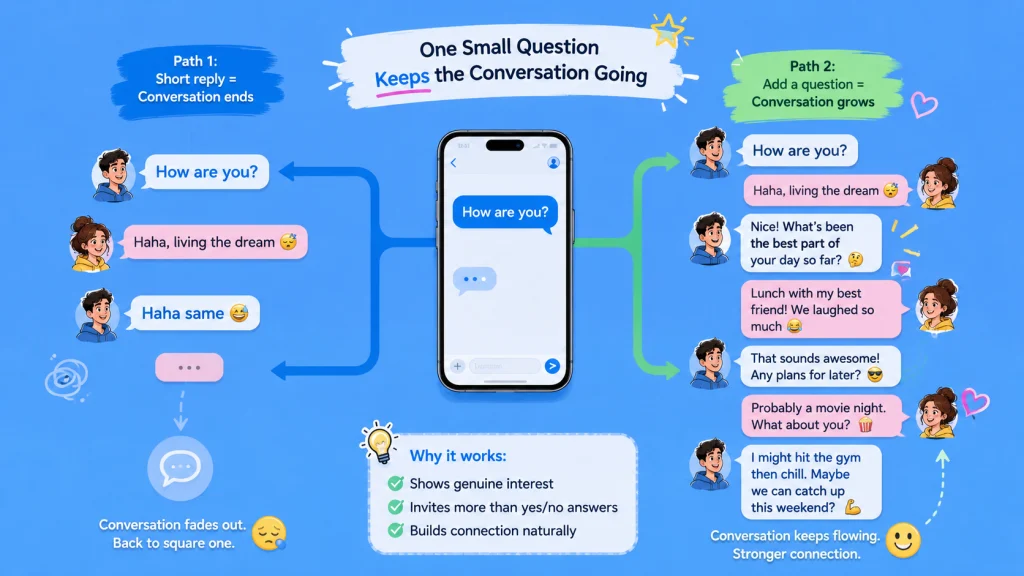
Sometimes the goal isn’t just a funny answer, it’s keeping the conversation alive without it feeling like work. The trick is pairing a short funny line with a return question that gives the other person something specific to respond to, instead of the generic “you?” that ends up feeling like an afterthought.
This matters most when you actually want the exchange to keep going, an early conversation with someone you are interested in, a friend you have not talked to in a while, anyone where the silence after your answer would feel like a missed opportunity rather than a natural pause.
Each of those does double duty. The joke lands first, and the question right after makes it easy for the other person to keep talking instead of having to come up with their own opener from scratch.
What Not to Say: The Jokes That Make the Asker Regret Checking In
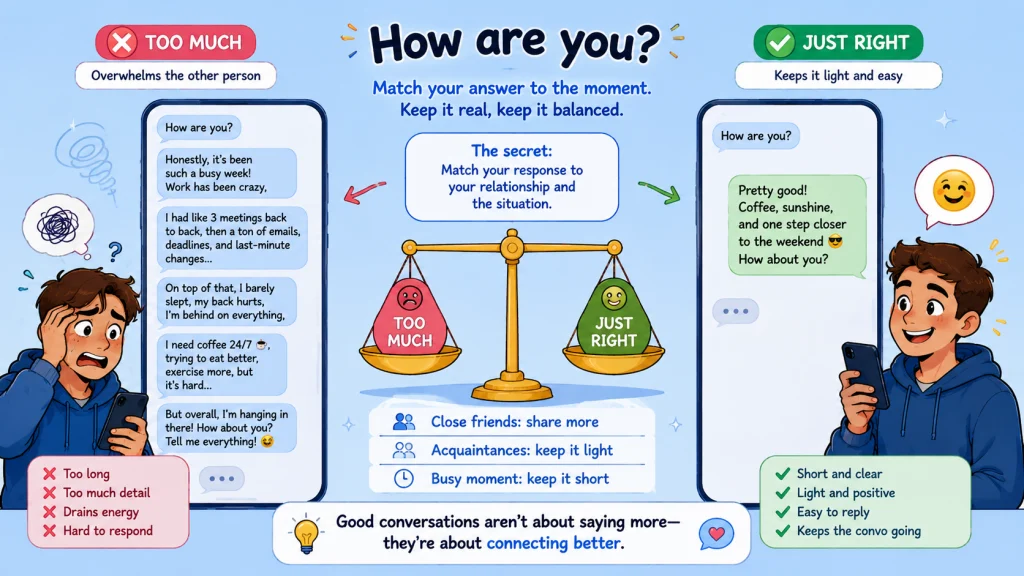
There is a specific failure mode I have seen play out enough times to call it a pattern. Someone reaches for a dark joke about their mental state, exhaustion, or general will to function, expecting it to read as relatable humor, and instead it lands as a genuine red flag the other person now has to decide whether to address. That is not the reaction you were going for, and it puts the asker in an awkward spot they did not sign up for.
The other common miss is going too long. A funny answer that turns into a three-sentence monologue stops being a quick exchange and starts feeling like the other person opened a door they now have to stand in for longer than planned. Humor works best here when it is short enough to land and move on, not when it turns a casual check-in into a whole production.
| Who’s asking | Tone to aim for | Tone to avoid |
|---|---|---|
| Stranger or acquaintance | Light, quick, no follow-up needed | Anything too personal or too dark |
| Friend | Honest, exaggerated, a little chaotic | So polished it doesn’t sound like you |
| Coworker or manager | Funny about small external things | Jokes that sound genuinely burned out |
| Partner or close family | Dramatic but clearly affectionate | Sarcasm with no warmth underneath |
| Someone you want to keep talking to | Short joke plus a specific return question | A vague “you?” that ends the momentum |
Reading the table back, the common thread is restraint. The funniest version of this answer is almost never the most extreme one, it’s the one sized correctly for who is actually standing in front of you.
Final Thoughts: Pick the Person Before You Pick the Joke
None of this requires memorizing a script. Once you get used to sorting by relationship before you reach for a line, the right tone starts coming faster, because you are no longer trying to find one funny answer that works for everyone, you are just matching what you already know about the person in front of you.
If the version of this question you got was more about a dead-end “I’m fine” you are tired of typing, the dedicated breakdown of what to say instead of I’m fine covers that specific itch better than a generic mood answer would. And if you are not sure which type of check-in actually landed in your texts, the full breakdown sorted by what each version is really asking sits at funny things to say when someone asks how you are. For lighter replies beyond just this one question, the wider collection lives at funny replies.
FAQs
💬 What’s a good funny answer to “How are you?”
It depends on who’s asking. For a coworker, keep it light and external, like joking about coffee or a slow inbox. For a friend, something honest and a little exaggerated lands better.
😅 How do I answer “How are you?” without sounding fake?
Skip the flat “I’m fine” and exaggerate something that’s actually true. A line that’s funny because it’s real beats a generic joke every time.
💼 What’s a funny but professional way to answer “How are you?” at work?
Joke about something external and low-stakes, like the inbox or a slow morning. Avoid anything that sounds like you’re genuinely struggling, even as a joke.
🔥 Can I be too funny when someone asks how I am?
Yes. Dark jokes about your mental state or a long-winded answer can make the other person regret asking. Keep it short and match the relationship.
🔁 How do I keep the conversation going after a funny answer?
Pair your joke with a specific question back, not a generic “you?” Give the other person something exact to respond to.