“I’m tired” is one of those texts that can mean almost anything. It can be a simple complaint, a soft request to be seen, or the most understated signal that someone has had a genuinely rough time and does not know how else to say it. The right response is usually funny enough to lighten the weight without being so clever it sounds like you missed the point. These 65 replies are sorted by situation and by how much warmth the moment actually needs, so you can find the one that fits without accidentally making a tired person feel worse.

“I’m Tired” Lands in About a Dozen Different Ways
Knowing what to say when someone says they’re tired is harder than it sounds because the text is doing at least three different things depending on who sent it. From a friend mid-week it is usually an invitation to commiserate. From a partner at the end of a long day it is closer to a request to be taken care of, even if just a little. From someone who sends it every single day it has become a check-in, a greeting, a habit. None of those situations want exactly the same reply, and treating them the same is where most responses go flat.
The risk is not usually saying the wrong word. It is missing the register entirely. A joke that reads as dismissive to someone who is genuinely depleted is not a funny reply, it is a reason for them to put the phone down and feel slightly more alone than before. I have watched this happen in real time at the bar more than once, someone venting tiredness and the person across from them launching into a bit instead of a beat of recognition first. The bit gets a polite smile and then the conversation dies. The recognition keeps it going.
What works here is humor that acknowledges before it deflects. Funny as solidarity, not funny as redirection. That is the gap between a reply that lands and one that just sits there. For a broader range of situations where tone is doing all the work, the collection of funny and witty replies across everyday texts covers a lot of the same territory. Here, it is just “I’m tired,” and what to do with it.

When Acknowledging It First Is the Right Call
Sometimes the moment calls for warmth before anything else. Not therapy, not a plan, just a line that says: I hear you, that makes sense, and I am not about to pile on. These replies do that. They are not heavy, but they have enough softness in them to land before the slight wit kicks in. The pattern is the same across all eight: acknowledge first, joke second, and only barely.
These work best when you genuinely do not know what is behind the text. “I’m tired” from someone you have not talked to in a few days could be anything. Leading with acknowledgment is the safer move, and it also tends to feel better to receive than a punchline fired back with no pause.
- “I know. You’re doing an impressive job of staying upright.”
- “Valid. Tired is the human default setting and no one warned us.”
- “I hear you. The body is a scam and I stand by that.”
- “That’s fair. Existing is genuinely exhausting and I think we undercount it.”
- “You are allowed to be tired. The world will wait five minutes.”
- “Acknowledged. Please hydrate and sit down if that’s an option.”
- “I believe you. Rest when you can. I’m here in the meantime.”
- “That tracks. You’ve been doing a lot. Being tired makes complete sense.”
“You are allowed to be tired” is the one I reach for when someone seems like they might be waiting for permission to stop pushing through. It sounds simple. It tends to hit harder than expected because most tired people are also quietly judging themselves for it.
Friend Replies: Shared Exhaustion and Dramatic Solidarity
Friends who text “I’m tired” are almost always inviting you to be tired too. The best reply is usually some version of “same, and here is how dramatic I am prepared to be about it.” Solidarity is the whole move. Not sympathy from a distance, just two people in a trench confirming that yes, this is hard, and no, neither of them is handling it particularly gracefully.
One thing that tends to go wrong with friends is over-performing the joke. There is a version of the funny reply that turns “I’m tired” into a bit, and the bit is clearly more about being funny than about the person who is tired. That reads as an exit from the conversation rather than an entry into it. The lines below are funny but they stay inside the shared experience instead of spinning off from it.
- “Same. I am running on four hours of sleep and the memory of coffee.”
- “We are tired together. This is our bond now.”
- “I’m tired too. Should we just cancel everything and lie on the floor?”
- “Bold of you to be tired when I am also tired. Solidarity.”
- “Tired? I haven’t slept properly since before it became a talking point.”
- “You and me both. Let’s not make any decisions today.”
- “The correct response to that is ‘same’ and then a long silence.”
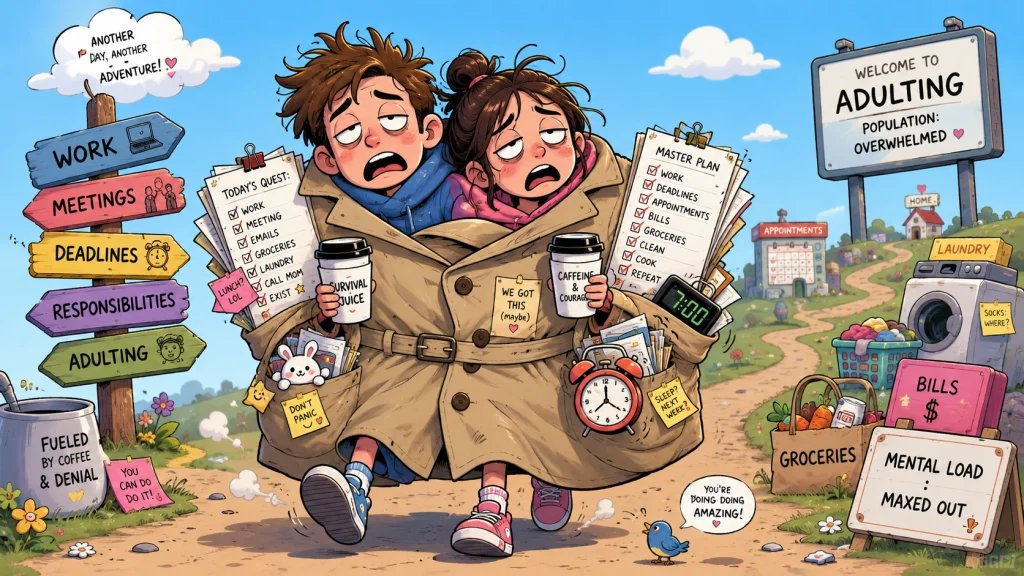
- “Two tired people in a trench coat pretending to be functional adults.”
- “I was going to say ‘same’ but I think you’ve got me beat, so you win this round.”
- “Exhausted solidarity. Come over. We won’t do anything.”
- “We are both tired and yet we continue. That is either inspiring or a problem.”
- “I feel that. Let’s be tired together and blame it on the time of year.”
- “I’m tired just reading that. Let’s cancel our personalities for the rest of the day.”
- “Tired? What if we just stopped being so responsible. Hypothetically.”
- “You’ve been tired for three weeks. At this point it’s a personality trait and I love it.”
“Come over. We won’t do anything” is the one I have seen actually work as an invitation. It removes the pressure of showing up and performing and just offers presence. Tired people tend to respond to that more than they respond to plans.
Partner Replies: Caring Without the Unsolicited Lecture
Partner replies need the most care of any category here. “I’m tired” from a partner is usually not a request for advice, a sleep hygiene lecture, or a list of things they could do differently. It is almost always a request to feel seen and, when possible, taken care of for a minute. The funny version of that is not a deflection. It is warmth with a little lightness in it, which is a different thing.
The version that backfires most reliably is the one that turns care into a task list. “Have you eaten? Did you drink water? You should go to bed earlier.” All of that is probably true and none of it is what the person needed right now. These twelve stay on the side of soft and useful without turning into an intervention.
- “Tell me everything. I’m listening.”
- “Come here. I’ll handle whatever you were about to do.”
- “You’ve been going nonstop. Being tired is the only reasonable response.”
- “I know. I’ll sort dinner. You sit somewhere comfortable.”
- “That’s your body asking you to stop. I’m backing your body on this one.”
- “Rest. I’ve got you.”
- “You’re allowed to be tired. I also made tea, if that helps.”
- “Come be tired next to me. It’s easier here.”
- “I noticed. You’ve been running hard. Can I take anything off your plate tonight?”
- “That’s fair. Let’s make tonight boring in the best way.”
- “Tired makes sense. You have been carrying a lot.”
- “I’ll take the next thing on the list. Go sit somewhere soft.”
“Come be tired next to me” is quiet in the right way. It does not fix anything, which is correct, because “I’m tired” usually does not want fixing. It wants company. That distinction matters more than most people think when they are composing a reply.
When It’s Work Tired: Caffeine, Meetings, and Survival
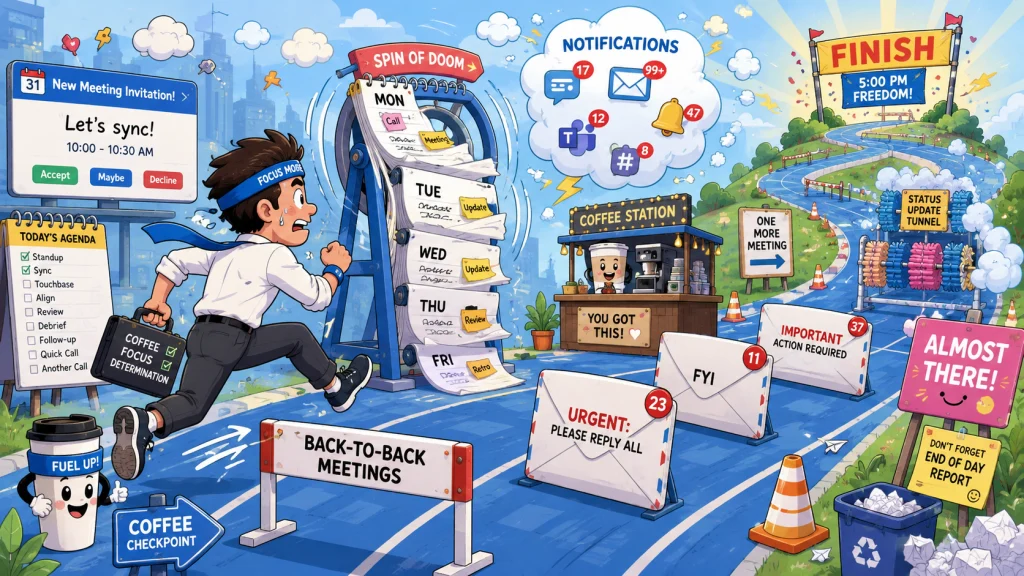
Work tired is its own category and it deserves its own set of replies. There is a particular texture to the exhaustion that comes from back-to-back calls, inboxes that never get to zero, and the specific kind of brain drain that happens when you have been performing competence for eight hours straight. These replies name that without overdoing it. They are funny in the way that work humor tends to be funny, which is mostly recognition with a little absurdity around the edges.
“I’m tired” after a long workday is often the last sentence before the conversation turns into something more comfortable, which is why the clever responses to “how was your day” tend to pick up where this one leaves off. But for the opener itself, these land well.
- “The meeting that could have been an email has claimed another victim.”
- “Valid. We were not built for eight hours of this and no one will say it out loud.”
- “Tired is just how Tuesday feels now. It’s not personal.”
- “I’m impressed you made it this far without declaring an emergency.”
- “Survived another one. Tired is the correct response to that.”
- “You need water, a snack, and to be literally anywhere else. In that order.”
- “The human body was not designed for back-to-back meetings and I think about that often.”
- “Tired at work just means you’re paying attention. That should count as a skill.”
- “I also have not blinked since 10 AM. We’re in this together.”
- “We’re halfway through the week. The finish line exists. Allegedly.”
- “That is the appropriate response to doing this job on a Tuesday.”
- “Tired makes sense. You’ve been holding things together all day and it shows.”
“The meeting that could have been an email has claimed another victim” is the one that tends to get the laugh. It names the specific absurdity instead of just agreeing with the feeling, which is what good work humor usually does. It says: I see exactly what kind of tired this is and I also find it ridiculous.
Quick Textable Lines for When You’re Tired Too
Short replies get underestimated in conversations about tone and empathy, but they are often exactly right. When someone sends “I’m tired” and you are also tired, or mid-something, or you just want to acknowledge it without starting a thread, the short version is not a cop-out. It is a well-timed signal that you heard them. The key is that it still needs to feel like a person sent it, not an auto-reply.
These ten work best in established relationships where a little goes a long way. If you want more options across this kind of quick-response territory, the range of funny text replies for everyday moments covers a lot of the same ground. For “I’m tired” specifically, any of these hold their own.
- “Same.”
- “Valid.”
- “Noted. Rest.”
- “I know. You’re doing great.”
- “Makes sense. You’ve been doing a lot lately.”
- “Oof. Go lie down somewhere.”
- “Heard. Let’s both stop trying so hard today.”
- “The feeling is mutual and it has been for weeks.”
- “I see it. Get some rest when you can.”
- “You’ve earned it.”
“You’ve earned it” is the quietest one in the list and sometimes the most useful. It does not ask anything of the person, does not add weight, and does not try to be funny. It just confirms: yes, the tired is justified. For certain kinds of exhaustion that is the only thing that actually lands.
When “I’m Tired” Is Just How They Say Hello Now
Some people send “I’m tired” so often it has become their default opener. The tiredness is real, probably, but the text has turned into a ritual. A check-in. A low-stakes way of saying “I’m still here and things are still a lot.” Teasing that pattern can work beautifully if the relationship has the history for it, and it can also go badly wrong if it reads as dismissal. The difference is usually warmth. These eight stay on the right side of that line.
None of these should be sent to someone who is clearly in a rough patch. They are for the friend who says “I’m tired” every Tuesday and then goes and does twelve more things, or the person whose tired-texts have become so consistent that acknowledging the pattern is itself a form of affection. This is also different territory from the funny replies to “I’m bored”, where the person is usually looking for distraction. Chronic tired texts are not boredom. They are usually someone who needs to slow down and has not figured out how.
- “I know. You say this every Tuesday and then somehow power through anyway. You’re a mystery.”
- “Every single day. And yet here you are, still answering texts. Impressive.”
- “At this point ‘I’m tired’ is just how you say hello and I respect that deeply.”
- “I have logged this complaint. It will be added to the ongoing record.”
- “You’ve been tired for so long you might just be a tired person now. That’s okay. I still like you.”
- “The notification I get most from you is ‘I’m tired.’ You are nothing if not consistent.”
- “I’ve started assuming tired is your resting state and you’re just checking in to confirm.”
- “You say that and then you do twelve more things. I have stopped worrying and started admiring.”
“At this point ‘I’m tired’ is just how you say hello and I respect that deeply” is the one that tends to get the best response, because it names the pattern without judging it and it still carries warmth. The person feels known rather than called out. That is the exact line you are trying to walk.
What Not to Say When Someone Says They’re Tired
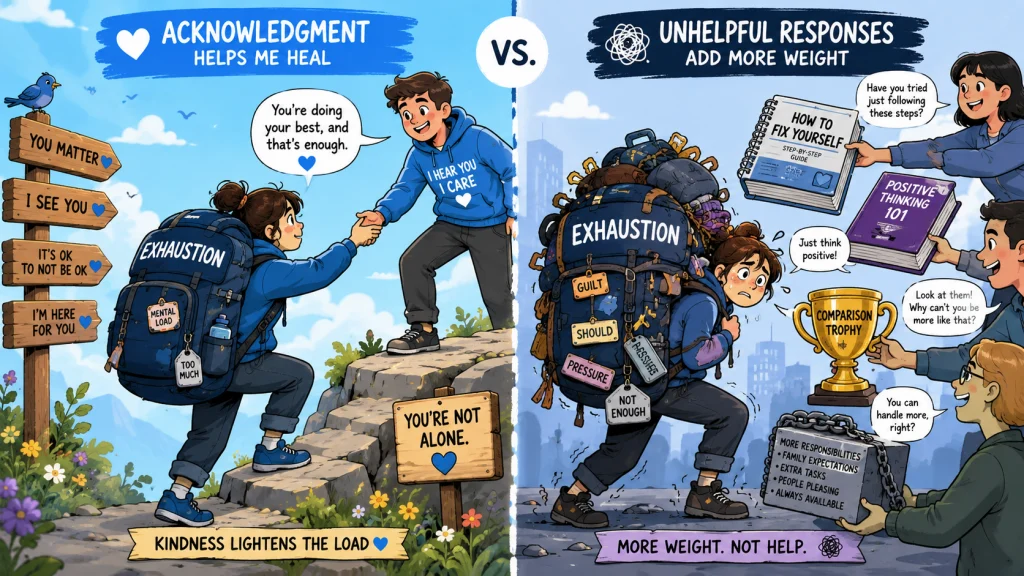
The most common mistakes here are not mean-spirited. They are well-intentioned replies that land wrong because they prioritize the wrong thing: being funny over being present, or offering advice the person never asked for, or doing the competitive tiredness thing where you accidentally make it about yourself. These are all avoidable once you can see the pattern.
The table below covers the main categories. These are not obscure edge cases. They are the things people reach for instinctively and then sometimes realize, a beat too late, did not quite land.
| What you might send | Why it tends to miss |
|---|---|
| “I’m more tired than you, trust me.” | Competitive tiredness turns their moment into a comparison. They feel unheard and slightly worse than before they texted. |
| “You should go to bed earlier.” / “Have you tried melatonin?” | Unsolicited advice reads as dismissal. They did not ask for a fix. They wanted to be acknowledged. |
| “Lol same” with nothing else. | The “same” is fine. The nothing else is the problem. It mirrors the text without actually engaging with it. |
| A joke with no warmth in it. | Humor that skips straight to the punchline can read as deflection. If the joke is the whole response, it usually lands as indifference. |
| “That’s because you work too hard.” / “You need to slow down.” | Sounds like a compliment but arrives as a critique. The tired person is now also being told they caused this. |
| “Just push through, you’ve got this.” | Motivational framing is rarely what a tired person needs. It can feel like pressure disguised as encouragement. |
The competitive tiredness one is worth holding onto because it is the easiest trap to fall into with close friends. You mean to commiserate and you accidentally turn it into a one-upmanship that neither of you wanted. “I’m more tired than you” is never the move, even as a joke, unless the relationship is so established that you can both laugh at the absurdity of the comparison. Even then, lead with their tiredness first.
Final Thoughts: The Reply That Does Not Add to the Weight
The goal with any “I’m tired” reply is not to fix the tiredness or to turn it into a bit. It is to make the person feel like they did the right thing by sending it. That is a lower bar than most people aim for, which is probably why so many replies miss. They try to be too useful, or too funny, or too something, when the moment just needed a quick signal that you were there.
A small note: if someone’s “I’m tired” feels like it might be carrying more weight than usual, or if there is something underneath it that goes beyond a long day, that is a different conversation entirely. This list is for the everyday exhaustion, not for someone signaling that they are not okay. Those two things can sound similar, and reading the difference correctly matters more than any line in this list.
FAQs
💬 What do you say when someone texts “I’m tired”?
Match how much warmth the moment needs before you go for funny. A quick “Valid. You’ve been doing a lot” lands better than a punchline that has no acknowledgment behind it. Acknowledge first, joke second, and only if the relationship has the room for it.
😄 Can you be funny when someone says they’re tired without seeming dismissive?
Yes, as long as the humor is solidarity rather than deflection. “We are both tired and yet we continue” keeps you in the moment with them. A joke that skips past the feeling and goes straight to the bit tends to read as indifference, even when that is not what you meant.
📱 What’s a good short reply to “I’m tired”?
“Valid.” and “I know. You’ve earned it.” both work well for short. They acknowledge without adding anything heavy. The mistake with short replies is usually sending something so minimal it reads as disinterest. One warm word is fine. Zero words in a reaction sticker is usually not.
❤️ What do you say to your partner when they say they’re tired?
Skip the advice and offer something concrete instead. “I’ll sort dinner, you sit” says more than any amount of “you should rest more.” Tired partners almost never need a plan. They need to feel like someone has them for a minute.
🚫 What should you avoid saying when someone is tired?
Avoid competitive tiredness, unsolicited sleep advice, and jokes with no warmth behind them. “I’m more tired than you” and “have you tried melatonin?” are both guaranteed to make the person regret texting. The reply that does the least harm acknowledges first and jokes second, if at all.
🔁 What do you say to someone who always texts “I’m tired”?
Tease the pattern with warmth, not judgment. “At this point this is just how you say hello and I respect it” names the habit without making them feel bad about it. The goal is to feel known, not called out. Keep the affection visible and the joke light.