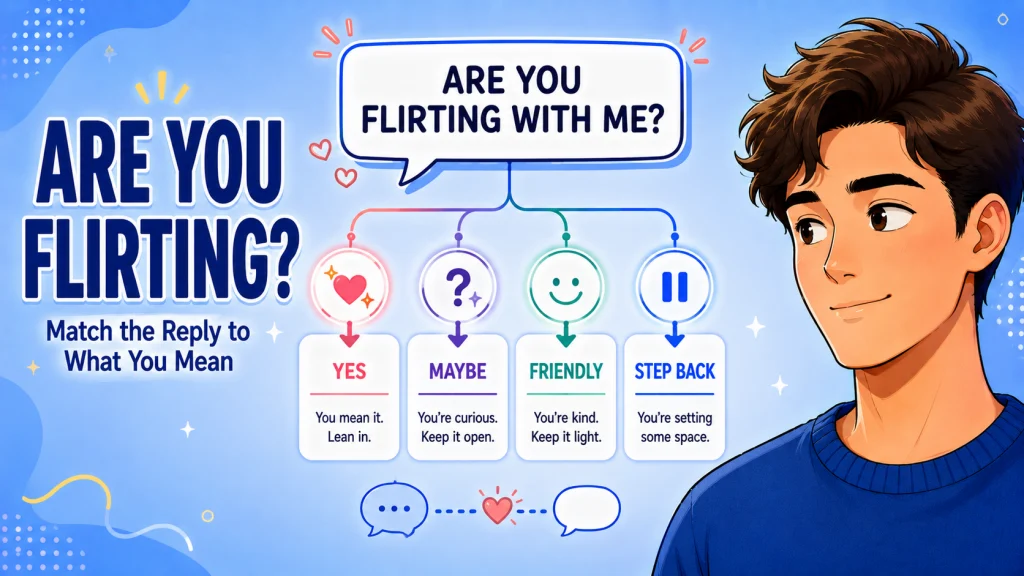
When someone asks, “Are you flirting with me?” the easiest way to make the moment awkward is to answer with more confidence than you actually feel. A good reply should match what you mean: yes if you mean yes, playful maybe if you are still testing the room, a friendly reset if you were not flirting, or a clear pullback if the question sounds uncomfortable. The line matters, but the space you leave after it matters just as much. You are not trying to win the exchange, you are giving the other person something honest enough to respond to.
What changes when the subtext becomes the actual question
When “Are you flirting with me?” lands, the subtext gets dragged into daylight. The best flirty responses to “are you flirting with me?” start with one decision: what did you actually mean? I have watched people handle playful tension just fine until someone names it, then suddenly they explain, backpedal, and turn one light moment into a speech. The shorter answer usually works better because it gives the other person room to show you how they feel about what just became explicit.
There is another reason not to rush into the boldest comeback: the question itself does not prove interest. It can sound teasing, curious, surprised, cautious, or genuinely uncomfortable depending on the room and the relationship. That is why the broader set of playful flirty comebacks only works when the playfulness is actually shared. Your best move here is not to decode the other person from one sentence, it is to give a reply that stays true even if you guessed their tone wrong.
| What you mean | Best reply direction | Short dialogue | What it leaves open |
|---|---|---|---|
| You were flirting | Give a short, confident yes | Them: “Are you flirting with me?” You: “Yeah, a little.” Them: “I thought so.” | They can welcome it or slow it down |
| You might be flirting | Use a playful maybe or question back | Them: “Are you flirting with me?” You: “Maybe. What gave me away?” Them: “That was not exactly subtle.” | They can meet you halfway without pressure |
| You were only being friendly | Reset gently and plainly | Them: “Are you flirting with me?” You: “No, I was just being friendly.” Them: “Got it. I wanted to check.” | No false promise, no unnecessary embarrassment |
| They sound uncomfortable | Pull back and acknowledge it | Them: “Are you flirting with me?” You: “I was, but I can back off.” Them: “I would rather keep this friendly.” | The conversation can return to neutral ground |
This sounds obvious, but in the moment people often answer the version of the question they hoped they heard. Someone who wants the flirting to be mutual hears an invitation, while someone embarrassed about being caught hears an accusation. I would rather use a line that survives either interpretation than one that only works if the room is already on my side. That is the whole advantage of choosing your lane before choosing your wording.
Quick flirty yes replies
If you know you were flirting and you are comfortable owning it, a direct yes is cleaner than pretending you got caught doing something mysterious. The confidence comes from not making the other person drag the truth out of you. Your reply can stay flirty without becoming elaborate: admit it, then let the next beat belong to them. You do not need to turn the admission into a dare, a challenge, or a promise that the flirting will keep escalating.
- “Yeah, a little.”
- “I was hoping you noticed.”
- “Yes. I can stop pretending otherwise.”
- “Caught me.”
- “A little more obviously than I planned, apparently.”
The strongest lines here are the ones you could still stand behind if the other person answered, “I thought so,” and nothing more. Regulars used to hold up their phones behind the bar and ask me what to say back, and this was one of those questions that made people add too much after a perfectly good first sentence. That extra sentence is often where playful turns into pressure. Say the honest thing, stop, and see whether they move toward the moment or away from it.

Playfully evasive replies when you want them to meet you halfway
Sometimes you are flirting, but not enough to want a full confession in the middle of the conversation. That is where a light question back can help, as long as it does not make the other person do all the emotional work. The trick is to be evasive without becoming slippery. You want to leave room for mutual play, not force them to prove interest before you admit any of your own.
- “Depends. Are you complaining?”
- “Maybe. What gave me away?”
- “I thought we were both being subtle.”
- “I might be. You seem very observant.”
- “Should I be?”
These replies work best when there is already an easy back and forth, not when the other person sounds tense or confused. When you want to keep the tension without overplaying it, think of the question back as an invitation, not a trap. “Should I be?” gives them a clean opening to encourage you, laugh it off, or change direction. That is much better than a line that makes them feel they have to declare attraction just to keep the conversation moving.
Honest maybe replies when you are figuring it out too
Not every flirt starts as a deliberate plan. You can be enjoying someone, getting a little more playful than usual, and still not have a neat answer ready when they call it flirting. In that case, “maybe” is not weak if it is genuinely where you are. It is only frustrating when you use uncertainty as a way to keep someone chasing an answer you already know.
- “Maybe a little. I am figuring that out too.”
- “I did not start out trying to, but this got a little flirty.”
- “Possibly. I am having fun talking to you.”
- “I am not entirely sure, which is probably an answer by itself.”
That last kind of reply is useful because it says what is true without pretending uncertainty is seductive on its own. People often reach for mystery because they think certainty will make the moment less exciting, but fake mystery usually just creates more work. The better set of flirty replies lets the other person know where you are without scripting what has to happen next. If the chemistry is real, it does not need a fog machine.

If you were being friendly and do not want to lead them on
Sometimes the cleanest answer is simply no, but you can say it without making the other person feel foolish for asking. If you were joking, being warm, or naturally chatty, clarify that instead of suddenly acting as though they imagined something ridiculous. That kind of defensive denial can make a small misunderstanding feel much bigger than it was. A calm reset protects the truth without turning the question into a humiliation.
- “No, I was just being friendly.”
- “Not intentionally. I can see how it sounded that way, though.”
- “I was joking with you, not trying to lead you on.”
- “No, but I am glad you asked instead of guessing.”
These are also useful replies to “are you flirting with me?” when you want to close the romantic interpretation without shutting down the entire conversation. You do not owe a long explanation, and you definitely do not need to apologize for having been friendly. What matters is removing the ambiguity once it has been named. If the conversation is actually moving toward availability rather than intent, these flirty replies when someone asks if you are single fit that separate moment better; here, the job is simply to clarify what your friendliness meant.
If the question sounds like a boundary check
A playful question and a boundary check can use exactly the same words, which is why delivery matters more than finding the cleverest response. If they sound uneasy, flat, surprised in a bad way, or they have already pulled back from the conversation, drop the performance. You do not need to defend your intent before acknowledging their comfort. The useful answer is the one that makes it easy for them to say they want the flirting to stop.
- “I was. Sorry if that felt too direct.”
- “A little, but I can back off.”
- “I meant it playfully. If it is not welcome, I will stop.”
- “I was, but I do not want to make you uncomfortable.”
Notice what is missing from those lines: no guilt, no bargaining, and no attempt to make them reassure you that everything is fine. A respectful pullback does not need a speech about how harmless you meant to be. It simply recognizes that intent and impact are not the same thing, then gives the other person space. If they want to restart the playful tone, they can do that without being pushed into it.

Why “is it working?” is not right for every room
“Is it working?” is popular because it is short, confident, and easy to remember when your brain has gone blank. It can land well when both people are already teasing each other and the question clearly sounds amused. The problem is that the line assumes the flirting is welcome enough to be scored like a game. In a room where the other person is actually checking whether you mean what they think you mean, that confidence can read as pressure instead of charm.
I learned behind a bar that the same line can get a laugh from one pair of people and a dead stare from another, even when the words barely change. That is why even a cute answer still has to fit the temperature of the conversation. If they are smiling, leaning into the joke, and already giving playful energy back, a cheeky line has somewhere to land. If they sound guarded, uncertain, or serious, answer the question before you try to be impressive.
What not to send: pressure, workplace risk jokes, or pretending no means try harder
The worst reply is usually not the least clever one, it is the one that refuses to accept the other person’s answer once you have your own ego involved. Do not turn “Are you flirting with me?” into a demand that they confess attraction, explain their tone, or reward you for being bold. If they say they are not interested, seem uncomfortable, or steer the conversation back to neutral ground, take the exit they just gave you. A comeback is not improved by making someone work harder to say no.
- Avoid “You know you like it” or anything that tells them what they feel.
- Avoid “I will keep trying until you say yes” or any version of persistence after a no.
- Avoid turning a serious workplace interaction into a sexual joke because you think confidence will rescue it.
- Avoid pretending you were never flirting if a simple, respectful admission would be clearer.
Work situations deserve extra caution because a playful line can carry very different stakes when one person has authority, influence, or professional leverage over the other. This is not the place for a risky joke designed to test how much you can get away with. Keep the response neutral, and if the situation is genuinely uncomfortable or involves pressure, step out of the flirting frame entirely. The goal here is a usable reply, not a strategy for pushing past someone else’s hesitation.

Final thoughts
Being asked whether you are flirting can feel bigger than it is because the conversation suddenly stops being about hints and becomes about intent. You do not need the perfect line, you need the honest lane. Say yes if you mean yes, use a genuine maybe if you are still feeling it out, reset the tone if you were only being friendly, and pull back if the question sounds uncomfortable. That gives the other person something clear enough to answer without turning the moment into a test.
The best response is often the one that leaves the least cleanup afterward. A short answer can keep the tension alive without creating an obligation for either person to escalate it. Confidence is not pretending you know exactly where the conversation is going. It is being clear about where you are standing now, then letting the next person decide where they stand too.
Frequently asked questions
The question sounds simple, but people usually get stuck on the same few details: whether to admit it, whether to joke, and what to do when the tone is hard to read. I would keep all three decisions tied to what you actually meant rather than trying to predict the other person’s feelings. A line that is honest can survive a little ambiguity. A line built entirely on an assumption usually cannot.
The answers below stay short on purpose because that is how these moments usually work best in real conversation. You can make the wording sound more like you, but do not change the basic signal just to sound cleverer. If you mean yes, let it sound like yes. If you mean no or not anymore, make that just as easy to understand.
💬 What do I say when someone asks if I am flirting with them?
Answer the intent first, then add personality. “Yeah, a little” works if you mean yes, while “Not intentionally, I was just being friendly” works if you do not. Keep it short enough that they still have room to respond.
😉 Is “maybe” a good answer to “Are you flirting with me?”
Yes, if maybe is actually true. It works best when you are still figuring out the vibe, not when you already know the answer and are using mystery to make them chase you. Add one honest sentence if the bare “maybe” feels too slippery.
🎯 Should I say “Is it working?” when someone asks if I am flirting?
Only when the tone is clearly playful and mutual. If the question sounds serious, uncertain, or uncomfortable, answer it directly instead of turning it into a challenge. The line is fun when the room is already fun.
🌿 How do I answer if I was only being friendly?
Say so without making them feel foolish for asking. “No, I was just being friendly” is enough, and “I can see how it sounded that way” can soften the reset if you want. Then let the conversation move on.
🛑 What if they sound uncomfortable when they ask?
Drop the flirt and make room for a clear boundary. A simple “I was, but I can back off” is more useful than trying to explain why you meant no harm. If they want the tone changed, change it.