“Do you miss me?” sounds simple until you realize that yes, maybe, and no all change the temperature of the conversation. The cleanest flirty reply starts with what is actually true, then adds as much teasing or warmth as you genuinely want to give. You do not have to dodge the question to stay interesting, and you definitely do not have to manufacture longing just because the other person asked for it. The goal is a reply that feels like you, only a little quicker on its feet.
Why “do you miss me?” is harder than it looks
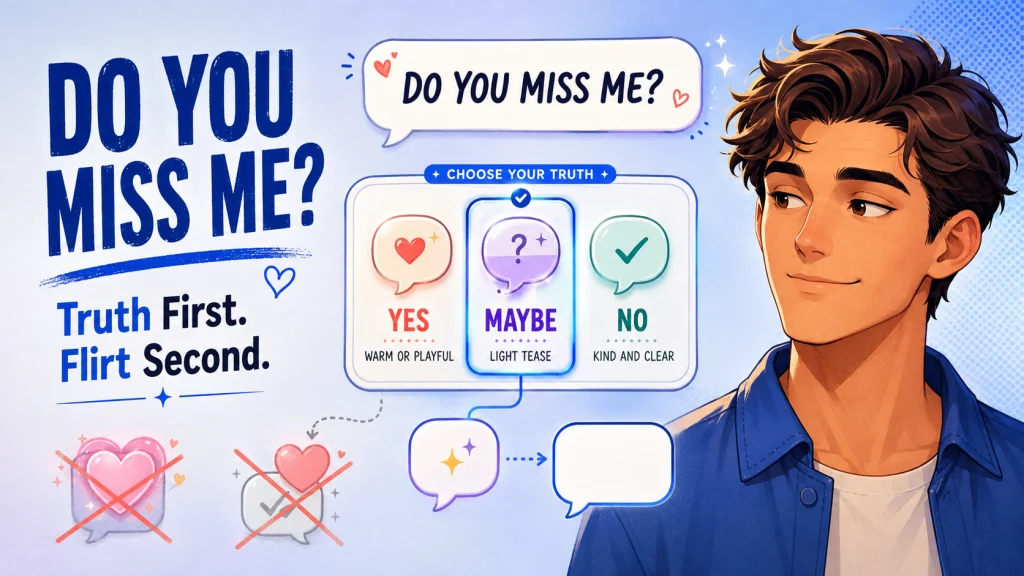
“Do you miss me?” is only four words, but a flirty response to “do you miss me” can send three very different signals depending on whether your real answer is yes, maybe, or no. That is why I would decide the truth before I decide the joke. If you do miss them, flirt with that. If you do not know yet, or you do not miss them at all, you can still answer with charm without pretending the feeling is stronger than it is.
Regulars used to hand me their phones across the bar and ask what they should send back, and feeling questions were always the ones that made people type too much. Most people were not short on words. They were trying to control how the answer would be received. That is where a simple text gets stiff. The better move is usually to answer the actual question first, then choose whether the extra beat is teasing, warm, curious, or gently noncommittal.
| If your honest answer is… | Best direction | Keep away from |
|---|---|---|
| Yes | Warm, playful, or openly affectionate | Acting colder than you feel just to create tension |
| Maybe | Light teasing with honest uncertainty | Giving a bigger emotional answer than you mean |
| No | Kind, brief, and non-escalating | Fake longing or a cruel joke |
That small choice matters more than finding the cleverest line on the screen. A reply that matches your real level of interest is easier to send, easier to stand behind, and much less likely to trap you into a tone you never meant to start. If you want broader options for the same kind of attraction-forward exchange, my page on flirty and romantic text replies covers more ways to match warmth without turning every message into a declaration. Here, though, the job is narrower: answer the missing-you question without faking the answer.
Quick flirty yes replies
If the answer is yes and you do not need to make a production out of it, short flirty replies to “do you miss me” are usually the strongest choice. They let the other person feel the answer without turning a playful question into a speech. I like these when the conversation is already easy and you want the text to land cleanly. The trick is to sound pleased, not breathless.
A short yes also gives the other person room to do something with it. They can tease you back, admit they miss you too, or move the conversation forward without feeling like they have to match a huge emotional paragraph. I have watched people weaken a perfectly good answer by adding three extra explanations after it. Once the line has landed, stop helping it.
- “Yeah. More than I was planning to admit.”
- “A little too much, actually.”
- “You already know the answer.”
- “I do. Happy now?”
- “Annoyingly, yes.”
- “Maybe I was hoping you would ask.”
- “Yes, but do not get smug about it.”
- “I do. That was a very confident question.”
The wording can be soft or dry, but the common thread is that it does not apologize for liking someone. If “I miss you” is true, saying it does not automatically make you needy. What usually creates that feeling is piling on reassurance, explaining how much you have been thinking about them, or asking them to immediately confirm the same thing back. A clean yes has more confidence than a yes that needs a receipt.

Teasing answers when you do miss them but want to play
Teasing works best when the answer underneath the joke is still readable. If someone has to solve a riddle to figure out whether you like hearing from them, the flirt can start feeling like avoidance. I prefer a tease that gives away just enough truth to keep the exchange warm. You are not hiding the yes, you are making them earn half a grin before they get it.
This is also where tone does most of the work. “Maybe” can sound cute with someone who already knows you like them, and strangely cold with someone who has no idea where they stand. I have seen the same basic line land completely differently depending on whether the two people already had an easy back-and-forth. If the history is uncertain, keep the tease lighter than your instinct tells you.
- “Who told you?”
- “I was doing fine until you reminded me.”
- “Possibly. I will deny this later.”
- “Depends. Are you offering a cure?”
- “I might have noticed you were missing.”
- “Bold question for someone I may have been thinking about.”
- “A little. Try not to make this your whole personality.”
A teasing answer should feel like an open door, not a locked one with a joke taped to it. That means the line should give the sender something to respond to besides “okay.” If the joke is so defensive that it erases your interest, you have created distance where you meant to create tension. Keep the truth visible and let the tease sit on top of it.
Direct warm replies when the feeling is obvious
Sometimes the best answer is not clever at all. If you both already know the feeling is mutual, a direct reply can be more intimate than a polished one-liner because it does not duck behind performance. This is one of those moments where the simplest answer can also be the most flirtatious. Say yes, add one warm detail, and leave enough space for them to come toward you too.
I would use these with someone where affection is already established, not as a shortcut to create closeness that is not there yet. The stronger the line, the more it assumes a shared level of comfort. That does not make bold replies bad, it just makes context important. A sentence that feels natural with a partner can feel like a leap with someone you have barely started flirting with.
- “I do. I miss having you around.”
- “Yeah, I really do.”
- “I miss you more than I expected to.”
- “I do. Hearing from you helps.”
- “Very much, and I am not even pretending otherwise.”
- “I miss your face. There, I said it.”
Direct warmth gets awkward only when it outruns the conversation that came before it. If you are already affectionate, there is no prize for pretending not to care. If you are still figuring each other out, use a smaller version and see what comes back. Flirting works better as an exchange than as one person trying to set the whole emotional temperature alone.

Maybe replies when you like them but are not ready to overstate it
Maybe is a real answer, and it does not need to be dressed up as either a secret yes or a dramatic no. You can like someone, enjoy the flirting, and still not feel a big wave of missing them when they are away. That is exactly where overly cute answers can get misleading if they assume everyone must secretly be longing. I would rather keep the flirt and tell the truth at the same time.
The easiest way to do that is to respond to the person, not to the pressure inside the question. You can say they have crossed your mind, that you noticed their absence, or that you are enjoying the fact they asked. None of those claims a bigger feeling than you actually have. It keeps the tone alive without borrowing emotion from a version of the connection that does not exist yet.
- “Maybe a little. I am still deciding how much.”
- “You have crossed my mind.”
- “I noticed you were gone, if that counts.”
- “I might. Ask me again after you charm me properly.”
- “I like that you asked more than I expected to.”
- “A little, but I am not writing poetry about it.”
What I would avoid is upgrading “maybe” into “constantly” because the stronger line sounds more romantic. Once you send that, the other person is allowed to take you at your word. You should not have to spend the next conversation walking back an answer you never meant. A smaller honest flirt is easier to build on than a bigger fake one.
If you do not miss them, keep the reply kind and real
You do not owe someone a fake yes just because they asked the question flirtatiously. If you do not miss them, the cleanest answer is usually brief, warm enough not to humiliate them, and free of language that invites a level of closeness you do not want. The point is not to punish the question. It is to avoid promising a feeling you do not have.
This is one of those moments people often get wrong because they are trying so hard not to sound mean that they accidentally sound more interested than they are. I have watched people write a whole paragraph to soften a simple no, then end up with a message that reads like a shy yes. You can be kind without becoming vague. Clarity is not cruelty when it is delivered without a jab.
- “Not really, but I am glad to hear from you.”
- “I would not say I miss you yet, but I like talking to you.”
- “Not in the dramatic sense, no.”
- “I am not there yet, but I am enjoying this.”
- “I do not want to fake that answer, but I am happy you texted.”
If the sender reacts badly to a calm, truthful answer, you do not have to keep negotiating your wording until they approve of it. Flirting is not a contract that requires equal feelings on command. You can decide how much engagement you want based on the actual exchange in front of you. A good reply gives your real answer and then stops before it becomes a defense.

Turn the question back without making it a test
Asking the question back can be flirty, especially when you already have an answer and want to hear theirs. What I would not do is use it as an escape hatch so you never have to reveal anything first. “Do you?” can sound playful, but it can also sound like you are collecting information before deciding what answer is safest. Give them at least a little of your side before you toss the ball back.
The difference is tiny on the screen and obvious in the feel of the exchange. “Maybe. Do you miss me?” gives something before it asks for something. “You first” makes the whole thing a negotiation. If you want to keep the momentum, reciprocity works better when it is voluntary rather than extracted.
- “I do. Do you?”
- “A little. What about you?”
- “Maybe more than I should. Your turn.”
- “You have been on my mind. Am I on yours?”
- “I will answer properly if you do too.”
The last one is the most conditional, so I would save it for a clearly playful exchange where you both already tease each other that way. In a newer flirt, I would choose one of the first four because it sounds less like a challenge. The point of turning the question back is to keep the conversation moving, not to force a confession. If they want to answer warmly, give them room to do it on their own.
“Do you miss me?” is different from “I miss you”
These two messages look closely related, but they put the emotional work in different places. “I miss you” offers a feeling first, while “Do you miss me?” asks you to provide one. That small difference is why the reply can feel more loaded even when the tone is playful. You are not only reacting to affection, you are deciding how much affection you want to reveal.
That is also why copying a reply meant for “I miss you” can feel slightly off. A simple “miss you too” fits a statement because it mirrors what was already offered, and I keep those situations separate in my examples of flirty replies to “I miss you”. With a question, you have more room to tease, qualify, or answer honestly without matching a declaration that never came. If you want more examples across attraction, compliments, teasing, and other text setups, flirty replies for different situations gives you a wider range of tones to work with.
I would keep this distinction in mind when the message catches you off guard. You do not need to treat the question as proof that the sender feels anything specific beyond what they actually typed. They may be flirting, they may be curious, or they may simply be keeping the conversation going. Answer the words you received, not a motive you had to invent.
What not to send when flirting starts feeling like a test
The weakest replies are usually the ones built to make the other person chase harder. Pretending not to care, hinting that they need to prove themselves, or withholding a real answer until they say something flattering first can create tension, but not the useful kind. It turns a simple flirt into scorekeeping. If you like them, you can be playful without making affection something they have to win.
Fake longing causes the opposite problem. It sounds generous in the moment, but it asks the other person to respond to a level of feeling that may not be real. I would also stay away from guilt lines that punish them for being absent, especially if the conversation has not established that kind of closeness. A flirty message should not quietly become an invoice.
- Avoid: “Maybe if you texted me more, I would.”
- Avoid: “Prove you miss me first.”
- Avoid: “I have been miserable without you,” unless that is genuinely what you mean and the relationship already supports that level of openness.
- Avoid: “Of course not,” if you actually do miss them and are only saying it to look harder to get.
- Avoid: a long explanation of why you are allowed to feel uncertain.
People often reach for these lines because certainty feels risky. Saying “yes” exposes interest, while saying “maybe” or “no” risks disappointing someone, so a game can feel safer than a straight answer. I get why that happens, but the game usually creates more work two messages later. A clean reply lets the other person respond to you instead of to a tactic.

Final thoughts: flirt with the truth you actually have
The best answer to “Do you miss me?” is not automatically the boldest, cutest, or most romantic one. It is the line that matches what you genuinely feel and still sounds like a person you would recognize when you read it back. If the answer is yes, you can own it. If the answer is maybe or no, you can stay kind without faking a feeling just to keep the flirt alive.
Nine years behind a bar taught me that people usually do not regret the short honest line as much as they regret the elaborate one they sent to manage somebody else’s reaction. You cannot control what the other person does with your answer. You can control whether the sentence you send is true enough to stand behind. That is plenty for one text.
Frequently asked questions
The same four-word question can mean very different things depending on who sent it and what the conversation already feels like. That is why I would not choose a reply from tone alone. Start with your real answer, then decide whether you want to make it warmer, more playful, or more neutral. The questions below cover the situations that tend to make people hesitate the longest.
There is no single flirty line that works for a crush, a partner, and someone you barely know in exactly the same way. History matters, and so does how openly you have both been flirting up to this point. Keep your answer proportional to the connection you actually have. When in doubt, the shorter version is usually easier to send and easier for the other person to read correctly.
💬 What is a flirty way to say yes when someone asks if I miss them?
Try a short yes with one playful turn, such as “Yeah, more than I planned to admit.” It confirms the feeling without turning the reply into a speech.
😏 What if I like them but I do not really miss them yet?
Keep the flirt, but shrink the claim. “You have crossed my mind” or “I noticed you were gone” can be warm without pretending you feel more than you do.
❤️ Should I just say “yes” if I really miss them?
Yes, if that is the answer you want to give. A simple honest yes usually sounds more confident than pretending not to care and hoping they decode it correctly.
🎯 Can I ask “do you miss me too?” back?
You can, but give a little of your own answer first. “I do. Do you?” feels more open than making them confess before you reveal anything.
🌿 How do I say no without making the conversation awkward?
Be brief and kind: “Not really, but I am glad to hear from you.” Do not add fake affection just to soften the answer, because that usually makes the message less clear.
✨ What is a cute flirty response if we already like each other?
Use the shared comfort you already have: “I do. Happy now?” or “Annoyingly, yes.” A little teasing works because the affection underneath it is already understood.