A one-letter “K” can feel colder than it proves. The cleanest response is usually short, proportional, and based on what came before it, not on a story you build around one letter. Sometimes a light joke works, sometimes a neutral acknowledgment works, and sometimes the best move is no reply at all. The point is to answer the conversation you actually have, not the tone you are afraid might be hiding inside it.
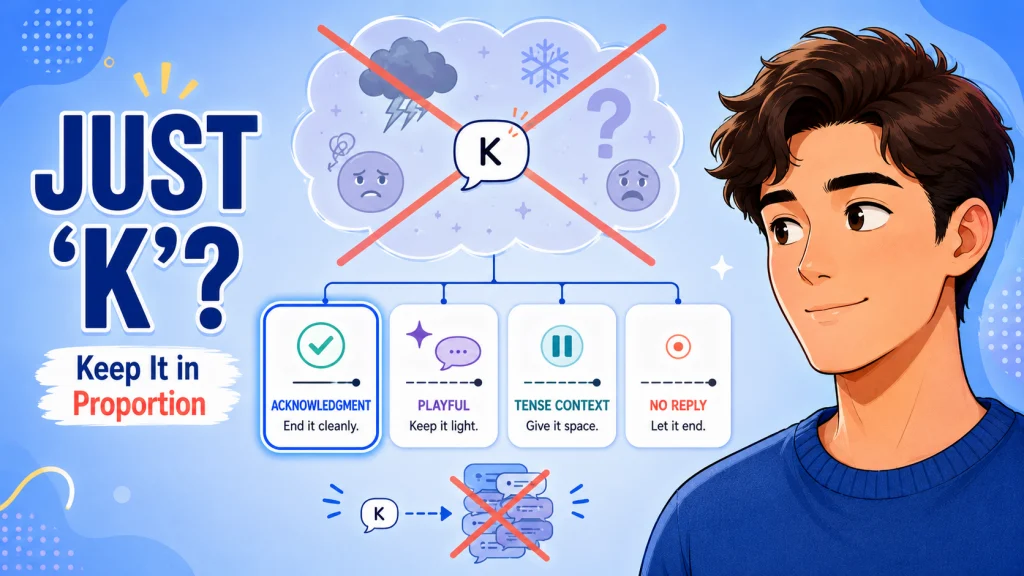
K is one letter, which is why people put so much tone into it
If you are figuring out how to respond to a K text, do not treat the letter as proof of anything by itself. “K” can be a clipped acknowledgment, a rushed reply, a conversation closer, or a sign that the person is irritated, and the message alone does not tell you which one you got. Nine years behind a bar taught me how quickly people can fill a tiny reply with a tone that was never actually stated. The safest first move is proportion: answer what was said, then let the surrounding context do the rest.
That matters because the coldest possible interpretation is often the first one that jumps into your head. A practical text such as “I left the key under the mat” can get a perfectly functional “K,” while the exact same letter after a tense paragraph can land very differently. With short replies, I have learned to separate what is on the screen from what I am tempted to infer from it. Before you fire back, look at the message before the K, the usual texting rhythm between you, and whether the exchange even needs another turn.

Quick replies to K text that keep the moment small
The best replies to K are rarely the cleverest ones on paper. They are the ones that fit the temperature of the exchange without demanding a second conversation about the first conversation. If the K is harmless, a short neutral response keeps you from sounding rattled. If the mood is playful, a tiny tease can work as long as it sounds like you are smiling, not keeping score.
- For logistics: “Got it.”
- For logistics: “Perfect.”
- For plans: “See you then.”
- For a neutral close: “Cool.”
- For a neutral close: “Copy that.”
- For friend banter: “A whole letter? Generous.”
- For friend banter: “Such detail. I am moved.”
- For friend banter: “Poet.”
- For friend banter: “Concise. Respect.”
- When you do not need another turn: no reply.
If you want a funny response to K, keep the joke aimed at the brevity, not at the person. “A whole letter? Generous” can be light between friends who already tease each other, but it can sound needling with someone you barely know. Broader funny responses to dry texts work on the same principle: joke about the moment without pretending you know the motive. Once the other person has to defend their tone, the joke has stopped being a quick reply and become a second conversation.
When K is probably just acknowledgment
Some messages are built to end with acknowledgment, and K can do that job even if it is not especially warm. If you text, “Parking on the north side,” and they answer “K,” there may be nothing left to discuss. The same is true for simple schedule updates, reminders, or information the other person only needed to receive. I would not manufacture a second turn just because the acknowledgment was shorter than you would have written it.
| What came before K | What the moment needs | A proportionate move |
|---|---|---|
| “I am outside.” | Simple confirmation | No reply, or “Coming down.” |
| “Dinner is at seven.” | Plan acknowledged | “Perfect.” |
| Friendly banter | Light continuation | “Poet.” |
| A tense explanation | More context before reacting | Pause before sending anything |
The common mistake here is replying to the feeling of seeing K instead of the function the message just served. If the practical exchange is complete, another response can make a finished conversation feel oddly unfinished. A neutral close such as “Perfect” is fine when you want to add warmth, but silence is also a complete response when nothing else needs saying. Short does not automatically mean rude, and complete does not automatically mean cold.

When K follows a tense message
A K after tension deserves more care, but not more theater. If you just sent something serious and got one letter back, the temptation is to demand an explanation immediately with “What is that supposed to mean?” or “Why are you being like this?” Those questions assume the verdict before the other person has actually given one. If the issue matters, leave space or send one calm line instead of turning a tiny reply into evidence for a bigger accusation.
Useful options include “I will leave it there for now,” “We can come back to this later,” or simply no reply until there is something more useful to say. Those lines acknowledge the tension without punishing the other person for being brief. The move people commonly get wrong is writing a paragraph to force warmth or reassurance out of someone who is not offering it in that moment. When the exchange is already strained, extra sarcasm and repeated demands usually create a new problem instead of clarifying the first one.
If K is part of a repeated dry-text pattern
One K is weak evidence, but a repeated pattern gives you more to work with. If every attempt at conversation gets “K,” “yeah,” “lol,” or another tiny answer while you keep supplying all the questions, the issue is no longer one mysterious letter. You are looking at a lopsided texting rhythm, and you do not have to compensate by becoming more entertaining. Keep your next message normal, use something simple like “All good” when a close is needed, or stop carrying the exchange and see whether the other person adds anything on their own.
This is where people often reach for sharper jokes because they want the imbalance noticed without saying it directly. I get the appeal, but repeated sarcasm is still effort, and it can turn a boring pattern into a petty one. A cleaner choice is to reduce your own output to what feels natural instead of treating each dry reply like a puzzle you have to solve. If you want more general options that stay playful without getting hostile, funny replies that stay light give you more room than matching coldness with colder text.
When no reply is cleaner
No reply is not a dramatic move when K has already closed the loop. If you said, “I will send the address in a minute,” sent it, and got “K,” the conversation can simply end there. You do not need to send “okay” back to their “K” just to prove that you are still participating. Sometimes the most natural response is to put the phone down and continue with your day.
Silence also makes sense when you are irritated enough that your first draft is clearly trying to punish the other person. That does not mean you have to ignore something important forever, only that you do not have to answer while the only available line is a revenge version of their brevity. Short-message contests rarely reveal anything useful about what either person actually meant. If there is a real issue, deal with the real issue later; if there is not, let the K be the period it may already be.

K versus OK
K and OK can carry the same basic acknowledgment while landing differently on the screen. K is visually more abrupt, so readers often experience it as colder, especially when the sender normally writes fuller replies. OK feels a little more complete because it is the familiar whole form, but even that does not tell you what someone feels without context. The useful distinction is not that one is secretly rude and the other is secretly kind; it is that one gives you less tonal cushioning.
That is why I would not use the two as interchangeable evidence in an argument. If a person always types K for plans, their K after “See you at eight” tells you less than it would from someone who normally writes “sounds good” and suddenly goes clipped during a tense exchange. The history between two people changes how the same letters land, and the same is true when choosing ways to respond to an OK text. Compare the pattern first and the spelling second.
What not to send after K
The worst responses make a one-letter message pay for an offense that has not been established. “Wow, rude,” “Guess you do not care,” or “Fine, be like that” can turn uncertainty into a real fight. A long demand for a warmer answer does the same thing with more words. If you are annoyed, be direct when there is an actual issue to address instead of using the next message as a trap.
Also skip revenge dryness when your goal is clarity or a clean exit. If the person was simply busy, mirroring them with “kk,” “whatever,” or a deliberately icy reply creates conflict where there may have been none; if they really were irritated, it gives that irritation somewhere new to go. A short message should not force you into a performance. Send something you can stand behind without needing three follow-up texts to explain what you meant.

Final thoughts: keep one letter in proportion
The useful answer to K is not one universal comeback. Look at what came before it, decide whether the exchange needs another turn, and choose the smallest response that fits. A neutral “Got it,” a light joke, a calm pause, or no reply can all work in different situations. The shortest message in the conversation usually does not need the longest reaction.
I would rather miss a chance to be witty than manufacture a fight out of uncertainty. A repeated pattern can be dealt with when there is actually a pattern, and a real issue can be clarified when there is something concrete to clarify. You do not need to prove that you can be colder or sharper than the person who typed K. Keep the response useful, then let the conversation show you what comes next.
FAQs
Most questions about K come down to what kind of reply fits the moment. A practical exchange may need nothing, a playful one may support a joke, and a tense one may be better left alone for a while. The useful part is choosing a response that does not create more work than the message itself. That keeps the focus on what you actually need to say next.
The questions below cover the situations that most often make people hesitate before typing back. They do not require you to treat K as harmless or hostile by default. The right move changes with the relationship, the message before it, and whether this is a one-off or a repeated habit. Those details are more useful than trying to decode one letter in isolation.
💬 What to say when someone says K?
Say something short that matches the actual context, such as “Cool,” “Got it,” or “Perfect.” If the exchange is already complete, you can also say nothing.
😏 What is a funny reply to K from a friend?
Try a light line such as “A whole letter? Generous” or “Concise. Respect.” Use it only if teasing is already normal between you, because the same joke can sound irritated in a colder relationship.
🧊 Does K always mean someone is mad?
No. K can be a simple acknowledgment, a rushed reply, or a colder response, and you need the surrounding conversation to tell those apart.
📱 Should I reply K back to K?
You can, but it often reads like deliberate mirroring rather than a useful response. If you have nothing else to add, no reply is usually cleaner than starting a contest in minimalism.
🧭 What are the best replies to K after making plans?
“Perfect,” “See you then,” or no reply at all usually fits. The plan is already confirmed, so there is no need to make the exchange emotionally bigger than the logistics require.