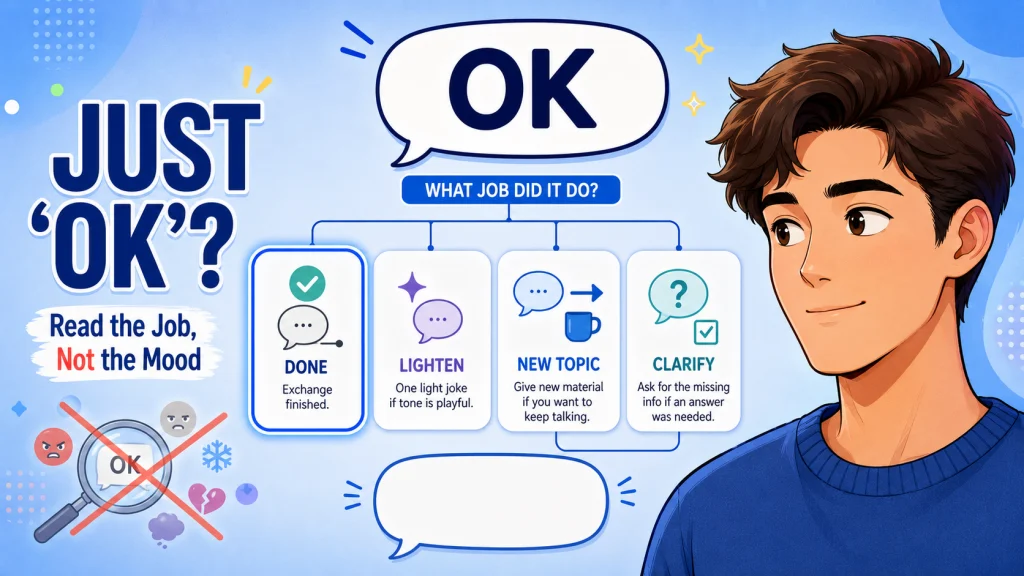
An OK can be a perfectly complete confirmation and still look strangely cold when it lands in a personal chat. The smartest move is not to decode two letters like evidence, but to decide what the conversation actually needs next: nothing, a little humor, a new topic, or one calm clarification. Below are 70 smart ways to respond to an OK text, sorted by what that OK is doing rather than by a mood you cannot prove. The goal is simple: keep a tiny reply from turning into a much bigger problem.
Quick funny responses to OK
An OK can end a logistical exchange perfectly and still look icy in a personal chat, which is why smart ways to respond to an OK text start with context rather than attitude. If you just confirmed a time or answered a simple question, those two letters may have finished the job. If you were halfway through a lively conversation and the energy suddenly collapsed into OK, then there may be something worth doing next. I have learned that the shortest messages get people into the most trouble when they start inventing tone the words themselves never gave them.
The useful question is not, “What does OK secretly mean?” It is, “What did that reply do to this particular exchange?” Sometimes it confirms, sometimes it closes, and sometimes the message before it needs more than a two-letter acknowledgment. If you want the broader version of this problem, my page on funny responses to dry texts sorts short replies by what they are doing to the conversation. Here, the quickest way to get your footing is to compare the OK with the message immediately before it.
| Message before OK | What the same OK does here | Best next move |
|---|---|---|
| “I will meet you by the entrance.” | Confirms a simple plan | Leave it alone or close lightly |
| “You will not believe what happened today.” | Gives the story almost nothing to work with | Add the interesting part or change direction |
| “I cannot make it tonight after all.” | May land abruptly after disappointing news | Give it room unless something still needs clarifying |
| “Should I book the earlier one or the later one?” | Does not answer the actual choice | Ask for the missing decision |
That is the same OK four times, but the sensible next move changes because the message before it changes. I would rather answer what is actually on the screen than pick a fight with a tone I guessed at. Once the exchange is light enough for humor, the safest joke treats the reply as comically tiny rather than as evidence that the sender did something wrong. Keep it short, because a six-line joke about a two-letter text starts to look more bothered than funny.
- “A breathtaking amount of detail.”
- “I appreciate the essay.”
- “Strong two-letter performance.”
- “Minimalism is thriving.”
- “Very mysterious. Very concise.”
- “I see we are conserving vowels.”
- “That was emotionally efficient.”
- “Message received with dramatic clarity.”
- “You really trimmed the fat off that one.”
- “A bold commitment to brevity.”
- “That reply traveled light.”
- “No wasted letters. Respect.”
- “I was not prepared for that much information.”
- “Straight to the point. Ruthless.”
- “The keyboard can rest now.”
- “I will need a minute to process all that.”
- “An entire chapter in two letters.”
- “Concise. Efficient. Slightly iconic.”
Pick one that sounds like something you would actually send, not something you would perform for an audience. If the previous message was serious, vulnerable, or already tense, skip this whole set because sarcasm can land like a jab even when you meant it as a wink. I have seen people overreach here because they want to make the chat lively again, and the better move is usually less performance, not more. Humor earns its place only when it makes the exchange lighter for both people.

When OK is just confirmation and needs no reply
If you texted, “I will be there after lunch,” and the answer is OK, the conversation may simply be finished. Nothing is broken, and you do not owe a reply just because your phone shows the last message came from them. This sounds obvious, but people often add another text because silence after OK feels impolite even when there is literally nothing left to say. I would rather let a completed exchange end cleanly than keep tapping it until it turns awkward.
- “Perfect.”
- “Sounds good.”
- “Got it.”
- “All set.”
- “Cool, we are good.”
- “Works for me.”
- “Great, talk later.”
- “Done and done.”
Those are for the moments when you want a clean closing line, not when the conversation needs rescuing. They are also useful replies to an OK text when you want to acknowledge the acknowledgment without opening another subject. If even one of those feels unnecessary, trust that instinct and send nothing. A finished conversation does not need a ceremonial final word.
When you want to keep talking
An OK gives you almost no material to work with, so trying to squeeze more meaning out of it is usually a dead end. If you want the conversation to continue, give it fresh material instead of demanding that the other person improve the reply they already sent. This is where a topic shift, a specific question, or one small story works better than “why are you being dry?” I have always found that the easiest way to revive a flat exchange is to stop staring at the flat part.
- “Anyway, I just remembered something ridiculous.”
- “Changing subjects before we both become boring.”
- “Important question: what are you eating later?”
- “Wait, I need your opinion on something.”
- “That reminds me, did I tell you what happened earlier?”
- “New topic. You get one guess what I just saw.”
- “Fine, but now you have to answer a better question.”
- “Quick vote: good idea or terrible idea?”
- “I am retiring that subject. What are you up to?”
- “Okay. Now tell me something less responsible.”
- “Fair. What is the most interesting thing you have done today?”
- “Accepted. Now I need your expert judgment.”
- “Noted. I have a completely unrelated story for you.”
- “We can leave that there. What is your current obsession?”
- “Good. Moving on before I overthink two letters.”
- “Okay, your turn to pick the subject.”
The best lines in this group do not punish the sender for giving you less energy than you wanted. They simply hand the conversation a new handle, something concrete the other person can actually grab. For more situations where the joke is supposed to keep an everyday exchange moving, I keep a wider collection of funny replies for everyday texts built around what each message is asking for. Here, the rule is even simpler: if you want more conversation, bring more conversation.
When the previous message makes OK feel tense
Context can make an OK feel heavier without proving exactly what the other person meant. If you just raised a disagreement, changed a plan that mattered to them, or said something personal and got only OK back, it is reasonable to notice the abruptness. The mistake is turning that notice into a verdict and replying as though you already know they are angry. I prefer a line that leaves room for tension without manufacturing it.
- “I know that was a lot. We can leave it there for now.”
- “I just wanted to be clear about where I stand.”
- “No pressure to keep talking about it right now.”
- “I meant what I said, but I am not trying to turn it into a fight.”
- “We do not have to solve this in one text thread.”
- “I am going to give that some room.”
- “If you want to come back to it later, we can.”
- “I hear the short answer. I will not push it.”
- “I wanted to say it clearly, not keep circling it.”
- “We can pause here without making it bigger.”
Notice what these do not say: “I know you are mad,” “wow, rude,” or “so that is all I get?” A tense-looking OK can tempt you to force the other person to explain their mood, and that often makes the conversation about the reply instead of the issue that came before it. If the original point mattered, protect that point by staying calm and specific. You can acknowledge the awkward landing without pretending you can read the sender’s mind.
Light clarification without asking if they are mad
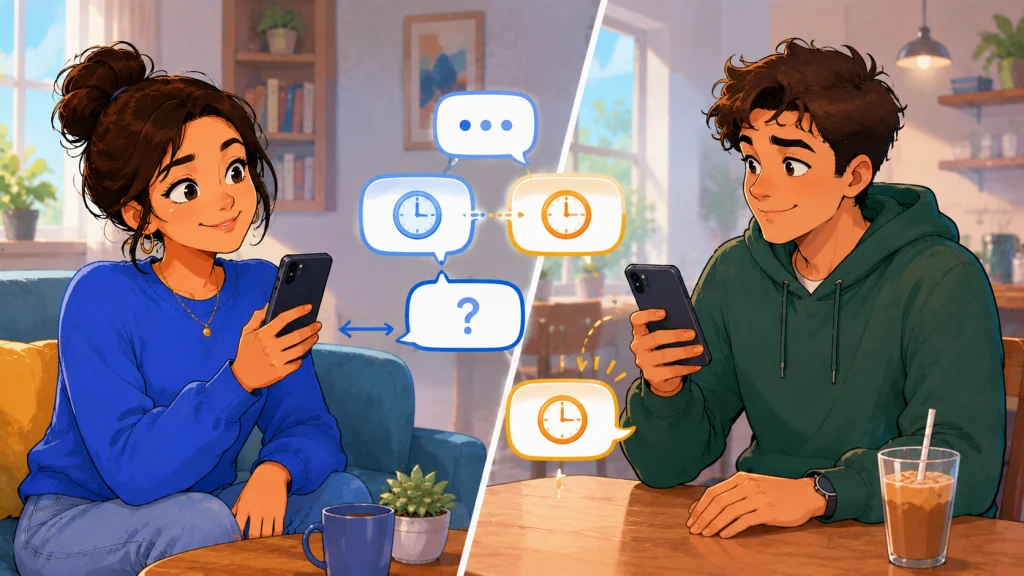
Sometimes you genuinely need more than OK because the message before it required a choice, an opinion, or a clear answer. In that case, clarification is not needy. It is practical. The trick is to ask about the missing information rather than the person’s emotional state. If you are wondering how to respond to an OK text without escalating it, this is the cleanest route when the conversation is actually incomplete.
- “Okay to which part?”
- “Just checking, are we still going with the first option?”
- “Got it. Does that mean yes?”
- “I want to make sure I read that right. Are we agreed?”
- “Quick clarification, should I go ahead with it?”
- “Do you mean OK as in confirmed?”
- “I can work with OK, I just need the decision part.”
- “Which one are you choosing?”
- “All good. I still need your answer on the second part.”
- “I am not reading tone into it, I just need a yes or no.”
This is the place people commonly get wrong because “are you mad?” feels like clarification when it is really a guess wrapped in a question. Ask for the information you are missing instead, and the other person has something concrete to answer. If there is no missing information, you probably do not need to clarify anything at all. A short reply is not automatically a problem that needs investigating.
OK versus K is a smaller difference than people make it
OK and K can feel different on the screen, especially if the person normally writes more, but neither one carries a universal emotional translation. K is even shorter, so people often read it as sharper, yet the useful evidence is still the surrounding exchange and the sender’s normal style. I would not turn spelling length into a personality test. If the one-letter version is what has you stuck, keep it separate from this moment rather than assuming every OK is secretly the same thing.
- “K received. Civilization continues.”
- “Efficient. I respect the commitment.”
- “Noted. Tiny but mighty.”
- “Got it, keeping this one short too.”
- “Okay works for me.”
- “All clear on my end.”
- “Cool, we can leave it there.”
- “Message understood.”
Those last eight are deliberately mild because the point is not to start a second argument about whether one letter is ruder than two. If someone consistently uses K in moments where the conversation feels off, that pattern is more useful than any single message, but the text itself still does not prove a motive. If the one-letter reply is the thing bothering you, I handle how to respond to a K text separately because K has its own rhythm on the screen. With OK, choose among closing, continuing, clarifying, or leaving it alone based on what this exchange actually needs.
What not to send when nothing is actually wrong
The fastest way to turn a harmless OK into a real problem is to answer an accusation that nobody made. A line like “what is your problem?” forces the other person to defend a mood they may not even be in, while “fine, be like that” creates the coldness you were worried about in the first place. I understand why people reach for those lines because a tiny reply leaves a lot of empty space for imagination. The better move is to refuse to fill that space with the worst possible explanation.
- Do not send an accusation just to test whether they deny it.
- Do not stack three follow-ups because the first one did not get more energy.
- Do not use sarcasm if the previous message was serious or vulnerable.
- Do not demand reassurance when the exchange was already complete.
- Do not turn OK into evidence of anger, boredom, or disinterest without more context.
If you need something from the conversation, ask for that thing directly. A missing decision deserves a decision question, while a flat but harmless exchange may just need a better subject. That keeps your response tied to something real instead of making the other person defend a mood you invented. If nothing is actually unfinished, there is no problem to solve.
Final thoughts: let OK be as small as it is
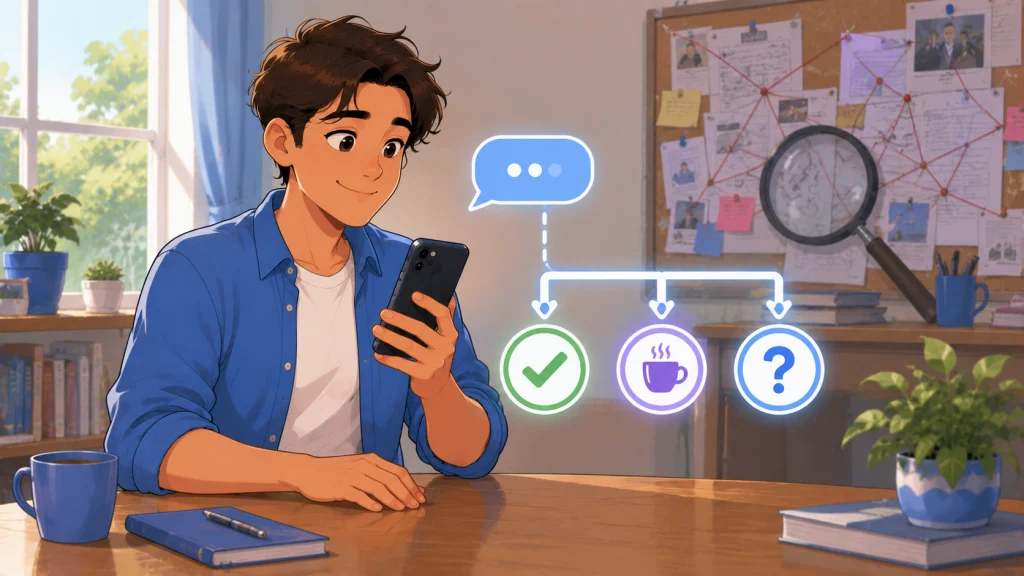
The smartest response to OK is often less dramatic than the one your first reaction wants to send. The message before it usually tells you whether the exchange is finished, stalled, or genuinely incomplete. Match your response to that job instead of trying to decode a hidden verdict from two letters. That restraint keeps a tiny acknowledgment from becoming the main event.
I have spent enough time watching people search for the perfect comeback to know that the better line is usually the one doing one clear job. Make them laugh, keep the thread moving, get the missing answer, or stop typing. You do not need to win against OK. You only need to decide what comes next, if anything does.
Frequently asked questions
Most questions about OK come from the same problem: the message is short enough that people start supplying their own tone. I would rather answer the practical question in front of you than pretend there is one secret meaning behind the word. The safest replies stay close to context, especially when you do not know what the sender intended. These are the questions that matter when you are staring at the screen deciding whether to type again.
💬 What should I reply when someone just says OK?
If the conversation is complete, you may not need to reply at all. If you want to keep talking, change the subject or ask something specific instead of reacting to the shortness.
😅 How do you reply to okay without sounding annoyed?
Keep it neutral and give the message a job. “Sounds good,” “all set,” or a fresh question works better than sarcasm when you are not sure how the OK was meant.
🧊 Does OK mean someone is being cold over text?
Not by itself. It can look cold in some contexts, but two letters are not enough to prove anger, distance, or disinterest.
🔄 How do I keep the conversation going after OK?
Bring in new material. Ask a specific question, tell a short story, or switch topics rather than asking the other person why their reply was dry.
🧭 Should I ask if they are mad after an OK text?
Only if there is real context for that concern, and even then a more specific question is usually cleaner. If you simply need a decision or clarification, ask for that instead of guessing at their mood.
✂️ Is K worse than OK in a text?
K can feel sharper because it is shorter, but there is no universal rule that makes it rude. The sender’s normal style and the message before it matter more than the letter count.
If you are still unsure, go back one message and read the exchange as a sequence instead of isolating the OK. Look for a loose end you can actually name, such as an unanswered choice or a topic that ran out of material. If you cannot find one, you do not need to invent one. A concrete next move is more useful than a theory about tone.
If your only reason for replying is that being the last person who did not text feels strange, you can leave the phone alone. Silence after a completed exchange is not a failed conversation. Save your next message for something you genuinely want to say. That will sound more natural than adding one more acknowledgment just to even the score.