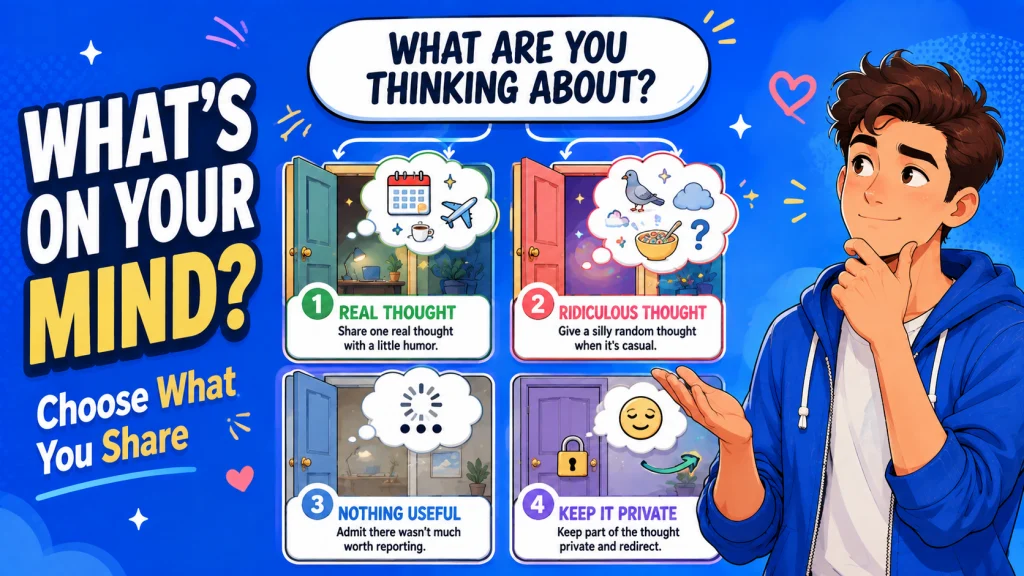
When someone asks what you are thinking about, you do not owe them a tour of your entire brain. The useful choice is smaller: give them the real thought, turn it ridiculous, admit you had nothing worth reporting, or keep part of it private without making the question sound like a crime. The funniest answers usually work because the joke matches how much you actually want to reveal. Pick the disclosure level first, then pick the line.
When “nothing” is doing too much work
Nothing is usually not literally nothing. If you need funny responses to “What are you thinking about?”, start by deciding how much of the real thought you actually want to share. Sometimes you have one stray thought that is too boring to explain, sometimes the real answer feels a little too personal, and sometimes your brain genuinely produced the conversational equivalent of dryer lint. Once you choose the amount you want to hand over, the reply gets much easier.
Regulars used to show me texts on their phones at the bar when a simple question suddenly felt much more loaded than it looked. I watched plenty of people answer casual curiosity like they were being cross-examined, then spend three sentences defending why they did not want to explain themselves. If you want more everyday lines built for low-stakes messages, these funny text replies stay in that same conversational lane without turning every exchange into a performance. Here, the goal is narrower: answer the question at the exact level of honesty you actually mean.
Quick funny replies
If you need a funny reply to “What are you thinking about?” and you do not want to build a whole bit, start short. These work because they answer just enough to keep the other person moving instead of forcing them to decode whether you are joking. I would use this group when the question is casual, the conversation already has some bounce, or you simply want to buy yourself one easy laugh. Do not explain the joke after you send it.
- “Mostly snacks and poor financial decisions.”
- “Whether I could stop losing my keys through sheer optimism.”
- “My next unnecessary purchase.”
- “Nothing useful enough for a meeting.”
- “How confident squirrels are for no reason.”
- “Dinner, with disturbing seriousness.”
- “A brilliant idea I will forget almost immediately.”
- “Whether naps count as a personality.”
- “My ongoing feud with laundry.”
- “How to become wealthy without changing anything I do.”
- “The exact location of my motivation.”
- “Why I walked into this room.”
- “Something important, probably. It escaped.”
- “My next meal. I plan ahead.”
- “How suspiciously fast free time disappears.”
- “A problem I definitely invented myself.”
- “Whether I deserve a treat for doing almost nothing.”
- “The fact that my brain has no off switch.”
- “Several things, none approved by management.”
- “Honestly, I was hoping you would not ask for an official transcript.”
The best quick line is the one you can send without feeling like you suddenly became a comedian for hire. If one of these sounds too polished for the way you normally text, trim it until it sounds like you. A good funny response does not need to be the funniest sentence anyone has ever read. It only needs to feel natural coming from you in that particular conversation.

Ridiculous thoughts that work when the question is casual
Ridiculous answers are useful when the real thought is boring, private, or honestly not worth the paperwork. The trick is making the nonsense obviously harmless so the other person knows you are playing, not hiding a dramatic secret behind a smoke machine. I have seen random thoughts land better than elaborate jokes because they give the other person something easy to grab and continue. Weird is useful when it opens a door instead of ending the conversation.
- “If pigeons have favorite buildings.”
- “Whether ghosts get tired of standing around.”
- “How many ducks would make a situation officially serious.”
- “If fish think boats are weather.”
- “Whether my houseplants are disappointed in me.”
- “Who decided cereal needed a mascot.”
- “If a raccoon has ever felt overdressed.”
- “Whether chairs know we have favorites.”
- “How dogs would review us if they had apps.”
- “If clouds ever look down and see shapes in us.”
- “Whether one goose could ruin a wedding.”
- “If elevators judge people who press the button twice.”
- “Whether aliens would understand small talk and leave immediately.”
- “How long I could pretend to understand chess.”
- “If my fridge light has opinions about unauthorized snacks.”
Notice that none of these require the other person to admire how clever you are. They are little conversational toys, which is exactly why they work in low-stakes moments. If they laugh and add their own ridiculous thought, great, now you have a conversation instead of a performance. If they ask again what you were really thinking, you can still decide whether the real answer is something you want to share.

Real thought plus a joke when you want connection
Sometimes the right answer is not a dodge at all. If you want a little more connection, give one real piece of the thought and add a joke so it does not arrive wearing a name tag that says Serious Conversation. This is the disclosure level people skip when they think their only choices are total honesty or “nothing.” A small true answer often gives the other person far more to work with than a mysterious one-liner.
- “I was thinking about how tired I am, but apparently not tired enough to stop scrolling.”
- “I was thinking about work, which was rude of work to do in my free time.”
- “I was thinking I should call my family more, right after I finish avoiding every notification.”
- “I was thinking about taking a trip somewhere, preferably somewhere my inbox cannot find me.”
- “I was thinking about changing a few things, starting with absolutely none of them yet.”
- “I was thinking about something I said earlier and giving myself an unnecessary replay.”
- “I was thinking I need a quieter schedule, so naturally I have made six plans.”
- “I was thinking about whether I am actually hungry or just bored with excellent timing.”
- “I was thinking about you a little, which is inconveniently honest.”
- “I was thinking about what comes next, but my brain has submitted no useful proposal.”
This style works best when you would not mind the natural follow-up question. That is the whole test. If you say you were thinking about work, a trip, family, or the person asking, assume they may ask for one more sentence. When you want broader options for turning ordinary messages into something less flat, my collection of funny replies covers more situations without pretending every exchange needs a perfect punchline.
When you genuinely were thinking about nothing useful
Yes, sometimes “nothing” is basically accurate. Your brain was wandering, you were staring at a wall, or you had ten half-thoughts that would take longer to explain than they deserve. This is where witty responses to “What are you thinking about?” should stay light rather than inventing a fake secret. You can admit the blank space and still make it sound like a human answer.
- “Nothing with a plot.”
- “Just background noise with excellent branding.”
- “Honestly, the loading screen was up.”
- “Not a single thought made it to final review.”
- “I had one, but it left without notice.”
- “Mostly static and a snack commercial.”
- “Nothing I could defend in court.”
- “My brain was between programs.”
- “I was mentally staring out a window.”
- “Nothing useful, which felt peaceful.”
People commonly get this wrong by forcing a bigger answer because “nothing” feels socially inadequate. It is not inadequate if it is true. A tiny joke gives the other person a little texture without turning an empty moment into a confession booth. If they were only making conversation, that is usually more than enough to keep things comfortable. If the message was about your activity rather than your thoughts, these funny responses to what are you doing fit that different question better.

Light privacy replies when you do not want to explain
Not every thought needs an audience, even when the question itself was completely harmless. The cleanest privacy reply does two things at once: it keeps your boundary and avoids accusing the other person of crossing one. That distinction matters because casual curiosity can sound invasive only after the answer makes it feel invasive. Keep the line light, then move the conversation somewhere you actually want it to go.
- “Classified, but boring classified.”
- “A private little side quest.”
- “Something I am still keeping in drafts.”
- “Nothing ready for public release.”
- “I am keeping that one in the vault for now.”
- “A thought with no guest list yet.”
- “Still deciding whether that thought deserves witnesses.”
- “I will tell you when it has passed quality control.”
- “That one is staying backstage.”
- “Ask me again when the thought has better lawyers.”
These are boundaries with a smile, not traps designed to make the other person chase you. If you actually do want them to ask again, fine, but do not use fake mystery as a game and then punish them for being curious. A light privacy answer should reduce pressure, not manufacture it. After that, change the subject naturally or ask them something back if you want the conversation to keep moving.
Friend versus close-person tone
The same line can feel easy with a close friend and strangely intimate with someone you barely know. What to say when someone asks what you are thinking depends less on finding the cleverest sentence and more on how much context already exists between you. A friend may understand a dry “classified” instantly, while someone closer might reasonably hear that as you pulling away if the conversation had already turned personal. Read the relationship before you read the joke.
| Disclosure level | When it fits | Example |
|---|---|---|
| Almost none | Casual friend, passing text, low-stakes moment | “Nothing with a plot.” |
| Ridiculous | Playful friend who likes random bits | “If pigeons have favorite buildings.” |
| Small real answer | Someone you trust enough for one honest detail | “I was thinking about work, which was rude of work to do in my free time.” |
| Light privacy | You like the person but do not want to explain this thought | “Something I am still keeping in drafts.” |
I think of these as four doors, not four personalities. You can be open in one moment and private in another without sending some coded message about the relationship. The question only asks what is on your mind, not for permanent access to everything in it. Pick the door that fits this moment, and let the tone do the rest.
What not to say: fake dark jokes, mind-reading games, or making harmless curiosity feel invasive
There are three easy ways to make this simple question heavier than it started. A fake dark joke can force the other person to figure out whether you are actually upset, a vague “you should know” turns curiosity into a test, and an aggressive privacy line can make an ordinary question sound like an offense. None of those are automatically forbidden between people who know each other well, but they create more work than a casual funny reply needs. If the joke depends on the other person feeling worried, guilty, or confused, it is probably the wrong tool here.
I have watched harmless questions go sideways because someone answered the meaning they imagined instead of the words that were actually said. “What are you thinking about?” can be curiosity, closeness, boredom, flirting, or simply something to say during a quiet moment, and you usually cannot know which one from the sentence alone. Do not diagnose the asker, do not turn your reply into a loyalty test, and do not pretend they invaded your privacy just because you prefer not to answer. A simple boundary or a ridiculous thought keeps you in control without inventing a conflict that was never there.

Final thoughts: say only as much as you mean
The useful part of this question is not finding the funniest possible sentence. It is noticing whether you want to share the real thought, share a smaller version, replace it with harmless nonsense, or keep it to yourself. Once that choice is clear, the wording becomes easy. A line that matches your actual comfort level will almost always sound better than one chosen because it looks clever on a list.
If you want connection, give one real detail and leave room for a follow-up. If you want lightness, choose something ridiculous and let the other person play with it. If you want privacy, keep the boundary calm enough that it does not turn curiosity into a fight. You are answering one question, not signing over the contents of your head.
FAQs
Most follow-up questions about this line come down to tone, especially when the asker is someone you know well. The safest answer is rarely a universal script because the same sentence can read playful, cold, or intimate depending on the history between you. I would start with the smallest truthful level you are comfortable sharing, then make it funny only if humor fits the moment. That keeps the reply useful instead of turning it into a trick.
It also helps to remember that you can change levels from one conversation to the next. You do not have to be the person who always gives a joke, always gives the full truth, or always stays mysterious. A casual question can get a casual answer, and a closer moment can get something more real. The FAQs below are built around that flexibility.
💬 What is a funny answer to “What are you thinking about?”
Use a short answer that sounds like something you would actually say, such as a harmless random thought or a tiny self-roast. The shorter version usually lands better because the other person can respond without first unpacking the joke.
🤔 What if I really was thinking about nothing?
Say that, just give it a little texture. “Nothing with a plot” is more conversational than forcing yourself to invent some deep thought you never had.
🔒 How do I answer without telling them what I was really thinking?
Keep the boundary light and clear, then move on. A line like “Something I am still keeping in drafts” says no without making the question itself sound offensive.
😄 Should I give a ridiculous answer or a real one?
Choose based on what you want the next message to be. If you want connection, give one real detail; if you want casual banter, ridiculous is easier and usually lower pressure.
❤️ What if someone close to me asks what I am thinking about?
You can still keep things light, but closeness may make a tiny real answer feel more natural than a full dodge. Share only what you mean to share, because being close to someone does not make every thought automatically public.
🎭 Is a mysterious answer a good way to make them chase the conversation?
Not if you are using mystery as a test. A playful dodge is fine, but deliberately making someone anxious or forcing them to prove curiosity turns a simple exchange into a game nobody needed.