Being called weird does not automatically call for a comeback. The useful first move is figuring out whether the person is teasing, genuinely confused, or trying to make you feel small. Once the tone is clear, the best reply is usually shorter than the speech you start building in your head. You can play along, own the difference, ask what they meant, or end the conversation without turning “normal” into a courtroom argument.
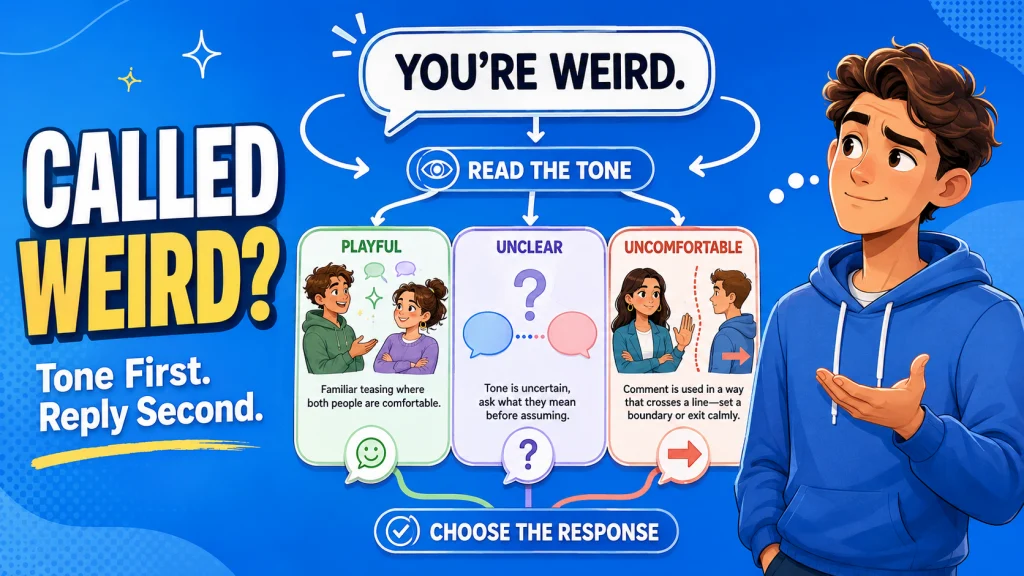
Weird can be an insult, a joke, or almost a compliment
Weird is one of the few insults that can split a room without changing a single letter. One person hears affection, another hears exclusion, and both can be responding to the exact same word. If you are wondering how to respond when someone calls you weird, listen to the delivery before you reach for the sharpest line you know. A friend laughing with you is not the same situation as someone staring you down and trying to make the rest of the group laugh at you.
I learned that distinction long before I started writing replies down. Regulars used to slide their phones across the bar and ask what they should send back, and half the problem was that the same sentence looked completely different once I knew who had sent it and how they normally talked. A reply that sounds confident in one conversation can sound strangely aggressive in another. Tone sorting is not about pretending you can read minds. It is about using the evidence you actually have.
| Tone | What it often looks like | Best reply direction |
|---|---|---|
| Playful | Smiling, familiar teasing, or an inside-joke kind of delivery | Play along or answer with a light joke |
| Ambiguous | Flat wording, unclear expression, or a relationship where teasing is not established | Ask what they mean or answer neutrally |
| Insulting | Mocking repetition, public embarrassment, or obvious pressure to make you defend yourself | Use a short boundary, dry comeback, or exit line |
This sounds obvious when you are reading it calmly, but it is the part people skip when the comment lands in real time. They hear one loaded word and answer the harshest possible version of it, even when the other person was only teasing. The reverse happens too, with someone laughing off a comment that is clearly being used to embarrass them. Give yourself one beat to decide which conversation you are actually in, then pick the line.

Quick replies for a clearly rude “you are weird”
When the tone is clearly rude, the best comebacks when someone calls you weird are usually the ones that refuse the invitation to defend your entire personality. A long explanation makes it sound as if the other person has been appointed judge of what counts as acceptable. You do not need to win a debate about normal people, because that debate has no useful finish line. A short reply gives the insult less room to grow.
- “And yet, here you are keeping track.”
- “That sounded more important in your head.”
- “You are allowed to think that.”
- “Good thing I was not auditioning for normal.”
- “Noted. Anyway.”
I would use the sharper lines only when the rudeness is actually there. If someone is deliberately needling you, a flat “Noted. Anyway.” can do more than a paragraph because it denies them the performance they were hoping to provoke. If you want more options for moments where the insult is the point, what to say when someone insults you is the broader lane. The goal here is not to punish them. It is to stop giving one lazy label more power than it earned.
Playful answers when a friend means it affectionately
Funny replies to “you’re weird” work best when the relationship already has room for that kind of teasing. If a friend says it while laughing at the strange snack you made, the line does not need armor on it. You can accept the label, exaggerate it, or hand the joke back without making the room suddenly wonder whether everyone should stop talking. The lighter the moment, the lighter your answer should stay.
Try “Finally, some recognition,” “I have worked very hard on this brand,” or “You knew what you signed up for.” Another easy one is “That is why you keep me around,” which works when the friendship already has that playful rhythm. I have watched people ruin perfectly harmless teasing by answering as if they had just been publicly attacked, and the awkwardness usually comes from the mismatch more than the original word. The same tone check applies to what to say when someone calls you boring, because that label can also land as teasing or as a put-down. If you are laughing with them, let the reply sound like you are still in the same joke.
Confident replies that accept being different
Sometimes the easiest answer is not a comeback at all. If the word does not bother you, you can simply own the difference without turning it into a motivational speech about how special you are. “Probably,” “I can live with that,” and “I have heard worse” all work because they do not ask for approval. Confidence is often quieter than people expect.
The moment gets harder when you feel pressured to prove that being different is secretly better than being ordinary. You do not need that argument either. If you are stuck on what to say when called weird, “Maybe I am” can be a complete answer, especially if your tone says the subject is not open for cross-examination. The cleanest version is often the one that lets the label fall to the floor instead of picking it up and polishing it.

When the word is being used to exclude you in a group
A group changes the stakes because the comment may be less about you and more about getting everyone else to react. If someone says “You are so weird” and then looks around for laughs, you have more reason to keep the reply controlled. The worst move is often a long defense that turns one cheap comment into the center of the room. A short line can make the attempt look as small as it was.
Try “Was there a point after that?” or “You seem very invested in this.” If the group is clearly piling on, “I am not doing this with you” is stronger than trying to out-insult five people at once. For situations where you deliberately want a harder edge, savage comebacks can fit better than pretending every jab deserves a gentle answer. Even then, I would rather use one clean line and stop than turn the whole room into a contest over who can be cruelest.
Ask what they mean when the tone is genuinely unclear
Not every “weird” arrives with enough context to sort immediately. A text can flatten tone, and someone you do not know well may use the word in a way that sounds harsher than they intended. In that situation, guessing can create a fight that was never there. Asking one clean question is not weak. It is efficient.
“Weird how?” is usually enough. You can also say “Good weird or bad weird?” if the relationship is casual and the moment still feels light. Most people over-explain this part because they are worried that asking for clarity will sound insecure, but the short version does not. It puts the meaning back on the person who chose the word and gives you something real to respond to.

Short exit lines when you do not want a normality debate
You are also allowed to decide that the conversation is not worth improving. Some people keep using “weird” because they want you to explain yourself until they find another thing to criticize. You do not owe them a defense of your hobbies, clothes, laugh, interests, or whatever else they have decided to inspect. When the exchange starts feeling repetitive, an exit line is often the most useful reply left.
- “Okay.”
- “We can leave it there.”
- “You do not have to get it.”
- “I am not debating this.”
- “Cool. Moving on.”
These lines work because they do not offer another handle for the argument. “You do not have to get it” is especially useful when someone keeps pushing you to explain why you like something they do not. I would not decorate an exit with three more jokes after it, because then it stops being an exit. Say the line, let it be enough, and move your attention somewhere else.
What not to say when “weird” hits a nerve
The common mistake is trying to make the other person feel more abnormal than they made you feel. That can turn a lazy insult into a much uglier exchange, especially if you start diagnosing them, attacking an identity, or dragging in something personal that has nothing to do with the comment. You do not need to prove that they are secretly insecure, jealous, unstable, or anything else you cannot actually know. Answer what they said, not a personality profile you invented for them.
The other mistake is treating playful teasing like a declaration of war. If your friend is grinning and the relationship is full of harmless roasting, a scorched-earth reply can make everyone suddenly wonder what they missed. On the other side, if someone is repeatedly using the word to isolate or embarrass you, you do not have to keep turning it into a cute joke for their comfort. Match the response to the behavior you can actually see, and you will usually avoid making the moment bigger than it needs to be.

Final thoughts: make the tone decision before the comeback
The word “weird” is too flexible for one perfect response. A friend can say it with affection, a stranger can say it with confusion, and someone rude can use the exact same word to try to put you on the outside. That is why I would choose the tone first and the wording second. Once you know what kind of moment you are in, the reply usually gets much simpler.
You can joke back, say “Maybe I am,” ask “Weird how?” or end the exchange completely. None of those choices means you lost the moment, because the point is not to perform the cleverest comeback in the room. The point is to say something that fits what actually happened and still sounds like you when it leaves your mouth. That is a much better standard than trying to beat somebody at a debate over who counts as normal.
FAQs
The questions people ask about being called weird usually come down to what to send next, especially when the original comment was only a few words. Texts need a little more caution because tone is easier to misread there, while an in-person remark gives you expression and timing to work with. A short reply is usually easier to steer than a speech once you get new context. The answers below keep that practical distinction in view.
If you freeze, do not treat that as proof that you missed your chance. People think good replies have to arrive instantly, but a simple answer still works when you need a beat to find it. You can also decide not to answer at all if the exchange is going nowhere. The useful reply is the one that fits the situation, not the one that sounds most impressive after ten minutes of rewriting.
💬 What is the best response when someone calls you weird?
Start with the tone. If it is playful, joke back; if it is rude, use a short boundary or dry comeback; if you cannot tell, ask “Weird how?”
😄 What is a funny reply when a friend says “you are weird”?
Try “Finally, some recognition” or “You knew what you signed up for.” Keep it light only when the friendship already has that teasing rhythm.
🧊 How do you respond without sounding hurt?
A short neutral reply works well, such as “Maybe I am” or “Okay.” You do not need to prove that the comment did not affect you by turning your answer into a performance.
🤔 What if I cannot tell whether “weird” was an insult?
Ask for the missing context instead of guessing. “Good weird or bad weird?” keeps it casual, while “What do you mean by weird?” is better when the tone feels more serious.
🚪 Is it okay to say nothing when someone calls me weird?
Yes. If the person is only trying to provoke you or the exchange keeps repeating, disengaging can be more useful than finding another comeback.