A “WYD?” text does not need a full performance in return. The easiest move is to answer just enough to be real, add a small flirt if you want one, and then decide whether to hand the conversation back, invite a plan, or make the sender give you something better to work with. I have watched plenty of people overthink four letters because they feel responsible for creating all the chemistry from the reply alone. You are not, and the best response usually leaves room for the other person to show some effort too.
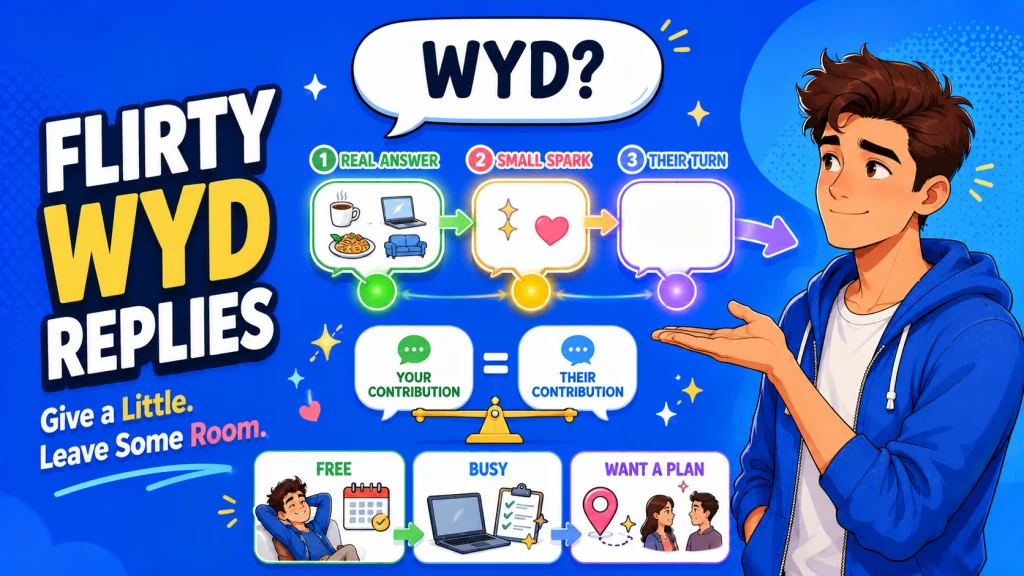
Why WYD is an opener, not a job assignment
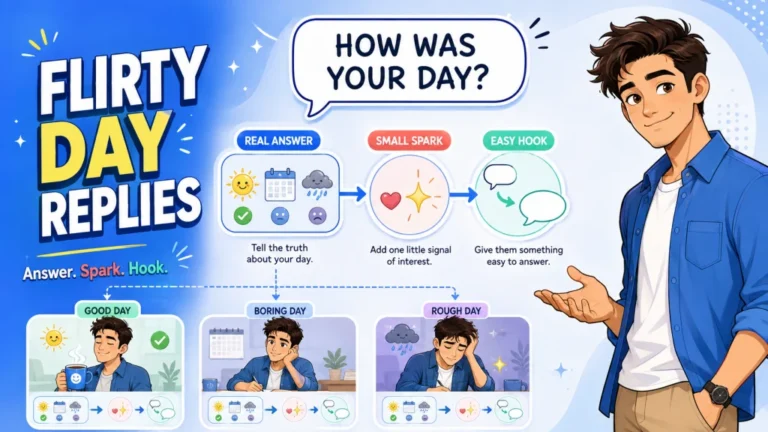
WYD is four letters doing the work of a whole opener, so your reply should not have to perform a full date by itself. The best flirty responses to what are you doing give one real answer, one small bit of energy, and one obvious place for the other person to go next. That can mean a tease, a question, or a gentle opening for plans. It does not mean inventing a fascinating life because someone sent the shortest possible check-in.
I learned to watch the effort balance long before I started writing these replies down. During nine years behind a bar, people regularly handed me phones with conversations that had stalled on some version of “wyd,” and the panic was almost always bigger than the message deserved. One person would be trying to manufacture a perfect flirt while the sender had contributed four letters and a question mark. The stronger replies raised the energy a little, then waited to see whether the other person would meet them there.
| Your situation | Best reply shape | Example |
|---|---|---|
| You are free | Real answer plus a light opening | “Taking it easy. You about to make my evening more interesting?” |
| You are busy | Brief truth plus a warm signal | “Working through a few things, but I like the interruption.” |
| You want a plan | Answer plus a direct handoff | “Nothing locked in. Did you have something in mind?” |
| You want more effort | Playful tease plus an invitation to improve the opener | “Giving you one chance to upgrade that question.” |
The table is not a script you have to obey. It is a quick way to notice what you actually want before you choose a line, because “free,” “interested,” and “willing to carry this entire chat” are three different things. If you know which of those is true, the wording gets much easier. That same effort-first approach runs through the broader set of flirty text openers, where the point is to create room for a real exchange instead of forcing chemistry on command.
Fast flirty replies when you are free
If you are free and already like the person, you can afford to be a little more obvious. A flirty response to WYD does not need to hide the fact that you are available, because availability is not the same thing as desperation. Give them a small opening and see what they do with it. The useful part is that your reply creates momentum without writing the next five messages for both people.
Most WYD flirty responses work better when they sound like something you could actually say out loud. The line can be cheeky, but it should still sound like you rather than a character who suddenly arrived with perfect banter. I would rather send one clean sentence with a little nerve than a paragraph that keeps adding wink after wink. When the vibe is already there, shorter usually gives the other person more room to play back.
- “Not much. You planning to fix that?”
- “Currently deciding whether talking to you counts as being productive.”
- “Free enough to hear your better idea.”
- “Taking it easy. What kind of trouble are you offering?”
- “Nothing exciting yet. Your move.”
Notice that none of those replies pretends the sender has already earned a huge reaction. Each one is easy to answer with something more specific, which matters more than making the line sound impressive. If they pick up the energy, the conversation moves naturally. If they answer with another one-word prompt, you can simply decide whether that exchange is interesting enough to continue.

If you are actually busy
Being busy is not a flirting problem, and you do not need to pretend you are mysteriously unavailable to make yourself more appealing. If you need a flirty reply to “what are you doing?”, say what is true in one line and add warmth only if you genuinely want to keep the door open. “Finishing some work, but your timing is not terrible” does both jobs without turning your schedule into a performance. The sender gets an answer, and you keep control of how much attention you have to give.
I have seen people make this harder by trying to sound busier than they are because they think interest has to be rationed. That usually creates a strange little contest where nobody says what they mean and both people wait for the other one to prove something. A cleaner reply is “Running around right now, but tell me what you’re up to,” if you still want the conversation. If you cannot talk, “Busy for a bit. I’ll catch you later” is perfectly fine too.
- “In the middle of something, but I’m listening.”
- “Working, unfortunately. Your distraction has decent timing.”
- “A little busy right now. Were you checking in or plotting something?”
- “Tied up for a bit, but I want the rest of that thought later.”
The flirt lives in the tone, not in pretending your calendar is a locked vault. You can be direct about being occupied and still show that the message was welcome. That makes the reply easier to trust because there is no fake scarcity for the other person to decode. It also keeps you from starting a conversation you do not actually have time to maintain.
Soft replies for a crush or new connection
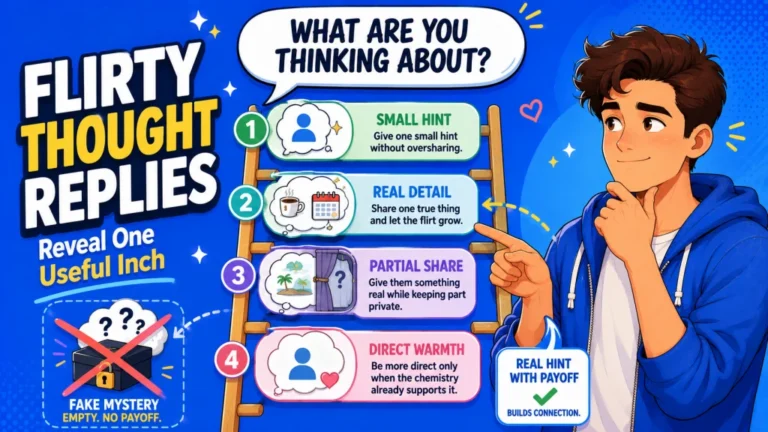
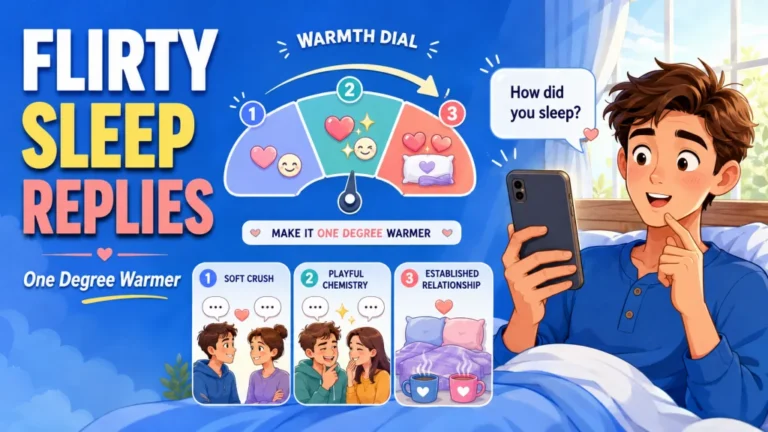
With a crush or someone new, the safest flirt is usually one notch lighter than the line you are tempted to send. You do not have enough shared history yet to know whether a bold answer will feel fun, intense, or just oddly ahead of the conversation. Give them something slightly personal, then let their next message tell you whether there is room to turn it up. A soft line can show interest without making the other person responsible for matching a huge leap.
This is where a plain answer about making dinner or picking something to watch often needs only one extra detail to stop feeling flat. Mention the meal you are attempting, the show you cannot choose, or the small thing you are procrastinating on, then give them an easy opening to respond. The flirt is mostly in the invitation to engage, not in a dramatic declaration. If they respond with equal playfulness, you can build from there without jumping three steps ahead.
- “Making dinner and pretending I know what I’m doing. What about you?”
- “Trying to pick something to watch. You seem moderately qualified to help.”
- “Just relaxing. I was wondering when you’d show up.”
- “Avoiding one very boring task. Your timing is suspiciously good.”
- “Nothing dramatic. I’m open to a better suggestion, though.”
Someone new may also be using WYD as plain conversation, and there is nothing wrong with leaving that possibility open. I do not treat every casual check-in as coded romantic intent, because the text itself usually does not prove that. These softer lines show your interest without assigning motives to theirs. That is the same reason I like broader flirty replies that can be adjusted up or down depending on what the conversation has actually earned.
Teasing replies that make a lazy opener contribute something
Sometimes you like the person and still think “wyd” is a lazy opener. Those two things can be true at the same time, and a teasing reply is useful when you want to signal both. The trick is to make the tease feel like an invitation, not a punishment for texting you. “That opener gets one free upgrade, try again” lands very differently from a lecture about effort.
I have watched people accidentally turn a flirt into customer feedback because they were annoyed by the opener and wanted the sender to know it. Once you start explaining why “wyd” is boring, the conversation has already become work. A shorter tease does the correction without making the room colder. “Four letters? I know you’ve got more than that” gives them a chance to improve the energy immediately.
- “I’ll answer after you add a little plot.”
- “Bold opener. What’s the follow-up?”
- “That depends. Is there an actual plan hiding behind WYD?”
- “You get one chance to make that question interesting.”
Use these only when teasing already feels normal between you. With someone brand new, the same line can sound like they failed an audition they did not know they were taking. If the sender tends to open with short check-ins, you can also borrow the lighter rhythm from flirty replies to what’s up instead of escalating the tease. The goal is to make the conversation more mutual, not to win a point over the wording of the opener.
Replies that naturally turn WYD into a plan
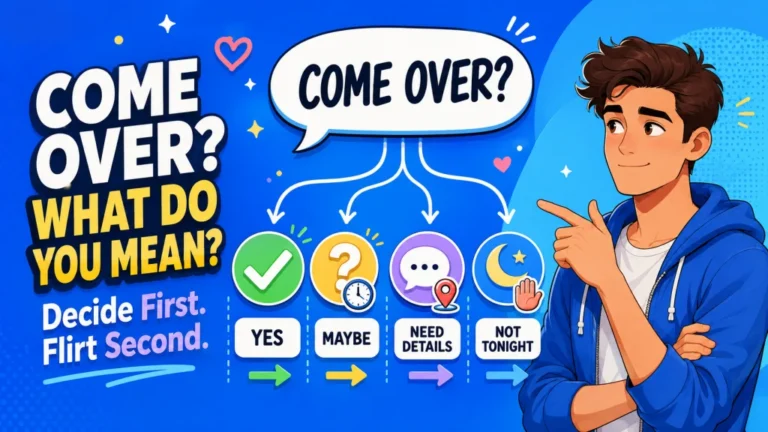
If you want to see them, WYD can be an easy doorway into a plan because the question is already about what you are doing. You do not need to wait for the sender to guess that you are open to meeting up, and you do not need to issue a formal invitation either. Say that nothing is fixed yet and ask whether they had something in mind. That moves the conversation one step forward while making room for the sender to contribute an actual idea.
The cleanest versions leave the plan open enough for the other person to contribute. You can say you are free and ask them to pitch an idea, which keeps the tone playful while still requesting some initiative. If you already have something simple in mind, mention it directly rather than circling around availability for five more messages. That is flirting with a destination instead of flirting in circles.
- “Nothing set yet. Were you about to suggest something?”
- “Free later. Convince me you have a plan.”
- “Currently available for a better idea than staying home.”
- “Not much. If this is your way of making plans, continue.”
Once you make the opening for a plan clear, the sender can either use it or keep chatting. Some people will suggest something immediately, while others were only checking in and never meant to make plans. You do not need to decode either outcome from one message. You have already said enough to make your own interest clear without planning the whole evening for them.
Late-night WYD without assuming sexual intent
A late-night WYD can be flirtier than the same message in the middle of an ordinary day, but that does not automatically make it sexual. Context still does the heavy lifting: who sent it, what the two of you have already been saying, and whether there is an existing pattern of making plans this way. I would not write a reply that assumes an invitation the other person has not actually made. You can keep the flirt alive while leaving the meaning open.
If you are interested, say you are winding down and ask what they had in mind. If you want to keep it lighter, tease the fact that the message sounds like it may have a second part. If you are not interested in a late plan, say you are calling it a night while keeping the tone friendly if that feels right. The same incoming text can support all three directions because your intention matters as much as theirs.
- “Winding down. Did that WYD have a second part?”
- “About to call it a night, but now I’m curious what you wanted.”
- “Relaxing. Is this a check-in or the beginning of a plan?”
- “Not doing much. You sound like you have something in mind.”
- “Getting comfortable and staying in tonight. What are you up to?”
This is one of those moments where people get themselves in trouble by treating a familiar pattern as a guaranteed meaning. A message can hint at availability, boredom, flirtation, or a plan, and sometimes it really is just a casual check-in. Let the sender make the next part explicit if it matters. Responding to what was actually written keeps the tone flexible without making the exchange colder.
When to answer plainly because the vibe is not there yet
Not every WYD deserves a flirt, even when you might eventually be interested in the person. If the conversation is new, uneven, or simply not playful yet, a plain answer can be the most natural move. Tell them what you are actually doing and hand the question back without adding a layer of forced chemistry. You can always turn the energy up later if they give you a reason.
I think people underestimate how attractive normal conversation can be when they are busy trying to sound clever. A forced line makes you monitor whether it landed, while a simple answer lets you pay attention to what the other person actually says next. If they bring warmth, curiosity, or humor, you have something real to respond to. If they keep sending bare prompts, you are not obligated to become the entertainment department.
- “Just relaxing for a bit. What about you?”
- “Finishing a few things. What’s up?”
- “Making food and trying not to ruin it.”
- “Nothing wild. How’s your day going?”
Plain does not mean cold, and it does not close the door unless you write it that way. The point is to match the amount of connection that actually exists instead of jumping ahead because the message came from someone attractive. You can flirt later with better information and better timing. That usually feels easier than trying to recover from a line that arrived three levels too hot.
What not to send after three letters
The most common mistake is not choosing the wrong clever line. It is treating WYD like a challenge that requires strategy, scarcity, and an entire flirt routine. You do not need to delay a reply on purpose, pretend to be unavailable, or create a fake story about how exciting your life is. None of that tells you whether the two of you can actually have a good conversation.
The second mistake is overpaying for the opener with effort. If they send “wyd” and you answer with a six-part joke, three questions, a teasing nickname, and a plan, there is nowhere for them to contribute except by reacting to your performance. I have seen people do this because silence feels risky, so they keep adding one more sentence to make sure the message lands. Usually the stronger move is to cut the last half and let the other person do something.
- Do not fake being busy to seem more desirable.
- Do not use delayed replies as a tactic to create anxiety or chase.
- Do not assume a late-night message is automatically sexual.
- Do not punish a low-effort opener with a lecture if you still want to talk.
- Do not send a full flirting routine when one playful line would do.
The cleaner alternative is to keep the interaction legible. If the sender wants to flirt, they can flirt back, and if they want to make plans, they can say so. You do not have to manufacture suspense to make either outcome happen. Hidden rules usually create more work than the original four-letter message ever deserved.
Final thoughts: give a little, then leave room
WYD works best as a flirty opener when you stop expecting your reply to do everything. Answer enough to sound real, add one small bit of personality, and decide what you want the next step to be. If you are free, open the door. If you are busy, say so without turning busyness into a performance.
If you want a plan, make that opening visible, and if you want more effort, keep the tease light enough that the conversation can survive it. The line matters, but the exchange matters more. I would rather see someone send a simple reply that sounds natural than a perfect one-liner they would never actually say. Four letters started the conversation, so your reply only needs to move it one useful step forward.
Frequently asked questions
Most questions about replying to WYD are really questions about how much energy to give back. The answer changes depending on whether you are free, busy, already flirting, or still figuring out the vibe. I do not think every message needs a clever comeback, and I definitely do not think every late check-in carries the same meaning. These quick answers keep the focus on what you can actually control: your own reply.
The simplest rule is still the most useful one: respond to the conversation you have, not the one you are imagining three messages from now. If the sender gives you more, you can give more back. If the exchange stays low effort, you do not have to rescue it. A flirty line should create room for mutual effort, not hide the fact that there is none.
💬 What is a good flirty response to WYD?
Try a real answer with a small opening, like “Taking it easy. You about to make that more interesting?” It shows interest without making you responsible for the whole conversation.
😉 How do I reply to WYD from a crush without sounding too eager?
Keep the flirt one notch lighter than your boldest idea. Give them something warm to work with, then let their next message show whether they want to match the energy.
🗓️ What should I say if I want WYD to turn into plans?
Make the opening obvious: “Nothing set yet. Did you have something in mind?” It invites a plan without forcing you to invent one for both of you.
🌙 Does a late-night WYD always mean they want to hook up?
No. It can be flirty, but the message alone does not prove sexual intent, so answer based on the actual history and what you want to invite next.
🧰 What if I am busy when someone sends WYD?
Say that plainly and add warmth only if you want to keep talking. “Busy for a bit, but I like the interruption” is enough to show interest without faking availability.
🎯 How do I make a lazy WYD opener more interesting?
Tease the opener lightly instead of lecturing the sender. “Is there an actual plan hiding behind WYD?” gives them a clean chance to bring more effort.