Being called smart is easy to overcomplicate because the same word can be a real compliment, a friendly nudge, or a dry little jab. The cleanest move is to accept sincere praise, add humor only if it fits, and save the sharper lines for obvious teasing. Below are 60 replies sorted by the room they belong in, not dumped into one giant list. You can sound pleased without performing fake humility, and funny without turning intelligence into a contest.
Smart can be praise or a raised eyebrow
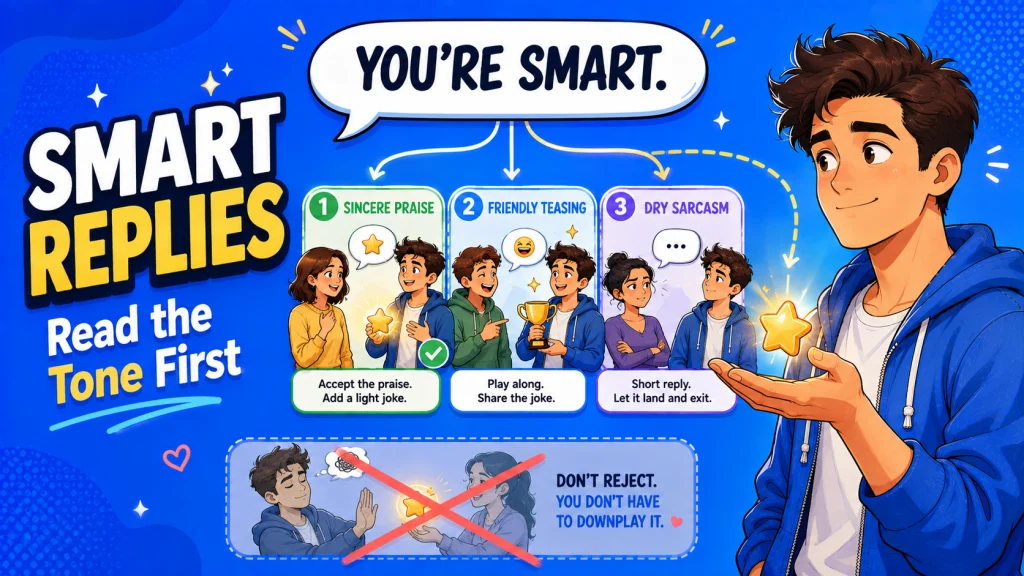
The best funny responses when someone calls you smart depend on one small thing: whether “smart” sounded like praise or came with a raised eyebrow. If it was sincere, accept it and add one light joke. If it was teasing, you can play along without turning the room into a contest. Answering the wrong version is what makes an easy moment suddenly feel stiff.
Nine years behind a bar taught me how quickly a compliment can get awkward when the person receiving it tries too hard to escape it. I watched plenty of people turn one kind sentence into a whole argument about why it was not true. The smoother moments were usually simpler: accept the praise, add a little personality, and let the conversation keep moving. That is enough.
| What “smart” sounds like | Best direction |
|---|---|
| Sincere praise | Accept it, then add a small joke if you want one. |
| Friendly teasing | Play along and keep the joke on yourself or the moment. |
| Obvious sarcasm | Use one dry line, then decide whether the exchange deserves more attention. |
This sounds obvious until the compliment lands on you and your brain suddenly wants to write a defense brief. If you are wondering what to say when someone calls you smart, start with the tone before you start hunting for the cleverest sentence. Someone warmly praising a solution at dinner is giving you a different opening from a friend calling you “genius” after you finally find the keys in your own pocket. Once you read that difference, the reply gets much easier.
Quick funny replies to “you’re smart”
A sincere compliment does not need a speech, and it definitely does not need you to argue the other person out of liking something about you. The quickest funny replies to “you’re smart” work because they let the praise stay intact while adding one small twist. I would keep these for moments where the delivery is clearly kind, not loaded. If the room feels easy, your reply should feel easy too.
The common mistake is reaching for a joke that secretly rejects the compliment. Saying you only got lucky can sound modest, but it can also make the other person defend what they just said. A better joke accepts the premise for one beat and moves on. That same rhythm works across funny ways to answer compliments when you want personality without turning praise into a negotiation.
- “Please, keep this rumor alive.”
- “I have my suspiciously competent moments.”
- “Finally, the branding is working.”
- “I’m putting that on the unofficial record.”
- “Thank you, I fooled another one.”
- “I save it for special occasions.”
- “That is extremely generous evidence.”
- “Good, my cover remains intact.”
- “I’ll take the win.”
- “Please tell everyone before I ruin it.”
- “A rare but beautiful development.”
- “I knew this moment had potential.”
Picture a friend hearing you solve a small problem and saying it with a real smile. You do not need to turn that into a bit about being secretly incompetent for the rest of the conversation. Pick one line, let them laugh, and keep the conversation moving. The joke should be the garnish, not an appeal asking them to withdraw the compliment.

Grateful replies with personality
Sometimes the funniest choice is barely a joke at all. If the compliment means something to you, gratitude can carry the reply and humor can just take the stiffness out of it. That works especially well when the praise comes from someone whose opinion you respect. You are allowed to sound pleased without making the moment bigger than it is.
I have watched people dodge a good compliment because they thought accepting it would sound arrogant. That usually created more attention and more reassurance than a simple thank-you ever would. A clean acknowledgment closes the loop without making the praise a bigger event. The same approach works with broader praise too, which is why these replies when someone says you’re amazing lean on acceptance before performance.
- “Thank you, I’m choosing to believe you.”
- “That’s kind of you, and very good for my ego.”
- “Thanks, I’ll try not to get unbearable about it.”
- “I appreciate that more than my face is showing.”
- “Thank you, I’m quietly delighted.”
- “That means a lot, unfortunately for my humility.”
- “Thanks, I needed one respectable review.”
- “I appreciate it. Please expect no immediate improvement in behavior.”
- “Thank you, that was dangerously nice.”
- “I’ll accept that with suspicious enthusiasm.”
A coworker praising a useful idea in front of other people is a good example of where this tone helps. You can acknowledge it without joking at their expense or pretending the work happened by accident. The personality comes from the small tag after the thank-you. That keeps the exchange light and credible.
Self-aware replies without fake humility
Fake humility has a strange way of making a compliment more awkward than a little confidence would have. You do not need to say you are brilliant, but you also do not need to act shocked that anyone noticed you know something. A witty response to a smart compliment can simply admit you had a good moment. Self-awareness is funnier when it does not require you to insult yourself first.
Most people overthink this because they are trying to avoid sounding full of themselves. The shorter version usually wins: accept the nice thing, then joke about your timing, your reputation, or the absurd seriousness of the compliment. That gives the other person somewhere to go next. It also avoids turning praise into a debate.
- “I do occasionally read the instructions.”
- “I briefly peaked there.”
- “That was one of my better operating modes.”
- “I had a strong showing, yes.”
- “I’m enjoying this version of events.”
- “I knew something useful would happen eventually.”
- “I can be alarmingly prepared sometimes.”
- “That one came from the premium brain cell.”
- “I’m having a very respectable moment.”
- “Let the record show I had one excellent idea.”
Say you remember one obscure fact during a trivia game and everyone suddenly acts as if you should be running a laboratory. That is a perfect place for self-aware humor because the compliment is real but the scale is ridiculous. You can enjoy the moment without claiming a permanent title. The best line shrinks the ceremony, not your own competence.

Friend teasing and genius jokes
Friends can turn “genius” into a compliment, an accusation, or a running joke before you have finished the sentence that caused it. With people who already tease each other, you have more room to exaggerate. The useful boundary is keeping the joke inside the shared moment instead of making it a ranking of who is smarter. A funny response to a genius compliment should sound like you are both in on it.
This is where mock formality works well because everybody knows the title is ridiculous. A tiny imaginary award, a fake press conference, or an over-serious acknowledgment can make an ordinary success funnier. What does not work as well is using the opening to call your friend dumb. Once the joke needs a loser, the easy chemistry disappears.
- “Please address me by my full imaginary title.”
- “The committee has finally noticed.”
- “I’ll be accepting a few questions.”
- “My tiny trophy is already in the mail.”
- “I’d like this entered into the group records.”
- “At last, recognition from my peers.”
- “Try to stay calm around greatness.”
- “I expect a very small parade.”
- “This changes absolutely nothing, thankfully.”
- “I’ll sign autographs after snacks.”
Think of a friend calling you a genius because you found the restaurant reservation they forgot to save. A mock award line fits because the stakes are tiny and the friendship already has that rhythm. The same line would sound strange from someone you barely know after a serious compliment. Familiarity earns exaggeration, so do not borrow friend-level banter for every room.
If smart was obviously sarcastic
Sometimes “smart” arrives with enough tone attached that nobody could mistake it for praise. If the sarcasm is light and the relationship can carry it, a dry answer is usually stronger than trying to prove anything. You do not need to defend your intelligence because that accepts the argument they just tried to start. One clean line can acknowledge the jab without giving it a whole stage.
I would keep these replies short because sarcasm gets worse when both people start explaining their jokes. You only need to show that you heard the tone and are not scrambling under it. There is no prize for proving who knows more. If the comment is plainly hostile instead of playful, you can stop feeding the exchange.
- “I sensed the standing ovation.”
- “Your confidence in me is overwhelming.”
- “I’ll treasure that glowing review.”
- “Subtle. Nearly missed it.”
- “I appreciate the delicate delivery.”
- “That sounded almost supportive.”
- “I’ll recover from the admiration somehow.”
- “Noted with tremendous ceremony.”
For example, a friend saying “smart move” after you spill your own drink can carry one of these because the mistake is already obvious and the teasing is small. You answer once, laugh if you feel like it, and the moment can die naturally. If somebody is using “smart” as a direct insult and pushing for a fight, this tone stops being useful. Not every jab deserves a better punchline.

Work and public-safe options
Public settings reward lines that are easy to hear and hard to misread. You can still be funny, but the joke should not depend on insulting yourself, teasing the other person, or making everyone nearby decode your relationship. A small dry reply is usually enough. It lets you accept the compliment and return attention to whatever everyone was doing.
These are the lines I would reach for when the person praising you is a coworker, classmate, client, acquaintance, or anyone you do not know well enough for sharper banter. They keep the tone clean without sounding robotic. You get a little personality, but nobody has to wonder whether you were secretly offended. That matters when the audience around the exchange does not know your usual rhythm.
- “Thank you, I’ll take that.”
- “Glad that one worked.”
- “Thanks, I had a good moment there.”
- “I appreciate that. I’ll try to maintain the illusion.”
- “Thank you, that’s going in the win column.”
- “Glad I could look prepared for once.”
- “Thanks, I’m pleased that landed.”
- “I’ll accept the compliment before you reconsider.”
- “Thank you, I’m keeping that review.”
- “Glad my brain showed up on schedule.”
A manager complimenting a clear solution in a meeting is not the same room as a close friend roasting you over dinner. In the first setting, the safest humor points inward very lightly and then gets out of the way. You do not need to become flat or formal, just legible. A good public reply lets everyone understand the moment once and move on.
What not to say when the compliment gets awkward
Three things make this moment heavier than it deserves: bragging past the joke, rejecting the compliment until the other person argues with you, and treating sarcasm like a formal challenge. None of those moves makes the reply sharper. They change one comment into a debate about how smart you are. That is too much work for a moment that usually needs one sentence.
The first trap is overplaying confidence until the joke stops looking like a joke. The second is fake humility, where every nice thing gets answered with a reason it supposedly does not count. The third is escalation, especially when a friend gives you a small sarcastic poke and you answer as if your reputation is on trial. The same restraint helps with funny replies for awkward moments, because a short line usually gives you more control than a long defense.
- Do not turn one compliment into a résumé of everything you know.
- Do not make the other person repeat the praise just to convince you.
- Do not answer light teasing with a personal insult.
- Do not explain the joke after it has already landed.
- Do not keep replying when the exchange has stopped being fun.
People commonly get the humility part wrong because they are trying to avoid sounding arrogant, not because they want attention. The cleaner fix is to accept the compliment once and keep the joke small. If you are proud of what they noticed, you can let that be true. Confidence sounds less dramatic when you do not spend several sentences denying it.

Final thoughts: accept the praise without making it a ceremony
When someone calls you smart, read the delivery before you reach for a line. Sincere praise can take a warm joke, friendly teasing can handle exaggeration, and obvious sarcasm usually needs something drier. Choose the version that fits the relationship instead of the cleverest sentence on the page. That keeps the reply sounding like you.
I have seen simple compliments get awkward because somebody tried to make the reply perfect. You do not need a speech, a disclaimer, or a victory lap. Pick a line you could actually say out loud, then leave room for the other person to keep talking. A good reply should help the moment move, not become the whole moment.
Frequently asked questions
The questions below are the versions people tend to ask when the compliment feels harder to answer than it should. Most of them come down to the same choice: accept the praise, read the tone, and do not add more performance than the moment can carry. You can be modest without denying what somebody noticed. You can also be funny without making the other person the target.
Keep the relationship in view when you choose a line. A close friend can hear exaggeration that would sound strange from a coworker or acquaintance, while obvious sarcasm may call for something drier than a sincere compliment does. If you are unsure, shorter and kinder is usually easier to recover from. The goal is not a perfect comeback, just a reply that sounds like you.
💬 What should I say when someone says I’m smart?
Start with a simple thank-you if the compliment is sincere, then add one light joke if that fits you. You do not need to deny the compliment to sound humble. If the praise came with friendly teasing, you can make the joke a little bigger. If you are unsure about the tone, keep the answer short and easy.
😄 How do I respond to “you’re smart” without sounding arrogant?
Accept the praise instead of expanding it. A short reply that thanks them and lightly jokes about the moment sounds more natural than either bragging or arguing that they are wrong. You can be pleased without announcing a verdict on your own intelligence. Let the compliment stand, then move the conversation forward.
🧠 What is a funny response when someone calls me a genius?
Mock formality works well with friends, especially when “genius” is deliberately oversized for what you just did. Keep the joke on the imaginary title or award rather than making somebody else look stupid. The fun comes from treating a tiny success like a grand achievement. With someone you barely know, use a calmer version.
🙃 What if someone calls me smart sarcastically?
If the teasing is light, one dry reply is enough. Do not start proving your intelligence or explaining why their sarcasm is unfair. If the tone is openly hostile, you do not owe the exchange another round just because you could think of one. Ending the exchange can be cleaner than trying to win it.
🤝 Is it okay to just say thank you when someone calls me smart?
Yes. A plain thank-you is often the cleanest answer, especially when the compliment is sincere or the setting is public. Accepting praise is not the same thing as bragging about yourself. If you want more personality, add one small joke and stop there.