Being asked what you are thinking about sounds simple until you actually like the person asking. The strongest answer usually reveals one real thing, then decides how much flirt to add without turning the moment into a performance. I sort the replies here by disclosure level, from a quick hint to direct attraction, with options for keeping part of the thought private. You do not have to confess everything to sound interested, and you do not have to reveal more than you actually want to share.
Why this question is really a disclosure choice
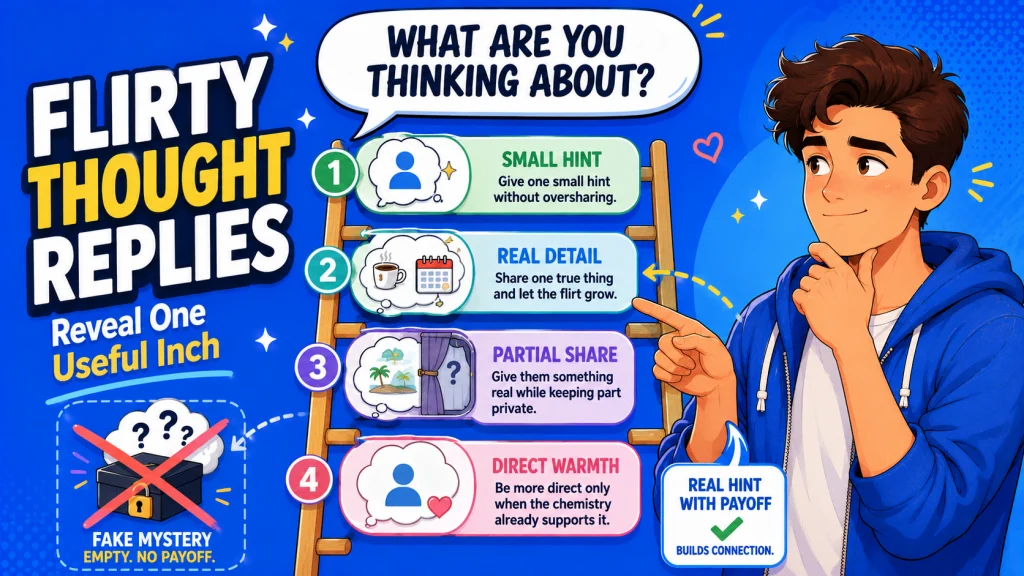
The best flirty responses to “what are you thinking about?” do not depend on inventing a secret. The useful choice is how much of the real thought you want to hand over, because one honest inch gives the other person something to answer. You can mention them, mention the real thing you were thinking about, or keep part of it private while still sounding open. That is usually more charming than acting as though your inner life suddenly needs a velvet rope around it.
Nine years behind a bar taught me that the lines people can actually say with a straight face usually give the other person something concrete to work with. A reply can be playful without making the other person drag the answer out of you. This question sits naturally beside other flirty text openers because it gives you room to choose the temperature of the conversation. Just do not treat ordinary curiosity as proof that the person asking is already flirting with you.
| How much you reveal | What the reply does | Best fit |
|---|---|---|
| One small hint | Names them without making a confession | Early chemistry or a light text exchange |
| One real detail | Starts honest, then adds warmth | When you actually have something on your mind |
| Playful partial answer | Keeps some privacy without going blank | When you want intrigue with a payoff |
| Direct attraction | Says the quiet part clearly | When the chemistry is already established |
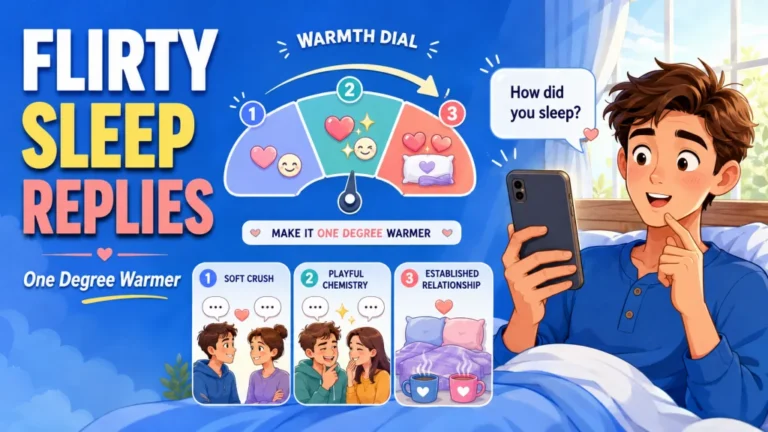
I think of that as a disclosure ladder, not a courage test. You are allowed to stay on the first rung if that matches the relationship, and you are allowed to climb higher when the exchange has already earned it. I organized these flirty response ideas for “what are you thinking about?” by disclosure level because the amount you reveal matters more than whether a line sounds cute, bold, or mysterious. The cleverest line in the world still feels strange if it asks the conversation to jump three levels at once.

Quick flirty answers when they actually are on your mind
If the honest answer is them, you have already been handed the easy version of this question. You do not need a speech, and you definitely do not need to turn one thought into a declaration. A short answer lets the interest land without making the other person manage a huge emotional moment. The trick is to sound pleased that they caught you, not embarrassed that you were thinking about them.
These work best when there is at least some warmth in the conversation already. They are flirty answers to “what are you thinking?” that leave room for the other person to lean in, tease you, or change the subject without feeling cornered. If you are unsure whether the energy is mutual, choose the lighter end of the list and keep the wording easy. One small signal is enough to see what the conversation does next.
- Honestly, you made the list.
- You, a little more than I planned.
- I was wondering when you would ask.
- You crossed my mind and apparently stayed.
- Mostly whether you know how distracting you are.
- I had a normal thought, then you texted.
- You, but I was trying to look productive.
- Something with your name attached to it.
Them: “What are you thinking about?” You: “You crossed my mind and apparently stayed.” Them: “Apparently?” You: “I am trying not to encourage you too much.”
That last exchange works because the first reply answers the question before the tease begins. The second line adds personality, but it does not erase the honest signal you already gave. Most people get this backward and hide the answer so well that the flirting has nothing to stand on. Give the truth a little daylight first, then play with it.
Honest replies that mention something real first
Sometimes you were not thinking about them at all, and that is not a problem you need to fix. Start with the real thing, then let the flirt live in how you invite them into it. A playful flirty response to “what are you thinking?” can be as simple as naming the boring thought and adding one warm turn. The honesty keeps the line from sounding like you pulled it off a shelf.
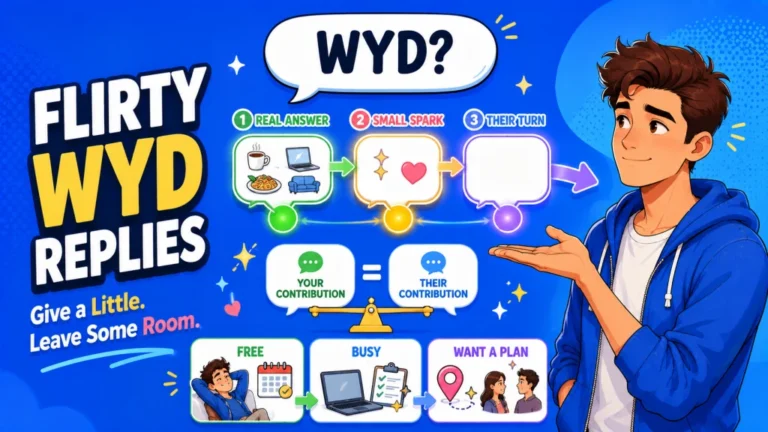
I prefer this style because it gives the other person an actual thread to grab. Food, a project, a place you want to go, a ridiculous decision you are avoiding, or something you saw earlier can all become a natural opening. If the easier opening is what you are up to rather than what is in your head, these flirty responses to what are you doing use the same kind of grounded starting point. You are not replacing your thought with flirting, you are letting the person into it and showing that you are glad they asked.
- I was deciding what to eat, but now I am wondering what you would pick.
- I was thinking about getting out of the house, and you are suddenly making that idea better.
- I was replaying something funny from earlier, and now you have interrupted the rerun.
- I was trying to solve a boring problem, so your timing is excellent.
- I was thinking about my weekend, and now I am curious what yours looks like.
- I was making a mental list, and you just added yourself to it.
- I was thinking about coffee, which somehow feels less interesting now.
- I was deciding whether to be responsible, and then you appeared.
Them: “What are you thinking about?” You: “Whether I should go out or stay in.” Them: “Which one is winning?” You: “Depends who is trying to change my mind.”
The useful part here is that the flirt grows out of something true. You could send the first answer by itself and still sound normal, which is a good test for whether the line is carrying too much performance. Then the second beat opens the door without pretending the whole evening was secretly about them. That balance is what keeps honesty from feeling flat and flirting from feeling staged.

Playfully mysterious replies without fake secrecy
Mystery works better when there is actually something behind it. If you answer with nothing but “you will never know,” you have not created intrigue, you have created homework for the other person. Give them a piece they can respond to, then hold back the part you genuinely want to keep. That makes the mystery feel playful instead of manufactured.
The cleanest version is a partial answer with a visible edge. You might tell them the thought involves them, admit it is flattering, or let them know they are close without turning the exchange into a guessing marathon. I have watched too many conversations lose momentum because someone thought being vague automatically made them interesting. It does not, especially when the other person has to do all the work after your line.
- I will give you a hint: you are not completely unrelated.
- Something I might tell you if you behave.
- I can tell you half of it, and the half is you.
- You are involved, but I am keeping one detail for myself.
- It started innocent enough, then you made an appearance.
- I have an answer, but you only get the edited version for now.
- I was thinking something flattering, which is all the information you get.
- You are warmer than your last guess would be.
Them: “What are you thinking about?” You: “Something flattering, but I am keeping one detail.” Them: “Now I need the detail.” You: “That is a much better reason to ask again.”
Notice that the first answer already gives them a reward. They know the thought is flattering, so the held back detail has a shape instead of being an empty locked box. That is the difference between playful privacy and fake secrecy. You can keep a little back without making the other person audition for basic information.
Direct replies when chemistry is established
Once the flirting is already obvious on both sides, you can stop pretending the answer needs camouflage. Direct does not have to mean intense, it can simply mean naming the attraction without padding it with twelve jokes. This is where a clear line often feels smoother than a mysterious one because neither person needs the extra disguise anymore. If you are already trading compliments, making plans, or openly teasing each other, a straightforward answer can feel like relief.
The important part is keeping the size of the statement proportional to the moment. Saying you were thinking about their smile is direct, while suddenly outlining an imagined future together is a completely different level of disclosure. If the chemistry is established, trust the signal you already have instead of trying to make the line more dramatic. You are flirting, not submitting a closing argument.
- Your smile, since you asked.
- How much I like talking to you.
- The fact that I would rather see you than keep texting about it.
- Whether you are this distracting in person on purpose.
- How good you looked the last time I saw you.
- Whether you know I like you yet.
- What I am going to say when I see you next.
- You, without the mysterious version this time.
Them: “What are you thinking about?” You: “How much I like talking to you.” Them: “That is suspiciously sweet.” You: “I can ruin it with a joke if you need me to.”
A line like that works because the direct part lands cleanly and the joke only softens the landing. It does not retract the compliment or turn sincerity into a trick. When the chemistry is there, hiding every real feeling behind irony can become its own kind of awkwardness. Say the thing, then let your personality show up around it.
If you do not want to share the actual thought
You are allowed to flirt without opening every drawer in your head. Maybe the thought is personal, unfinished, boring, or simply not something you want to explain. A privacy-preserving answer should still give the other person a tone to work with, which is why “not telling” usually lands better when it includes warmth. The goal is not to punish them for asking, it is to keep your boundary without making the conversation suddenly feel cold.
This is also where people sometimes overcorrect and invent a dramatic secret because they think privacy needs a performance. It does not. You can say the thought is staying with you, then offer another direction for the conversation. That keeps your actual thought private while making it clear you are still happy to talk.
- That one is staying in my head, but you can ask me something easier.
- I am keeping that thought, but I am not ignoring you.
- Private thought, good mood, you can work with the second part.
- I am not sharing that one yet, but I like that you asked.
- That thought is mine, but you can give me a new one.
- I will keep the thought and answer a different question.
- Not telling, but I promise the silence is not dramatic.
- I am keeping that one, so distract me with something better.
The strongest boundary here is usually the least theatrical one. You do not owe an explanation for why you are keeping a thought private, and you do not need to make the other person chase harder to prove they care. A simple limit plus a conversational opening is enough. If they respect it, the exchange can keep moving without turning your privacy into the main event.

Turn the question back without dodging it completely
Sending the question back can be flirty, but only if you answer at least a little first. A bare “what are you thinking about?” in return often reads like you threw the work back across the table. Give them one piece of your answer, then ask for theirs so the exchange feels mutual instead of evasive. That small bit of disclosure is what turns a dodge into a conversation.
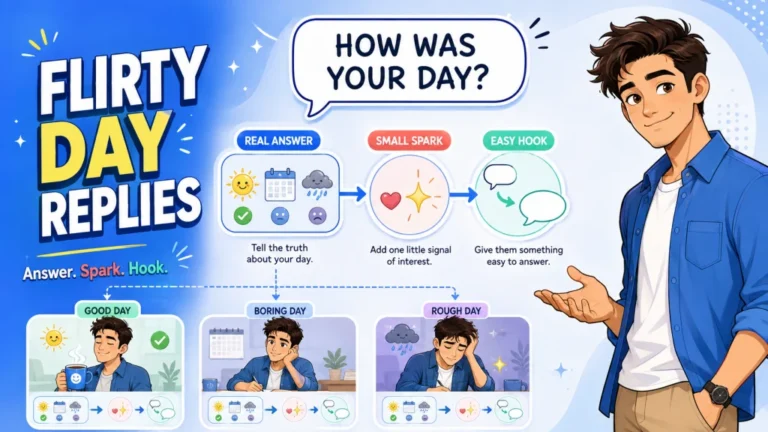
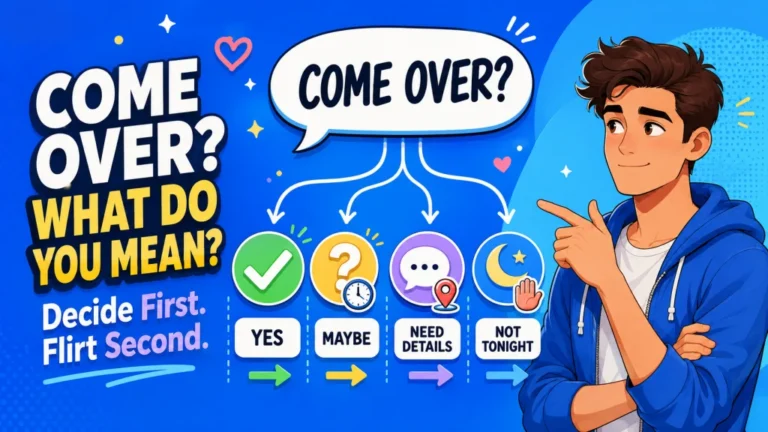
This works especially well when you want to test the tone without making a bigger move. The broader set of flirty replies for common texts follows the same principle: match what is actually happening before you raise the temperature. You can be curious and interested at the same time, and the return question gives them room to show you where they are. If they keep it casual, you can stay casual too.
- You crossed my mind. What were you hoping I would say?
- Something good. What is on yours?
- I have an answer, but I want yours first.
- A little bit about you. Fair trade, what about me?
- I was wondering what you were doing. Now your turn.
- Something I can tell you, but I want to know why you asked.
- I was thinking you sounded curious. What brought that on?
- You get one honest answer if I get one back.
The return question should create room, not pressure. “What were you hoping I would say?” is playful when the exchange is already warm, but it can feel pointed in a colder conversation. Pick the version that lets them answer easily without having to confess anything. Mutual flirting works better when both people can move one step at a time.
What not to send: fabricated fantasies, pressure, or mystery with no payoff
The fastest way to make this question weird is to answer a much more intense question than the one you were asked. If you were thinking about laundry, do not invent a cinematic fantasy because you think a flirty answer needs production value. If the chemistry is uncertain, do not use the moment to force a confession out of the other person either. The line should make the conversation easier to continue, not hand them a new social problem to solve.
The other common miss is making the other person carry the whole exchange. “Guess,” “you would not understand,” or “I cannot tell you” can work once if you plan to give them something on the next beat. Repeating the same vague move just turns flirting into work. One hint is enough to keep the exchange moving.
- Do not invent intimate fantasies you do not actually mean.
- Do not imply they owe you a flirty answer back.
- Do not turn a casual question into a test of their feelings.
- Do not make them guess through five rounds with no new information.
- Do not claim they are obviously thinking about you too.
- Do not use privacy as a way to make them chase harder.
A useful check is whether your reply gives them more freedom or less. The better lines give them several easy ways to respond, flirt back, ask a question, laugh, or keep things light. The worse lines demand one specific reaction and make anything else feel like rejection. Keep the door open rather than standing in it.

Final thoughts: reveal one useful inch
“What are you thinking about?” does not require a perfect line, it requires a choice about how much you want to reveal. Start with one real piece, then decide whether the moment calls for a hint, a tease, a direct compliment, or a clean boundary. That one useful inch keeps the reply proportionate to the relationship and leaves the other person room to respond. You are choosing a disclosure level, not trying to win the conversation.
If they really are on your mind, say so in a size that fits the relationship. If they are not, use the real thought and let the flirt grow naturally from there. If you want privacy, keep it without making them earn access through a guessing game. The best reply is the one that sounds intentional when you read it back, not the one that sounds most impressive on a list.
FAQs
The questions below come up because this kind of text sits right between ordinary curiosity and possible flirting. The answer changes with the relationship, so I would not read romantic intent into the question by itself. What you can control is how much interest you show and how much of the actual thought you keep. That is usually enough to keep the reply natural.
Shorter is also easier to recover from if the tone turns out to be different from what you expected. A light answer can become warmer if they flirt back, while an intense answer is harder to shrink after it lands. I would rather give the conversation room to reveal itself than force a meaning onto one question. Use the smallest reply that still says what you want it to say.
💬 What is a good flirty reply to “what are you thinking about?”
Try something that answers before it teases, such as “You crossed my mind and apparently stayed.” It shows interest without turning the moment into a confession. If the chemistry is newer, keep it lighter. If it is established, you can be more direct.
😉 How do I answer without sounding too forward?
Reveal one small thing and leave the rest alone. “You made the list” is warmer than a neutral answer but still easy to respond to. Avoid jumping straight to intimate fantasies if the conversation has not gone there. Let the other person show you whether they want to raise the temperature.
🤐 What if I do not want to tell them what I am actually thinking?
Keep the thought private without making the boundary dramatic. Say something like “That one is staying in my head, but you can give me a new thought.” You have answered the social moment without giving away the private content. You do not owe a longer explanation.
✨ Is “you” a good answer to “what are you thinking about?”
Yes, if you actually mean it and the relationship can carry that much directness. By itself, “you” is simple and clear, which can be its advantage. Add a small tease if you want it to feel lighter. Do not use it just because you think every answer has to be flirty.
🔁 Should I ask “what are you thinking about?” back?
Yes, but give them part of your answer first. A line like “A little bit about you, what is on your mind?” feels mutual instead of evasive. The return question works best when it continues the same tone. A bare question back can sound like you dodged theirs.
🧭 Does this question mean someone is flirting with me?
Not by itself. Someone can ask because they are curious, because you got quiet, or because the conversation has a flirty tone already. Read the surrounding exchange rather than treating one sentence as proof. You can still choose a light flirty answer if that is the direction you want to test.