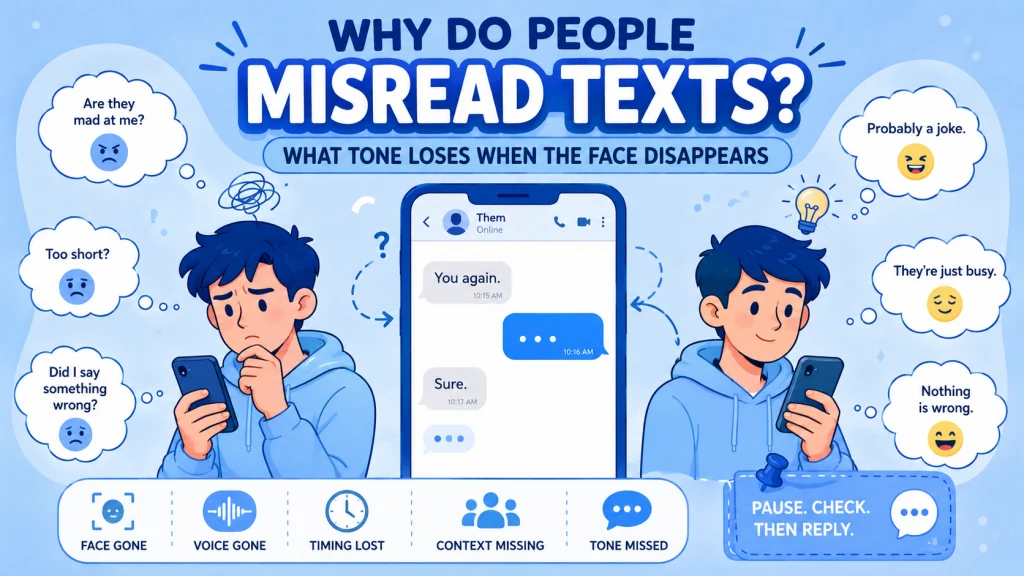
Texts lose more than just the words. The face is gone. The voice is gone. The pause before someone answers, the look they held a beat too long, the specific warmth or edge in a delivery: all of it vanishes the moment a conversation moves to a screen. Why people misread texts so reliably is not a mystery once you understand what information is actually missing. This piece breaks that down, explains why certain kinds of messages fail harder than others, and gives a practical rule for what to do before you reply to something you are not sure you read right.
The Same Sentence in Two Very Different Rooms
Behind a bar, I watched people say identical things in completely different ways without changing a single word. “You again” is a warm joke between two regulars who have been coming in for years. It is also the kind of flat greeting that ends a conversation before it starts. The difference was never the sentence. It was the face that came with it, the pace of delivery, whether there was a pause before or after, what had happened between those two people the last time they shared the same room. Nine years of watching that play out taught me something simple: words are actually one of the smaller parts of what gets communicated between people in real time.
Over text, that whole layer disappears. The same “you again” arrives as a string of characters on a screen, and the reader does what readers always do when information is missing: they fill the gap with whatever they were already feeling. If they were anxious going in, the message reads cold. If they were relaxed and expecting something good, it reads playful. The words did not change. The context the sender was standing in did not travel with them. That is the whole problem, and it is more structural than most people realize.

What a Text Cannot Carry
Researchers who study face-to-face communication describe what gets communicated beyond words as extra-linguistic cues: tone of voice, facial expressions, the timing and speed of a response, the direction of a glance, the pause that means someone is still thinking versus the pause that means they are done engaging. Celia Klin, a psychology professor at Binghamton University whose research focuses on text messaging, put it directly: “When speaking, people easily convey social and emotional information with eye gaze, facial expressions, tone of voice, pauses, and so on. People obviously can’t use these mechanisms when they are texting.” None of those cues transfer. What does transfer is text, and text has to work a lot harder to carry the same weight.
| Cue | In person | Over text |
|---|---|---|
| Facial expression | Visible, immediate, continuous | Absent; reader infers from context |
| Tone of voice | Tells you immediately if something is sarcastic, warm, or irritated | Gone; punctuation and word choice do partial work instead |
| Response timing | A pause in conversation is natural and expected | Silence reads as deliberate; fast replies read as eager or anxious depending on the relationship |
| Punctuation | Not part of spoken language at all | Carries unintended signals: a period on a short reply consistently reads as colder and less sincere than no punctuation |
| Shared history | Sitting between two people, active in the room | Requires the reader to consciously remember and apply it, which they often do not |
That last row is the one people underestimate most. Two people can have years of inside jokes, established dynamics, and a clear sense of how the other person communicates, and still misread a text because the history did not show up in the message. Context has to be actively reconstructed in text. In a room, it is just there.
Two Situations Where Misreading Gets Expensive
Short replies and humor are the two places where the gap between intention and reception gets widest, fastest. Short replies first. Research out of Binghamton University found that a one-word response ending with a period was rated as less sincere than the exact same word sent without punctuation. Not just vaguely less sincere, but measurably less sincere in the study. The person sending “Sure.” after a reasonable question probably just responded quickly without thinking about it. The person receiving it reads something closer to barely concealed irritation. The period did not intend anything. But the reader has nothing else to go on, so the punctuation becomes the tone.
Humor is harder. A joke told face-to-face has the delivery, the timing, the slight smile before the punchline, and the eye contact that makes it clear no one is actually being serious. A joke in a text has none of that. What makes something funny out loud, the shared context, the tone of voice, the visible absence of malice, all has to be reconstructed from a sentence. Sometimes it comes through. A lot of the time it lands flat, or worse, it lands as a genuine insult because the reader had no way to see the face behind it. I once watched a friend lose a weeks-long texting streak over a joke that would have landed perfectly if they had been in the same room. The words were fine. The delivery mechanism was not.
Three Tone Moments That Go Wrong for Different Reasons
The kind of misread that happens depends heavily on what type of exchange you are in. Funny texts, cutting texts, and flirty texts each fail in their own specific way, and understanding which failure is happening shapes how you should reply, or whether you should reply at all.
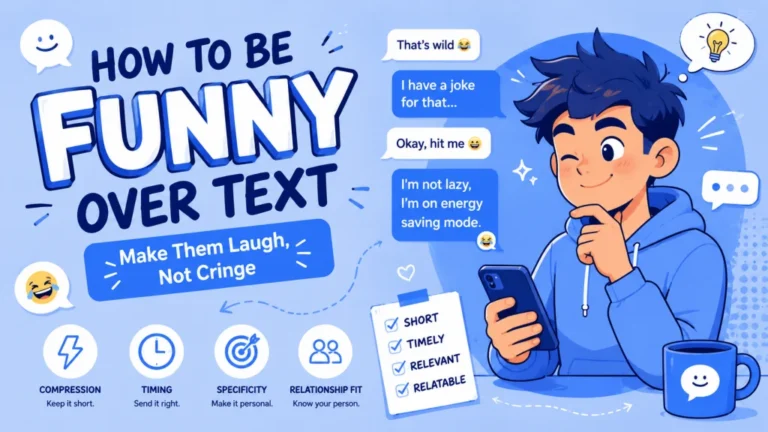
With humor, the risk is that the absence of tone turns a joke into a statement. Someone sends something self-deprecating or absurd and it reads as genuinely sad or passive-aggressive instead. This is where knowing that the person is someone who trades in dry humor matters a lot, because without that context, dry humor and genuine coldness are indistinguishable on a screen. If you are trying to send something funny and not sure how it will land, the full range of options for calibrating that kind of reply is something the funny replies side of this site is built around, specifically because tone-matching in humor is harder than it looks.
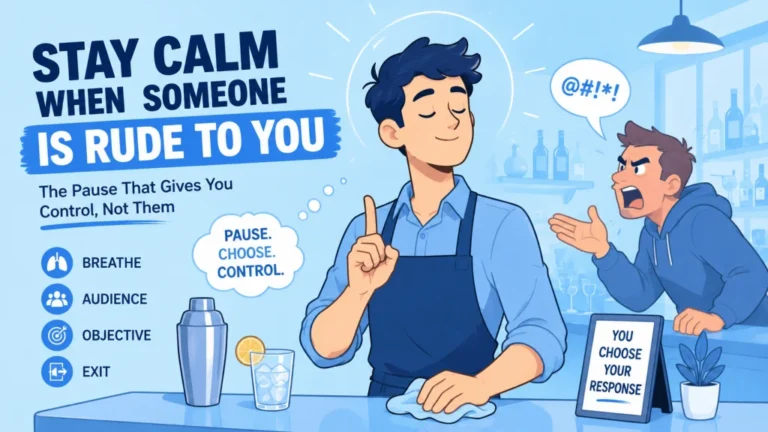
With sharper or more cutting texts, the failure mode runs the other direction: something intended as a quick, witty shutdown reads as genuinely hostile or disproportionate without the face behind it. The line between a clever comeback and a rude one is almost entirely in the delivery, and delivery does not exist in text. A comeback that would have gotten a laugh in a room can come across as vicious in a message thread because the reader has no visual cue telling them you were not actually angry. That gap is exactly what savage comebacks are designed to navigate, lines sharp enough to land but calibrated well enough not to cross into something harder to walk back.
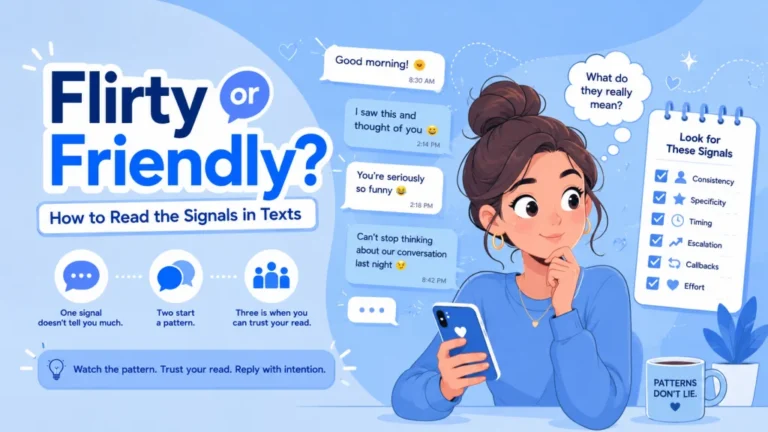
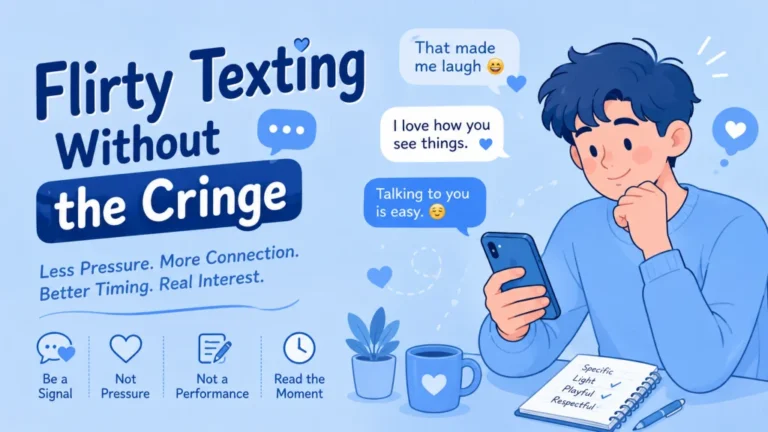
Flirty texts sit in the most ambiguous position of all. Warmth and friendliness read identically over text if the sender has not found a way to signal the difference, and even when they have, the receiver often does not trust the signal. A study on emoji use in interpersonal communication found that emojis can clarify emotional intent, but only when they are consistent with the tone of the text itself. An emoji that contradicts the text tends to create more confusion, not less. Which means even the tools people reach for to add warmth can backfire if they are not matched to the words around them. Getting that calibration right before you send something in the flirty replies direction is worth the extra second it takes.

One Rule Before You Reply to Something That Reads Wrong
The practical version of all of this is simple: assume less certainty before you escalate a response. Most misreads are not about the words. They are about the information that did not travel with the words. Before deciding someone is being cold, passive-aggressive, or aggressive toward you over text, run through a short checklist.
- Is there a simpler explanation? Most short, blunt replies are just short and blunt, not hostile. The period at the end of “Fine.” is probably punctuation, not a verdict.
- Do you actually know this person’s texting style? Someone who always writes in lowercase, sends one sentence at a time, or never uses exclamation points is not being cold with you specifically. That is just how they text.
- What were you already feeling before the text arrived? Your read of a message is heavily shaped by your mood going in. An anxious day makes neutral texts read as negative. A good morning makes ambiguous texts read as fine.
- Would this land differently if they had said it out loud in front of you? If the answer is yes, the problem is probably the medium, not the message.
None of this guarantees you will always read it correctly. What it does is introduce a pause between the text arriving and the reply going out, and that pause is usually where the most avoidable escalations get stopped.
Final Thoughts: Low Signal Is Not the Same as Bad Communication
Texting is not broken communication. It is low-signal communication. The same things that make it fast, asynchronous, and low-pressure to use also strip out most of the contextual information that makes tone readable in real time. That is not a flaw in the people using it. It is a structural feature of the medium. Knowing that does not fix every misread, but it changes how personally you take one. If someone’s text reads cold and you cannot tell why, the most likely explanation is not that something is wrong, it is that something is missing. Often it is just a face, a voice, or a room the two of you were not actually in together.
The version of this that matters for how you reply is the same one it always comes back to: before you respond to a tone you are not sure about, make sure you are responding to what was actually sent and not just to the story you filled in around it.
FAQs
🤔 Why do texts so often get misunderstood?
Because most of what makes tone readable in real conversation, the face, the voice, the timing, the shared physical context, does not transfer to text. What is left is words, punctuation, and whatever story the reader fills in around them. That story is usually shaped more by how the reader feels than by what the sender intended.
😬 Why do short text replies feel rude or cold?
Because brevity without warmth signals reads as flat, and a period at the end of a short reply amplifies that. Research found that one-word replies ending with a period were consistently rated as less sincere than the same word without punctuation. Most people who send them are not trying to be cold. The format is just doing the work for them.
💬 How do you tell if a text tone is intentional or just bad communication?
Start by checking whether the tone is consistent with how that person normally texts, and whether it would read the same way if they had said it out loud. If the answer to either is no, the medium is probably more responsible than the sender. Escalating a reply based on a read that might be wrong is usually the more expensive mistake.
😅 Why do jokes in texts land so differently than in person?
Humor depends heavily on delivery: the face, the timing, the visible absence of actual malice. None of that travels over text. A joke that would get a laugh in a room can read as a genuine insult in a message thread because there is nothing to tell the reader you are not being serious. Dry humor is especially vulnerable to this.
📱 Do emojis actually help with tone in texts?
Sometimes. Research shows emojis can clarify emotional intent when they match the tone of the text. When they contradict the text, they tend to create more confusion rather than less. An emoji does not fix a message that is already ambiguous. It just adds another layer the reader has to interpret.
Sources and References
- Gunraj, D. N., Drumm-Hewitt, A. M., Dashow, E. M., Upadhyay, S. S. N., & Klin, C. M. (2016). Texting insincerely: The role of the period in text messaging. Computers in Human Behavior, 55, 1067-1075. View on ScienceDirect
- Binghamton University. (2017). Study: Punctuation in text messages helps replace cues found in face-to-face conversations. View press release
- Hand, C. J., Ryder, H. C., & Filik, R. (2022). Interactions between text content and emoji types determine perceptions of both messages and senders. Computers in Human Behavior Reports. View on ScienceDirect