“You can’t handle me” is a dare when it comes with a grin. It is something else entirely when someone delivers it like a verdict on themselves. The replies here are built for the first version: sixty responses sorted by tone, from light and playful to direct and bold, with a separate set for when the line tips past teasing into something more self-satisfied than it needed to be. The goal throughout is the same: match the energy without looking like you care more than they do.
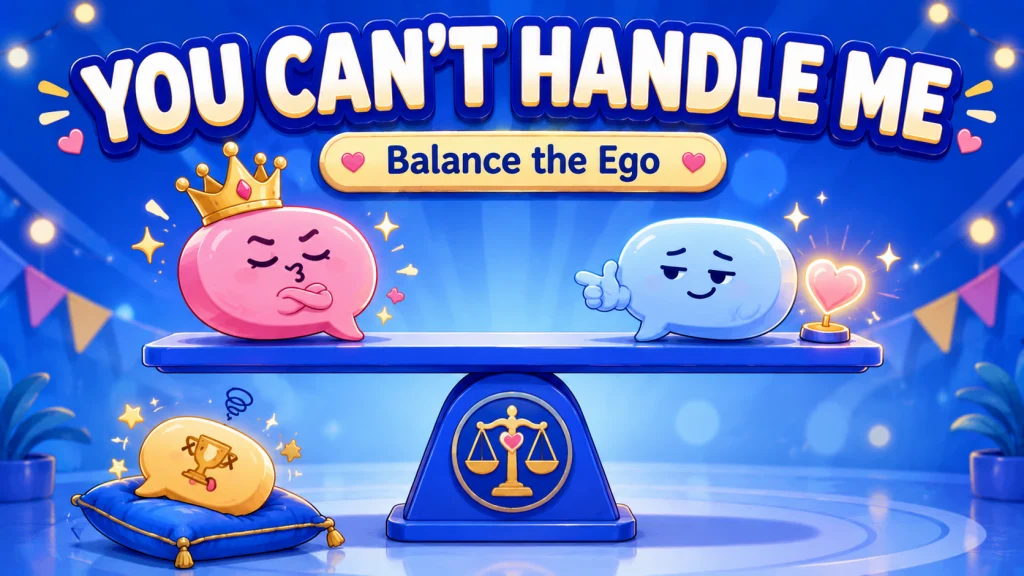
When the Line Is a Dare and When It Is a Statement
“You can’t handle me” does two very different things depending on the delivery. Said with a grin and a glance away right after, it is basically an invitation. The kind of thing someone throws out when they want to see what you do with it, and they will find you more interesting if you push back. Delivered with real self-satisfaction and no humor behind it, it stops being a game and starts being a personality trait they seem proud of.
I have watched this line get used across bars in three cities, and the split was obvious almost every time. The ones that were clearly flirting came with a smirk, usually right before looking away to see what the other person did next. The ones that were not came with someone nodding slowly at their own statement, waiting for a reaction that confirmed the premise. Same five words. Different reply needed. The table below breaks down the five tones covered here, so you can find the one that matches what actually happened.
| How they said it | What it probably means | Reply type to reach for |
|---|---|---|
| Grinning, light, clearly testing you | Come back at me | Playful challenge |
| Calm, direct, holding your eye | Interested, making you earn it | Confident reply |
| Softer, almost like a question | Testing whether you will stay | Soft reply |
| Clear history between you, real teasing | Expects you to match the energy | Bold reply |
| Genuine self-satisfaction, no playfulness | A statement, not a dare | Deflating reply |
One thing worth keeping in mind before the lists: the ego balance here is the whole move. The replies that land well do so because they do not need to win. They meet the energy, leave the other person somewhere to go, and do not perform so hard they start looking like the more invested party. The ones that misfire usually do so because someone came back too strong and made a light moment feel like a competition.
Playful Challenge Replies: Meet the Energy
These are for when the line was clearly an invitation. Someone said it with a grin, probably looked away right after, and what they meant was: push back. Show me something. The right reply in this situation does not try to out-clever them, does not get defensive, and does not write a paragraph explaining why the claim is wrong. It meets the dare with some ease and returns the ball.
The reply I have handed out the most in this situation is some version of “Try me.” Two words, no ceremony, and it answers the challenge while flipping it right back without burning a sentence on it. Which is exactly the kind of economy the best playful flirty comebacks run on: short, unhurried, and just enough to keep the other person going.
- “Try me.”
- “Sounds like a challenge.”
- “You keep saying that. Yet here you are.”
- “Is that a warning or an invitation?”
- “Bold claim. Prove it.”
- “I’ve heard that before. Still here.”
- “Pretty sure I could manage.”
- “That’s what they all say.”
- “Challenge accepted.”
- “I’ve handled worse. Way worse.”
- “I don’t know, I’m doing okay so far.”
- “You may want to rethink that.”
- “Sounds like you’re giving me a reason to find out.”
- “That’s an interesting way to start.”
- “Then again, you won’t know until you try.”
The common quality across all of these is that none of them flinch. They receive the line, stay easy, and give something back that keeps things moving. That is the only job here.
Confident Replies: Take the Bait Lightly
These replies do not push back so much as they simply do not move. Someone made a claim meant to get a reaction, and you are choosing to be quietly unimpressed, in a way that reads as more interesting than being rattled would have been. The tone is grounded. Not cold, not uninterested, just not especially thrown by what was said.
There is a version of this that reads as performing unbothered, which is its own kind of tell. The goal is not a production. It is saying what you would genuinely say if the claim did not intimidate you, because it does not. That distinction is subtle but people pick up on it. Short sentences help more here than long ones do.
- “I’m not worried about it.”
- “I’ve been told that. Turns out they were wrong.”
- “The ones who say that usually mean the opposite.”
- “I don’t scare easily.”
- “You’d be surprised what I can handle.”
- “I’m not the one who looks nervous right now.”
- “I think you underestimate me.”
- “That’s cute. Keep going.”
- “Noted. Still interested.”
- “Good thing I like a challenge.”
- “I’ve heard scarier things.”
- “Honestly, I’m not that easy to shake.”
- “The bar seems manageable.”
- “Oh, I can handle a lot.”
- “I’m not as intimidated as you think.”
These work best when you actually mean them. Delivered with real ease they land as confident. Delivered to hide nerves, they read a little hollow. Tone carries more weight than the specific phrase, which holds true across most flirty replies where the delivery and the words are doing equal parts of the work.

Soft Replies: Keep It Easy
Not every reply needs to be a counter-move. Sometimes the right response to this line is something that does not try to win at all, something that just holds the thread and shows you are not going anywhere. These are for when you want to stay in the conversation without escalating it. Warm, a little self-aware, no performance required.
Someone handed me her phone once, mid-conversation, asking what to send back to this line. She had met the guy two days before, liked him, but did not want to match his energy so hard she looked like she was auditioning for something. I told her to just say “I mean, I’m still here.” She did. He replied immediately. The soft reply is more effective than people expect, partly because it is honest in a way that a sharp comeback rarely is.
- “You might be right. Let’s find out though.”
- “I mean, I’m still here.”
- “Well, now I have to know.”
- “Maybe not, but I want to.”
- “Is that your way of keeping me around?”
- “Worth finding out.”
- “I’d like to try.”
- “I appreciate the heads up. I’ll stay anyway.”
- “Okay, but I’m not going anywhere.”
- “That might be the nicest warning I’ve ever gotten.”
- “You say that, but I’m pretty stubborn.”
- “I kind of hope that’s true.”
Admitting you are staying anyway lands differently than proving you can match them. It signals interest without competing, and there is something a lot more appealing about that in the early stages of any of this.

Bold Replies: Only With Established Chemistry
These require real context, not just one good date or one conversation where everything clicked. These are for when there is already a real history of teasing between you, when the line lands exactly as the dare it was meant to be, and when you know the other person will read the reply correctly because you have had enough exchanges to know how they take things.
Used too early, these read as someone performing confidence. Used at the right moment with the right person, they are exactly what the situation was asking for. If you want to push even further into that territory, the prove it flirty replies take that same energy and run with it more directly.
- “I know. That’s why I’m still here.”
- “Give me a weekend and let’s see.”
- “You’re going to have to do better than a warning.”
- “I’ve been waiting for someone who says that.”
- “Good. Boring is not really my thing.”
- “I hope not. This should be interesting.”
- “Say that again, but mean it this time.”
- “I’m not trying to handle you. I’m just enjoying the problem.”
- “Less talking, more proving.”
- “Let me be the one to decide that.”
“I’m not trying to handle you. I’m just enjoying the problem.”
That one sidesteps the original framing entirely. It does not accept the challenge on their terms. It offers a different angle on the whole thing, which tends to be the more interesting move when you actually have the chemistry to pull it off without it sounding like a rehearsed line.
Deflating Replies: When It Was Not Actually a Dare
Sometimes the line tips past playful. Not aggressive, not mean, but missing the lightness that would make it an invitation. When “you can’t handle me” arrives with genuine self-satisfaction and no humor in it, the flirty reply is the wrong read. Leaning into it would just be confirming a frame they set without asking.
The deflating reply does not argue the point. It does not insult anyone. It just steps sideways out of the game without making anything of it, which turns out to be a much more useful skill than it sounds once you have had to use it a few times.
- “Most people who say that are pretty easy to read, actually.”
- “That’s a lot of confidence for someone I just met.”
- “Good to know. I wasn’t planning to try.”
- “Okay.”
- “Interesting opening line.”
- “Is that what you tell everyone?”
- “I’ll take your word for it.”
- “Bold. We’ll see.”
The single-word reply, just “Okay,” is consistently underestimated. It refuses the premise without engaging it and is nearly impossible to argue with. Someone who was fishing for a reaction does not quite know what to do with a calm, completely flat acknowledgment. That tends to be the most effective move available.
What Not to Say When Someone Says You Can’t Handle Them
Three patterns tend to misfire here, and they are worth naming because they come up regularly.
The first is going competitive. Launching into reasons why you actually can handle them, or pivoting to why you are the complicated one actually, turns a light tease into a debate nobody signed up for. The original line was a dare, not an argument. Treating it as one makes the whole thing heavier than it needed to be and rarely goes anywhere useful.
The second is the aggressive comeback. Something meant to sound sharp and impressive that lands as mean instead. “You can’t handle me” as a flirty line is an opening, not an insult, and meeting it with actual hostility misreads the room. If the line genuinely annoyed you, the deflating replies above are the right tool. A put-down is not.
The third is adding sexual pressure before the conversation has earned it. Some of the bold replies above carry heat, but they work because they stay just vague enough to be read a few different ways. Pinning the reply to something explicitly sexual before the other person has indicated they are in that space creates discomfort far more often than it creates anything good.
Short version of all three: match the energy that was actually there. If it was playful, play back. If it was not, step out cleanly. Both are better than performing a reaction the moment did not ask for.
Final Thoughts: The Reply Matters Less Than the Energy Behind It
“You can’t handle me” is one of those lines where how you respond matters less than the ease you bring to it. Someone who answers a dare with genuine calm is more interesting than someone who fires back the sharpest possible reply while visibly working for it. These sixty replies are meant to give you something real to work with, not a script to perform against a situation that needed something human.
The same logic holds across most moments where the other person sets a frame and you have to decide how to meet it. Sometimes the line is a challenge like this one. Sometimes it is more of a direct question where the tone is different and the reply works differently too. The flirty replies to are you single cover that version, where someone opens with a question rather than a claim, and the reply has a different job to do as a result.
Here, the reply works when you mean it. That is the only rule that actually holds across all sixty.
FAQs
💬 What do you say when someone says you can’t handle them?
Depends how they said it. If they were clearly teasing, something short works best: “Try me” or “I’ve heard that before, still here.” If there was no lightness in it, a flat “Okay” or “Good to know” steps out cleanly without making anything of it. Reading the delivery matters more than picking the perfect line.
📱 How do you respond to “you can’t handle me” over text?
Keep it short. One reply, one bubble, leave them somewhere to go. “Try me,” “Noted. Still interested,” or “I mean, I’m still here” all read well on screen without coming across as over-invested. The longer the reply, the more it looks like the line landed harder than it should have.
🤔 Is “you can’t handle me” a flirty thing to say?
Sometimes, yes. It depends entirely on the delivery. Said with a grin and no real weight behind it, it is basically an invitation to push back. Said with genuine self-satisfaction and no humor in it, it is more of a statement than a dare. You can usually tell which one it is within about two seconds of paying attention to how they are holding the rest of the conversation.
😎 What is a confident comeback to “you can’t handle me”?
The ones that work best do not flinch. “I don’t scare easily,” “I think you underestimate me,” or “The ones who say that usually mean the opposite” all hold ground without getting competitive. Say whatever you would say if the line genuinely didn’t register as a threat, and it will not come across as a line at all.
🎯 When should you not flirt back when someone says you can’t handle them?
When there was no playfulness in how they said it. If the line came with real pride and no invitation behind it, a flirty reply just rewards the framing. Step sideways instead. “Good to know” or a plain “Okay” both close it without engaging it, and that tends to be the more effective call.