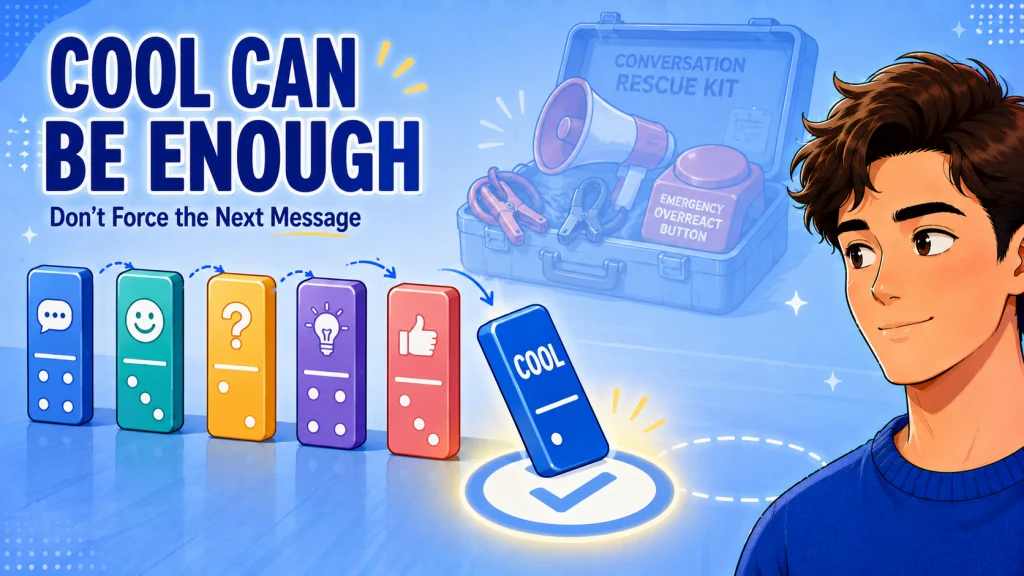
When someone replies with “Cool,” the smartest move is not automatically to rescue the conversation. Sometimes the word already did its job by showing approval or acknowledgment, and forcing another exchange only makes a simple moment feel awkward. If you do want to answer, keep it proportional: joke lightly, confirm what matters, pivot to a fresh topic, or let the thread end. The best reply depends less on the word itself and more on what you said right before it.
Quick funny replies
If you are figuring out how to respond to Cool, start with one small question: did the word already finish the job? If you said, “I booked the table,” and they answered, “Cool,” you probably received approval, not an invitation to perform CPR on the chat. A simple update can earn a simple acknowledgment. A brief reply does not automatically ask you to prove the conversation is still alive.
I learned to notice that distinction behind a bar, where people often felt compelled to fill every quiet beat. The awkward part was rarely the short answer itself. It was the extra messages after a finished exchange, each one trying harder to get a bigger reaction. Once you stop treating every “Cool” like a locked door, the next move gets easier.
Funny responses to Cool work best when there is already some ease between you and the other person. The joke should tease the tiny size of the response, not accuse them of being boring, rude, or secretly uninterested. I have watched harmless teasing land well when both people already had that rhythm, and watched the same kind of line feel strangely aggressive between people who barely knew each other. Keep the joke small enough that they can laugh, answer, or simply move on without having to defend themselves.
- “A full four letters. Generous.”
- “Well, that settles absolutely everything.”
- “I can feel the enthusiasm from here.”
- “Careful, you are spoiling me with detail.”
- “Strong review. Very concise.”
- “I will frame that glowing endorsement.”
- “That was almost a sentence.”
- “Say less. Apparently.”
- “I see we are conserving syllables.”
- “Huge if true.”
- “I accept this prestigious rating.”
- “A thrilling development.”
- “You really left it all on the field there.”
- “I asked for a reaction, not a novel. Perfect.”
- “Cool received. Ceremony complete.”
- “That reply wore sunglasses indoors.”
- “Minimalism is alive and well.”
- “I will try not to get overwhelmed.”
- “And the crowd goes mildly interested.”
- “Excellent. I can work with four letters.”
If the other person often sends short messages, do not make the joke sound like a complaint disguised as wit. That is the mistake people make when they are annoyed but still want to look casual, and the irritation leaks through anyway. If you want more options for low-energy messages without turning them into a bigger drama, these funny responses to dry texts stay in the same practical lane. The goal is a little spark, not a courtroom exhibit about their texting habits.

When cool means genuine approval
Sometimes “Cool” is doing exactly what you needed it to do: approving a plan, choice, idea, or update. If you told someone you changed the reservation, picked a route, or handled a small task, their reply may simply mean they are good with it. In that situation, you do not need to squeeze a second emotional reaction out of them. Just confirm the practical point if one still exists, then let the exchange breathe.
- “Perfect, glad you are into it.”
- “Nice, I thought you might like that.”
- “Good, then we are set.”
- “Love it. I will go with that.”
- “Great, that was the answer I needed.”
- “Nice, I am glad that landed.”
- “Perfect. I will keep you posted.”
- “Good call.”
- “Excellent, I am doing it.”
- “Nice, then that is settled.”
- “Glad we agree.”
- “Perfect, I will take that as a yes.”
The best responses to a Cool text start by watching the message before it more closely than the word after it. If you asked, “Does this plan work for you?” and got “Cool,” a simple confirmation may be enough even if the wording is not technically a full sentence. I would only clarify when the practical detail actually remains unclear, not because the reply failed some imaginary enthusiasm test. A conversation can be warm, useful, and finished at the same time.
When it is just acknowledgment
Acknowledgment is even simpler than approval because it may not require any decision at all. You send a detail, they let you know they saw it, and that is the entire conversational job. People often overread this because a one-word response looks visually small on a screen, especially after they sent something longer. Small does not automatically mean cold; sometimes it just means there was nothing useful left to add.
- “Got it.”
- “Sounds good.”
- “Perfect.”
- “Thanks.”
- “All set.”
- “Works for me.”
- “Good deal.”
- “Nice.”
- “Yep, that is all I needed.”
- “Perfect, thanks for confirming.”
You also do not have to answer an acknowledgment with another acknowledgment just to keep the symmetry neat. If you text, “I left the key with the neighbor,” and they answer, “Cool,” silence is a perfectly normal next move. If you do reply, use one of the short lines above because it serves a real function, not because you feel obligated to produce one more bubble. That restraint usually sounds more natural than sending a question you did not actually want answered.

If you want to pivot to something new
Sometimes the original topic really is finished, but you still want to keep talking to the person and are deciding what to reply after Cool. That is where a clean pivot beats trying to force more life out of “Cool.” You are not asking them to revise their response or prove interest in the old topic. You are simply opening a new door because you genuinely have something else to say.
- “Anyway, I have to tell you what happened next.”
- “Now that is settled, how did your thing go?”
- “Speaking of that, did you ever decide?”
- “Okay, new question for you.”
- “Good. Now tell me the important part.”
- “Nice. What are you up to later?”
- “Perfect. I need your opinion on something else.”
- “Cool. I just remembered something you will appreciate.”
- “Done. So, about that other story.”
- “Good. What did you end up choosing?”
- “Nice. Are we still on for the plan we talked about?”
- “Perfect. What are you doing this weekend?”
- “Alright, switching topics before we become painfully efficient.”
- “Good. I have a much less boring question.”
The strongest pivots are specific enough to answer without sounding like an emergency attempt to save the chat. “So what else is up?” can work, but it often puts all the work back on the other person. A real question about something you already share gives them an easier handle, whether that is a plan, a story, a choice, or a running joke. You are continuing because you have a new thought, not because “Cool” failed to entertain you.
When to leave cool alone
Leaving “Cool” alone is often cleanest when the exchange has reached its natural end. If the plan is settled or the information was received, another message can create work where there was none. I have seen people make a normal ending awkward simply because silence felt like losing. A finished exchange does not need a winner.
- “Then we are good.”
- “Perfect, see you then.”
- “Great, talk later.”
- “All set on my end.”
- “Perfect, that works.”
- “Done and done.”
Those lines are useful when you want a clear close, but sending nothing is also normal. Check for an unfinished task, not for a minimum level of enthusiasm. If there is no question, loose detail, or new thought you want to introduce, let the exchange end. A quiet stop beats inventing a reason to keep tapping the glass.
Cool versus OK and Sure
“Cool,” “OK,” and “Sure” can all close a small conversational job, but they do not always feel identical. “Cool” often carries a little more casual approval, “OK” can read more purely as receipt, and “Sure” usually sounds closest to agreement when someone has asked for something. None of those meanings are fixed, because the relationship and the sentence before them still matter more than the dictionary. The useful distinction is practical: decide whether you received approval, acknowledgment, or permission to move ahead.
| Short reply | What it often does in context | Useful next move |
|---|---|---|
| Cool | Casual approval or acknowledgment | Confirm, joke lightly, pivot, or stop |
| OK | Receipt or neutral acceptance | Continue only if a detail is still open |
| Sure | Agreement or permission | Move the plan forward if needed |
- “Cool, I will take that as a green light.”
- “Perfect. Moving ahead.”
- “Nice, I am glad that works.”
- “Good, we have a plan.”
- “Alright, I will leave it there.”
- “Great, I will catch you later.”
Do not turn these tiny words into personality tests. If “Sure” is the reply that keeps tripping you up, these ways to respond to Sure separate agreement from the moments that still need a follow-up. For a wider range of dry and playful options, the main collection of funny replies gives you more room to match the moment. The useful move is still the same: answer the job the conversation is doing, not a motive you had to invent.
What not to send when cool feels flat
The worst responses usually force certainty out of a message that contains very little information. A needy prompt asks for reassurance, hostile sarcasm punishes brevity, and fake certainty pretends you know the chat is dying. I would rather send one clean follow-up than make a one-word reply carry an accusation. If something needs clarification, ask about the actual detail instead of their tone.
- Avoid “Are you mad at me?” when nothing else in the exchange points there.
- Avoid “Wow, guess you do not care” unless you actually want to start a conflict about the response itself.
- Avoid sending several question marks or repeated nudges just to force a bigger reaction.
- Avoid pretending “Cool” definitely means rejection, boredom, or hidden annoyance.
- “You seem busy, so I will leave this here.”
- “No rush. We can pick this up later.”
Those last two work when you truly want to give the exchange room, not when they are bait for reassurance. People can usually hear the complaint hiding inside a supposedly casual line. If you need an answer to a real question, ask it once and plainly. Otherwise, let “Cool” stay exactly as small as it arrived.

Final thoughts
“Cool” gets difficult when you expect every text to hand you an obvious next line. It may be approval, acknowledgment, or simply the end of that topic. Match the reply to that job instead of demanding more emotion from the moment. A joke, a pivot, a plain confirmation, or silence can all fit.
If I kept one rule from all seventy options, it would be this: do not make four letters carry a story you cannot see. Read what came before, decide whether anything remains unfinished, and answer only that. Pressure makes people write more than the moment needs. Give the conversation a handle when it needs one, and leave it alone when it does not.
Frequently asked questions
Most questions about “Cool” come down to the same problem: the word is short enough that people start supplying their own meaning. I would not decide what someone feels from one tiny reply when the surrounding exchange can usually tell you much more. Look first at whether you asked for approval, sent information, or left an open question. That usually tells you whether to answer, clarify, pivot, or stop.
The other useful test is whether you genuinely have something to say next. If you do, say it without making the other person apologize for being brief. If you do not, a finished conversation does not need a ceremonial extra message. These questions cover the moments people most often overcomplicate.
💬 What do you reply when someone says cool?
If “Cool” confirms a plan or acknowledges an update, a short “Perfect” or “Sounds good” is enough. If the topic is finished, you can also leave it there.
😅 Is it rude to reply with a joke after cool?
Not if joking is already normal between you. Tease the tiny reply lightly, but do not turn the joke into an accusation that they are boring or uninterested.
📱 Does cool mean the conversation is over?
It can, especially when the previous message only needed acknowledgment or approval. It can also be a pause before a new topic, so check the job of the earlier message instead of guessing from one word.
👍 What should I say if cool means yes?
Move the practical part forward. “Perfect, we are set” or “Great, see you then” works better than trying to pull a bigger reaction out of a simple agreement.
🔄 How do I keep the conversation going after cool?
Start a genuinely new thread instead of asking them to elaborate on “Cool.” A specific question, shared joke, or new piece of information gives the conversation a fresh handle.
🛑 When should I stop replying after cool?
Stop when the original point is settled and you do not have another real thought to add. You do not need to keep a completed exchange alive just because the last message was short.