A “come over” text can be flirtatious, casual, vague, or all three at once, so the best reply starts with what you actually want. If the answer is yes, sound like yes; if it is maybe, ask for enough context to decide without apologizing for it. You can keep the tone playful while suggesting another time, another place, or a clean not tonight. The goal is not to win a flirting contest, it is to make your real answer sound like you.
Two words, four possible answers
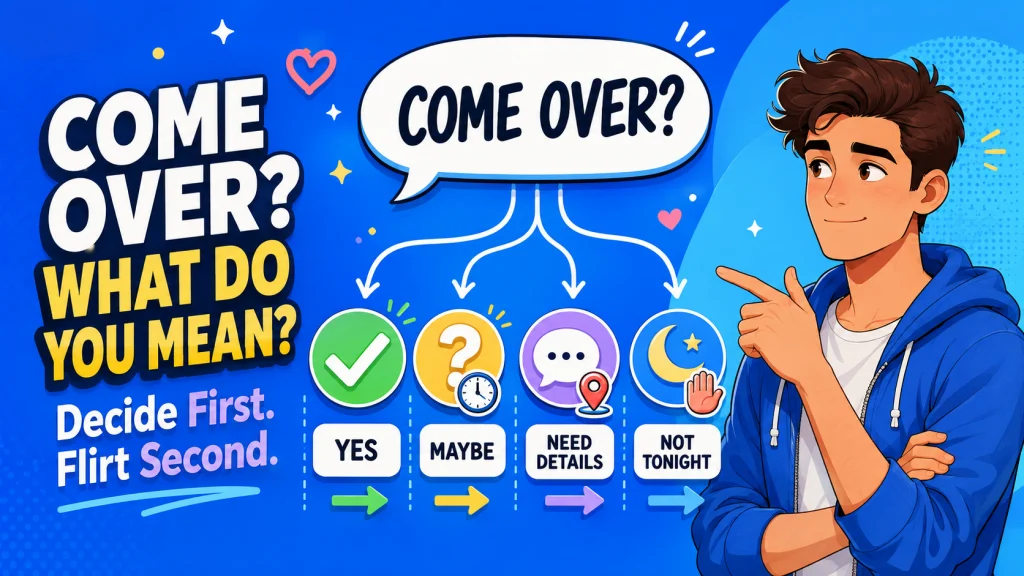
“Come over” is one of those texts where two words can contain an invitation, a flirt, a logistics problem, and a giant question mark at the same time. The best flirty responses to a come over text are not automatically the boldest ones. They are the ones that match whether you mean yes, maybe, tell me more, or no. Decide that first, then make the wording cute.
I have had people show me texts like this across a bar and ask what they should send back, and the hesitation usually was not about the sentence. They had not decided what they actually wanted yet. Once that part was clear, the reply got shorter almost immediately. That is the pattern worth stealing, because flirt works better when it is sitting on top of a real answer instead of hiding one.
| What you mean | Best reply shape | Example |
|---|---|---|
| Yes | Warm, direct, lightly playful | “Tempting. Give me a minute.” |
| Maybe | Interested, but not committed | “You are making a decent case. What is the plan?” |
| Clarify | Ask for context without making it an interrogation | “Come over for what exactly?” |
| No | Clear boundary with optional warmth | “Not tonight, troublemaker. Another time.” |
The table is simple on purpose, because people make this harder by trying to sound flirty before they know which lane they are in. If the message is vague, asking one normal question is not suspicious or unromantic. That extra detail gives the flirt something solid to work with. It also keeps the sender from having to guess whether you are interested, confused, or declining.
Quick flirty yes replies
If you already want to go, a flirty reply to come over text does not need a speech. A yes can be playful without pretending you need to be convinced. The strongest versions usually sound like you are choosing the plan, not getting swept into it. That little difference keeps the reply confident instead of overperformed.
Short works especially well here because the invitation already did most of the work. I have watched people type three versions of a coy answer when “tempting” would have carried the same energy with half the effort. A clean yes with one teasing edge usually reads more relaxed. The invitation already created the tension, so your reply does not need to manufacture more.
- “Tempting. I could be persuaded.”
- “You make a very convincing invitation.”
- “Dangerous suggestion. I like it.”
- “Give me a minute and behave yourself.”
- “That depends. Are snacks involved?”
- “I was hoping you would ask.”
Pick the line that sounds like something you would actually say out loud. “I was hoping you would ask” is warmer than “behave yourself,” while the snack line is lighter and more casual. None of them needs a second sentence explaining the joke. When the answer is genuinely yes, clarity is already doing half the flirting for you.

Maybe replies when you are interested but undecided
Maybe is where people get weirdly afraid of sounding difficult, so they drift into a soft yes they have not actually chosen. You do not need to do that. A maybe can still sound interested, amused, and open to the idea. The trick is to make your uncertainty about the plan clear without turning it into a test for the other person.
If you want a flirty response to come over but are still deciding, give them a little signal of interest and one reason the conversation needs to keep moving. “You are making a decent case. What time?” works because it keeps the flirt while asking for a useful detail. “Maybe, sell me on the snacks” is lighter if the relationship already has that kind of banter. You are not promising anything just because you are enjoying the exchange.
- “Maybe. What kind of trouble are you planning?”
- “I am considering it. Give me one good reason.”
- “Possibly. What is the plan?”
- “You have my attention. I have not said yes yet.”
- “Maybe, if the invitation gets more specific.”
- “I could be convinced by a good plan.”
I have seen people overcorrect here and send something so coy that the other person cannot tell whether they are interested at all. That usually happens because they think mystery is automatically flirtier than clarity. It is not, especially over text where tone already has fewer clues. If you mean maybe, let the maybe be visible.
Ask for the plan without sounding suspicious or apologetic
Sometimes “come over” is not enough information, and that is fine. Asking who is there, what the plan is, or whether they mean now does not ruin the mood. It just gives you something concrete to answer. The best version sounds curious rather than defensive, because you are gathering context, not cross-examining anyone.
Try “What are you proposing?” if you want it playful, or “Now, or later?” if timing is the only thing you need. “Come over for what exactly?” is more pointed, but it still leaves room for the sender to explain without you assuming what they meant. This is also where broader flirty replies for different texts can help, because vague messages often need tone control more than cleverness. A question can flirt just as easily as an answer when it sounds like you.
- “Come over for what exactly?”
- “What are you proposing?”
- “Now, or are we making actual plans?”
- “Who is there?”
- “What kind of evening are you suggesting?”
- “Give me a little more than two words.”
One common mistake is adding an apology before every normal request for context. “Sorry, what do you mean?” can make a perfectly reasonable question sound like you think you have broken some rule. You have not. Ask the useful question, keep your tone easy, and let the sender fill in the blank they left.

Playful negotiation that does not make consent a game
You can tease about details without teasing about whether your answer counts. That distinction matters. “Convince me with dessert” is playful if you are genuinely open to going and dessert is obviously just part of the joke. “Maybe means keep pushing” is not a fun premise, so do not build the exchange around wearing someone down or being worn down.
The clean version is to negotiate the plan, not the boundary. You can bargain over movie choice, food, timing, or who picks the music. You can say, “I might be convinced if I get control of the playlist,” and everyone still knows the decision is yours. Flirting stays fun when the joke has somewhere harmless to land.
I learned behind a bar that people often laugh most easily when the stakes of the joke are low. A playful condition about fries is low stakes. A condition that makes somebody prove they deserve access to you, or prove that your no is not serious, is not the same kind of game. Keep the tease on the plan and the answer itself plain enough to understand.
Suggest your place, another time, or a different plan
You can like the person and still dislike the specific invitation. Maybe you would rather meet somewhere else, maybe tonight is bad, or maybe you want them to come to you instead. That is not a rejection unless you mean it as one. A good reply simply swaps the plan while keeping the interest intact.
“Not your place tonight. Meet me for a drink instead?” is direct and still warm. “Counteroffer: you come here” works if that is genuinely what you want, while “Rain check for tomorrow?” keeps it easy when timing is the problem. If you want more playful ways to hold your ground without sounding stiff, these playful flirty comebacks stay in the same light, confident lane. The point is not to make the other person guess which part you are changing.
- “Counteroffer: you come here.”
- “Not your place tonight. Meet me out instead?”
- “Rain check for tomorrow?”
- “Different plan: coffee with me instead.”
- “I am not coming over, but I would meet you halfway.”
- “Another night, same invitation?”
This is another place where people sometimes over-explain because they are scared that changing the plan will kill the flirt. Usually it does not need that much defense. One clear alternative tells the other person more than a paragraph of reasons. If they like the invitation because they like seeing you, a reasonable change of venue or time gives the conversation somewhere to go.

Flirty no or not tonight replies
A no does not have to sound cold, but it does have to sound like no. If you are interested another time, say that. If you are not interested at all, do not add a flirty promise you do not mean just to soften the moment. Kindness is useful, but false encouragement creates more work for both people later.
“Not tonight, but ask me again another time” works when you truly want another invitation. “Cute try. I am staying in” is lighter when you want to decline without opening a scheduling conversation right away. “Nope, but I respect the confidence” is playful and more final. The tone can smile while the answer stays unmistakable.
- “Not tonight, troublemaker. Another time.”
- “Cute invitation. I am staying in.”
- “Nope, but I respect the confidence.”
- “Not tonight. Try me another day.”
- “I like the offer more than the timing.”
- “Tonight is a no. The flirting can stay.”
There is no prize for making a boundary sound so charming that the other person misses it. I have seen people add five cushions around one tiny no, then get frustrated when the reply is treated like a maybe. Keep the softening language optional and the decision visible. That is how a flirty no stays both flirty and useful.
Come over versus make me: an invitation is not a challenge
“Come over” asks you to choose whether you want to accept an invitation. “Make me” is different because it invites a challenge, a tease, or a little back-and-forth before either person does anything. Treating those messages as identical can make a simple invitation sound like a dare it never was. The reply should match the kind of energy actually on the screen.
If the sender really gives you a playful challenge, there are flirty replies to “make me” that lean into that push-and-pull without confusing it with a decision about plans. With “come over,” you usually need less performance and more clarity. A direct invitation already gives you something real to answer. You can tease around it, but you do not need to manufacture resistance just to make the exchange feel exciting.
This sounds obvious until somebody is staring at the phone trying to be clever. Then every short message starts looking like an audition. It is not. Sometimes the most attractive response is just the one that understands what was asked and answers it with a little personality.

What not to send: coercive bargaining, assumptions, or a yes you do not mean
The fastest way to make this kind of exchange messy is to treat vagueness as permission to invent the rest. Do not assume “come over” automatically means sex, a private night, a relationship milestone, or anything else the sender did not actually say. If that context matters to your answer, ask. A two-word invitation is not a mind-reading exam.
Also skip lines that turn pressure into flirting. If you mean no, do not send “convince me” unless you genuinely want to keep considering the idea. If the other person says no to your counteroffer, do not keep bargaining because you think persistence is charming. Playful replies work because both people still have room to choose.
Finally, avoid the yes that exists only because you are afraid a no will sound boring. That is one of the most common mistakes in flirty texting, and it usually comes from trying to protect the mood at the expense of your actual preference. A clear answer does not cancel the flirt. It just keeps the exchange from leaning on a misunderstanding.
Final thoughts: flirt inside the answer you actually mean
A “come over” text gets easier the second you stop treating flirtiness as a separate decision. First decide whether you want to go, might want to go, need more information, or do not want to go. Then choose a line that carries that answer without flattening your personality. You do not need to sound colder to be clear, and you do not need to sound vaguer to be attractive.
The best reply is usually shorter than the one you are building in your head. A yes can be warm, a maybe can be curious, a question can be playful, and a no can still have charm. What matters is that the person reading it does not have to decode the part that actually matters. Flirt is the seasoning here, not the substitute for an answer.
FAQs
Most questions about replying to “come over” are really questions about tone, not vocabulary. People want to know how to sound interested without sounding overeager, or how to say no without making the conversation suddenly formal. The answer usually gets simpler once you separate your actual decision from the playful wording around it. That is why the same invitation can need a completely different reply from one night to the next.
I would rather give you a line that is clear enough to use than ten clever ones that make your real answer harder to read. The questions below cover the points people tend to get stuck on most often. Keep the part that matches your situation and ignore the rest. Context still matters more than any single sentence.
💬 What is a flirty way to say yes to “come over”?
Try something short like, “Tempting. Give me a minute,” or “I was hoping you would ask.” A clear yes with one playful edge usually lands better than pretending you need to be chased.
🤔 How do I reply if I might want to come over but I am not sure yet?
Say maybe plainly and ask for the detail you need. “Maybe. What is the plan?” keeps the interest visible without committing before you are ready.
🕒 What should I say if they text “come over” with no time or plan?
Ask one normal question instead of guessing. “Now or later?” or “What are you proposing?” keeps the tone light while giving you something real to answer.
🌙 How do I say not tonight without sounding uninterested?
If you genuinely want another time, say so directly: “Not tonight, but ask me again.” You do not need a long excuse to prove that the interest is still there.
🚪 Do I have to explain why I do not want to come over?
No. “Not tonight” is already a complete answer, and you can add warmth only if you want to. A reason may be useful in some relationships, but it is not required just to make the boundary valid.