I have watched conversations die over a single word more times than I can count, and it is rarely the word anyone expects. Most replies do not go dry on purpose, they just close a door instead of opening one. This is about what actually makes a text read as flat, the real difference between an answer that ends a conversation and one that hands the other person something to walk through, and the small habits that fix it without turning you into someone who is clearly trying too hard. None of it requires being funnier or flirtier than you actually are. It just means knowing what a closed answer looks like before you hit send.
The Text That Went From Warm to Nothing in One Reply
A guy leaned over my bar one slow Tuesday and asked me, more or less, how to not be dry over text. He had a thread going with someone he liked, real back and forth, real momentum, until he sent “what are you up to tonight” and got back one word: “nothing.” No question back. No hook. Nowhere for him to go next. He sat there rereading it like the rest of the sentence might show up if he kept staring, and that is the exact moment most people mean when they say a reply felt dry.
Dry has nothing to do with being boring as a person. I have watched genuinely funny, interesting people send dead-end replies because they were tired, distracted, or just answering on autopilot between five other things. The problem is never the person, it is the reply itself, the fact that it gives nothing back and asks for nothing in return. A conversation needs somewhere to go. When a reply closes that path instead of opening it, the other person is left holding a dead phone screen and wondering if they said something wrong, when usually nobody did anything wrong at all. They just stopped building.
The Pattern Behind Dry Texting
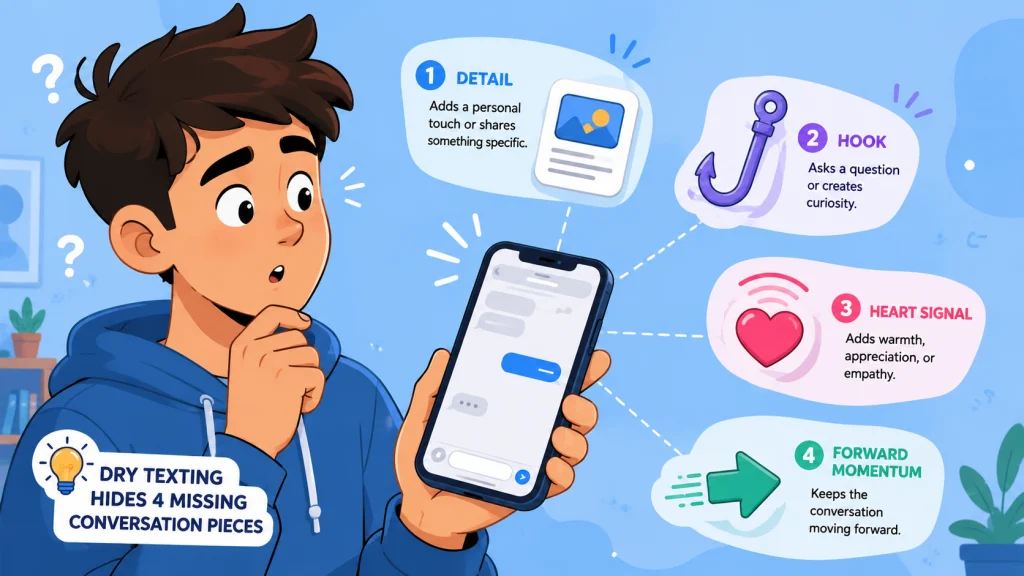
There is a pattern I started noticing behind the bar long before anyone gave it a name. A reply goes dry when it is missing one of four things: a detail, a hook, an emotional signal, or a next move. Take those away and you are left with a word that technically answers the question and does nothing else, the texting version of someone shrugging at you mid-conversation. It still counts as a response. It just does not count as anything else.
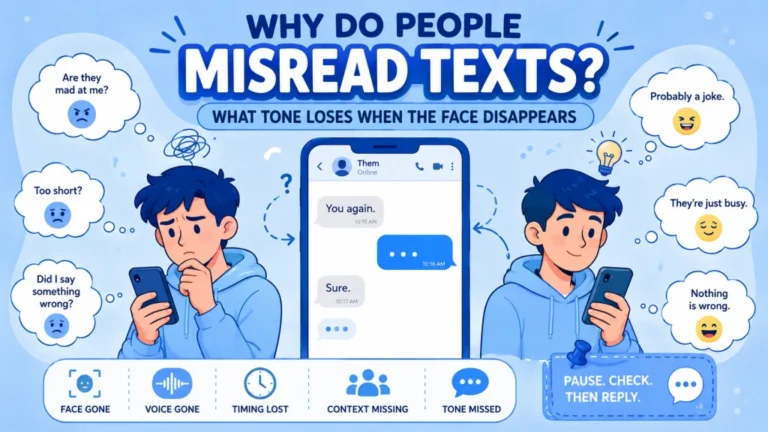
Here is the part most people get wrong, and I say that without judgment because I have done it myself plenty of times. People assume a short reply reads as relaxed, almost too busy and unbothered to type more, when the message on the other end can land completely differently. There is real research on email tone being misread showing that people consistently overestimate how clearly their intended tone comes through in writing, mostly because they can hear themselves saying it in their head while the other person only gets the bare words on a screen. What feels chill to you can read as bored or checked out to them, and you usually never find out which one landed.
Closed Answers vs. Answers With a Handle
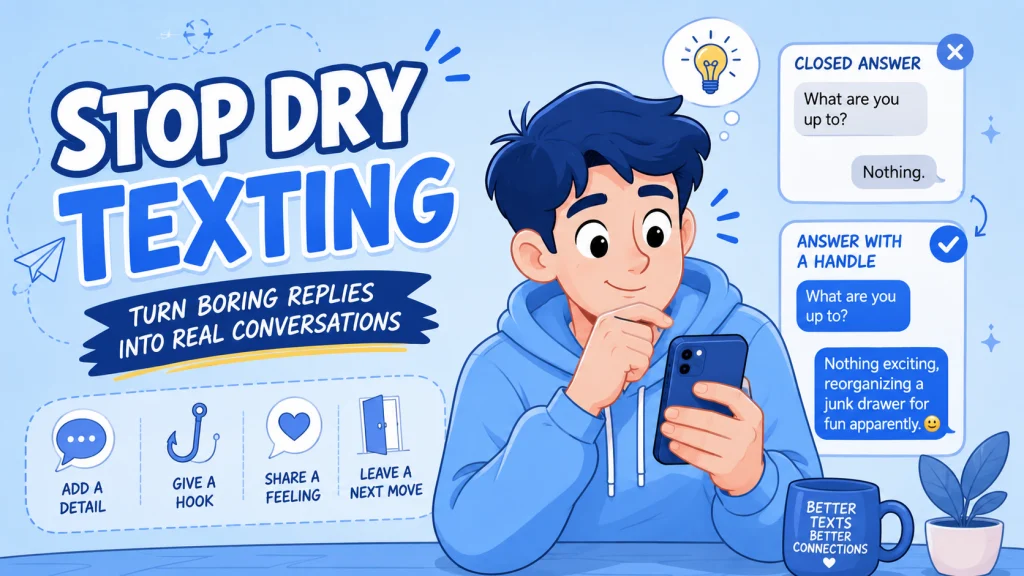
The fix is not longer texts. It is texts with a handle, something the other person can actually grab onto and use to keep going. A closed answer ends a sentence. An answer with a handle ends the sentence and leaves something right next to it for the other person to pick up.
There is one exchange I still think about. A regular asked me to help her answer a coworker who kept sending one-line non-questions, the kind that look like effort but carry none. I told her to stop trying to write something clever and just add one honest, slightly absurd detail from her actual day, since a detail is the easiest hook there is. She tried it almost as a joke, and he wrote back three full sentences for the first time in weeks. It was never about being funnier. It was about giving him something real to hold.
| What Came In | Closed Answer | Answer With a Handle |
|---|---|---|
| How was your day? | Fine. | Long. Spent ten minutes arguing with a vending machine, how was yours? |
| What are you up to? | Nothing. | Nothing exciting, reorganizing a junk drawer for fun apparently. |
| Did you see the game? | Yeah. | Yeah, that ending was unreal, did you catch it live or the replay? |
None of those right-column replies are clever. They are not jokes, they are not flirting, they are just open. That is the entire difference between a reply that keeps something alive and one that quietly kills it, and once you can see the pattern in that table, you start noticing it everywhere, in your own texts and in the ones you get back.

Why This Is Not Another List of Lines to Copy
If you came here hoping for a stack of ready-made lines, that already exists elsewhere on the site, organized by the exact kind of moment you are dealing with. There is a whole corner built around funny replies for everyday text banter, and a separate one for flirty replies built around tension and timing. Those run on different mechanics than what we are talking about here. A funny reply works because of surprise and timing. A flirty reply works because of tension and nerve. What we are talking about here sits underneath both of those, the plain difference between a reply that gives the other person something to work with and one that does not.
Even inside those corners of the site, the same closed-versus-open pattern shows up. Take something as basic as someone asking how you are doing. There is a whole set of funny answers to a basic how are you text built specifically because that question gets the driest replies of any text anyone sends, mostly because people assume it does not deserve effort. It is the cleanest example there is of a low-stakes moment where a slightly better reply costs nothing and changes the shape of everything that follows.
Three Bar-Tested Rules for Better Text Replies
None of this requires a personality transplant. Behind the bar, the rule was always to give people one small thing to work with, never a performance. Texting works the same way. There are three habits that consistently turn a closed answer into one with a handle, and none of them take more than a few extra seconds to apply.
- Add one real detail. Not a clever one, just something specific and true the other person did not already know.
- Answer the question underneath the question. Most texts ask something bigger than the literal words, so answer that part too, even briefly, instead of only the surface line.
- Give them somewhere to go next. A short question, an offer, or even a reaction works, anything that hands the conversation back instead of letting it land flat in their hands.
Stack all three together and a reply almost never reads as dry, even if it stays short. Two sentences with a detail, an implied answer, and a place to go will beat five sentences that say nothing at all. Those three habits are basically the whole anatomy of not dry texting, once you see the pattern. Length was never actually the problem.

Final Thoughts: Texting Is Not a Performance
None of this is about becoming a better writer or a funnier person over text. It is about noticing when a reply has nowhere for the other person to go, and giving it somewhere before you hit send. Pew Research data on texting habits shows texting remains one of the most common ways people keep in touch, which is why small patterns in replies can start to matter over time. That volume is exactly why a small, repeated habit like a dry reply adds up to something a relationship actually feels over time, even when no single text feels like a big deal on its own.
This is also not a tool for everything. If something heavier needs to be said, an apology, a real disagreement, a conversation that actually matters, text is often the wrong medium entirely, and research on resolving conflict over text backs up what most people already sense, that the stakes go up exactly when the cues go down. For the ordinary, low-stakes moments this is built for though, the good morning texts, the “how was your day” messages, the “what are you up to” check-ins, the fix is almost always smaller than it feels. One detail, one implied answer, one place to go. Not every text deserves a performance. But every reply you send should know whether it is opening a door or closing one.
FAQs
😶 What does it mean when a text feels dry?
It means the reply gave you nothing to respond to, no detail, no question, no reaction. The words technically answer what was asked, but they do not move the conversation forward. That gap is what reads as dry, not the length of the message.
🔁 Why do I keep getting one-word replies?
Usually it is not personal. Most one-word replies come from someone half-distracted or assuming a short answer reads as relaxed instead of distant. Give them an obvious detail to grab onto and most people will follow your lead.
😅 Is texting back fast or slow the actual problem?
Neither, on its own. Timing matters less than content. A fast “fine” is just as dry as a slow one, so focus on what you are saying rather than how quickly you send it.
🙃 How long should a reply actually be?
Long enough to give the other person a detail and a place to go, which is usually one or two sentences. A five-sentence reply with nothing to respond to is just as dry as a one-word one, it just takes longer to read.
📵 What if the other person is the one being dry?
You can only fix your own side of a conversation. If a few honest attempts at giving them an opening do not change anything, that usually says more about their interest level than anything you are doing wrong.
💬 Can one dry reply ruin someone’s interest in you?
One dry reply, almost never. A pattern of them, much more likely. People read patterns more than single texts, so do not panic over one flat answer, just pay attention if it keeps happening.