Comebacks for braggers work best when they stop the performance without turning you into the next contestant. A quick acknowledgment can be enough for ordinary good news, while repeated one-upmanship may call for light deflation, a direct pattern callout, a topic change, or a clean exit. I have learned that the strongest line is usually the one that restores balance to the conversation instead of trying to win it. The goal is not to punish someone for having something to celebrate. It is to stop every exchange from becoming their personal highlight reel.
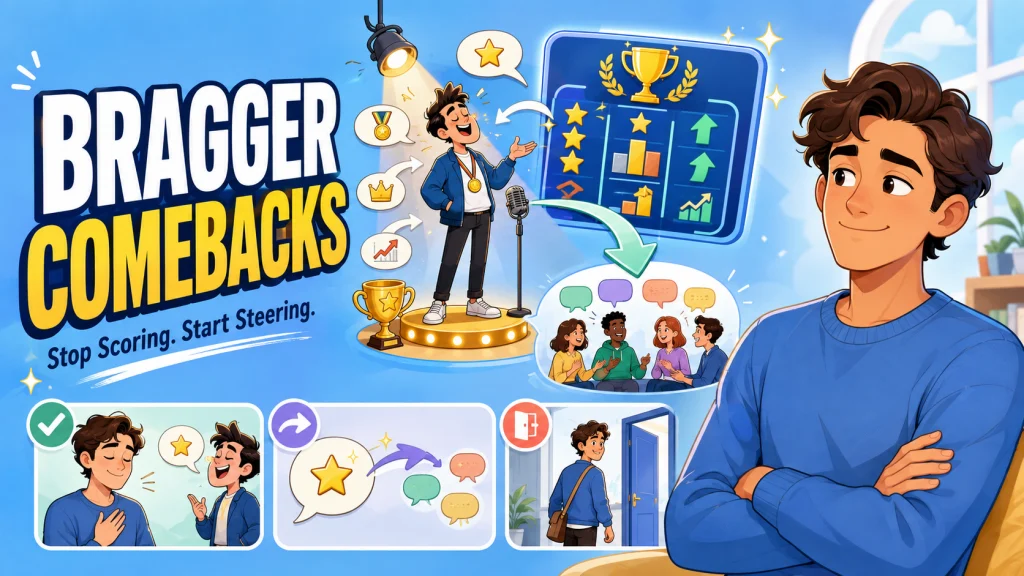
When a conversation turns into an awards ceremony
A bragger can make a normal conversation feel like an awards ceremony where they nominated themselves. The useful thing about comebacks for braggers is not that they produce a bigger insult, but that they give you a way to stop feeding the status contest. If the person is simply sharing one proud moment, let them have it. If every story gets rerouted through their money, connections, achievements, or supposedly better version of your experience, that is when a sharper reply starts earning its place.
I spent years watching rooms shift when one person stopped sharing and started performing for rank. The mistake people make in that moment is trying to beat the bragger with a better story, because now the conversation really is a competition. A short line, a flat acknowledgment, or a redirect usually does more because it denies the whole scoreboard premise. If you want broader options for someone who is being openly disrespectful rather than merely boastful, these comebacks for rude people stay closer to that situation.

Quick comebacks when the bragging is obvious
When the bragging is blatant, you usually do not need a speech. The best bragger comebacks are short enough to say once and leave hanging, because the pause after the line does half the work. I would start lighter than your irritation is telling you to start. You can always get more direct later, but you cannot unsay the line that turned a mildly annoying conversation into a full argument.
- “You have really been waiting to tell someone that.”
- “I can see this is your favorite topic.”
- “Noted. Very impressive. Very thoroughly noted.”
- “You are giving this achievement excellent press coverage.”
- “I think we have the headline now.”
- “You win the invisible trophy.”
These work because they point at the performance without attacking the achievement itself. Someone can have a great job, an expensive thing, a useful connection, or a genuine skill and still be exhausting about it. One of the common mistakes is adding three more sentences after a clean comeback because silence suddenly feels awkward. Do not rescue the line after it lands. Let the other person decide whether they want to keep performing.
“Them: I know, everyone keeps telling me how impressive it is. You: I can tell you have been collecting reviews.”
That kind of exchange works because the reply is proportionate to the brag. It notices the self-promotion, gives it one dry tap, and then leaves room for the subject to change. If they laugh and move on, you are done. If they use your line as a cue to deliver another achievement, the next section gives you a cleaner way to stop rewarding the pattern.
When a brief congratulations is enough
Not every proud sentence is bragging, and treating normal excitement like a character flaw makes the reply feel petty fast. If someone just got promoted, finished something difficult, bought something they had wanted, or had a lucky break, a plain “Congrats” may be the entire correct response. What matters is the pattern around the moment, not the fact that they said something positive about themselves. I would rather give a person one clean chance to enjoy good news than start a fight over a tone that may not even repeat.
| What you are hearing | What usually fits |
|---|---|
| One clear piece of good news | Congratulate them and keep the conversation moving. |
| Excitement with room for your response | Match the energy without assuming it is a competition. |
| Every topic comes back to their status | Use a short deflation or redirect. |
| Your story gets immediately topped | Call out the one-up without trying to outdo it. |
This distinction matters because witty comebacks for braggers sound a lot less witty when the person was merely happy for five seconds. A clean test is whether they can celebrate something and then return the floor, or whether every response becomes another exhibit in the case for their superiority. You do not need to name their motive to notice the pattern. You only need enough information to decide whether the moment calls for warmth, deflation, or a change of subject.

Replies for the person who turns every story back to themselves
This version is less about one big brag and more about conversational gravity. You mention your weekend, they have a better trip, you mention a difficult project, they have a harder one, you mention something funny, and somehow they were once funnier in a more impressive place. I have watched whole group conversations shrink around this habit because everyone starts deciding it is easier not to share. The cleanest responses to bragging here are the ones that return the original story to the person who was speaking.
“That reminds me, I was actually still listening to her story.”
You can also use “Hold that thought, I want to hear how this one ends,” or “We can get to yours in a second.” Those lines do not debate whether their story is better. They simply refuse to let it replace the one already in progress. If you are the person being interrupted, “Anyway, back to what I was saying” is sometimes stronger than anything clever. It sounds almost boring, which is exactly why it works. It treats the hijack as a minor interruption instead of an invitation to duel.
“You: I finally got the old place fixed up. Them: You should see mine, it cost twice as much. You: Sure, but I was still telling you about mine.”
I like that version because it does not argue over whose place is better. It simply puts the original speaker back in possession of their own story. That same principle matters with someone who corrects every detail as if conversation were a quiz, although that is a different problem. For that pattern, these comebacks for know-it-alls fit better than turning this page into a catch-all for every irritating conversational habit.
One-upper replies without starting a competition
One-upping is the moment bragging becomes comparative. You say you ran a race, they ran farther, you got a raise, theirs was bigger, you finally visited somewhere you loved, they went somewhere more exclusive. The trap is obvious once you are outside the conversation and much harder to resist when you are standing in it. If you answer with your own better fact, you have accepted their rules even if your story is completely true.
“I was sharing, not entering a competition.”
Other useful lines are “You do not have to top it,” “Mine can just be good too,” and “We can both have a story without ranking them.” I like those because they name the structure of the exchange instead of throwing a punch at the person. If the tone is lighter, “Congratulations on winning the conversation” can work, but only if your relationship can carry the sarcasm. When you are wondering what to say to someone who brags, choosing a line that refuses comparison is usually safer than choosing one that tries to humiliate them.
“You: I am pretty proud of that raise. Them: Mine was bigger. You: Great. Mine does not need to beat yours to be good news.”
That is the version I reach for when the comparison is obvious but the relationship is still worth keeping easy. It does not hand them a fresh fact to top, and it does not make their own success the target. The line closes the ranking game while leaving both pieces of good news intact. In a group, though, the job changes slightly because you are also managing what the rest of the room has to sit through.
Friend-group lines that reset the room
Group conversations make bragging trickier because the line is not only for the bragger, everyone else hears it too. A harsh comeback can make the whole table tense even when several people privately agree with you. What tends to land better is a room reset, something that makes space for everyone else without turning one person into the evening’s target. That balance is the part I learned to notice fastest behind a bar, because one person can pull an entire room toward them without ever technically interrupting.
“All right, highlight reel paused. Who else has news?”
You could also say “Let us pass the microphone,” “We are going around the table, not ranking resumes,” or simply call on someone else by name and ask them a question. The point is to redirect attention, not stage a public correction. If the group is already laughing with the bragger, a lighter line keeps you from sounding like you arrived to cancel the fun. If the behavior is part of a much ruder pattern, savage comebacks cover sharper territory, but I would not jump there just because someone likes hearing themselves talk.

Direct callouts for repeat bragging
If you have tried acknowledgment and redirection and the same person keeps turning every exchange into proof of their status, subtlety may stop being useful. Direct does not have to mean cruel. It can sound like “You keep turning this into a comparison,” or “I am happy to hear your news, but not every story needs a winner.” Those lines are plain enough that the person cannot pretend they missed the point, but they still leave room for the conversation to recover.
“You: I finally finished the project. Them: Mine took half the time. You: You do not have to top everything I say.”
I would keep the callout focused on what is happening right now rather than what kind of person they supposedly are. “You are doing it again” is specific, while “You are the most arrogant person alive” drags in a diagnosis-sized judgment the moment does not need. Another useful version is “Can we have one conversation where we do not rank everything?” It tells them what you want to stop without inventing a hidden reason for why they do it.
Exit lines when the conversation has become a scoreboard
Sometimes the best comeback is not a comeback at all. It is an ending. If every response becomes another claim, comparison, name-drop, or attempt to prove who has more, staying in the conversation only gives the scoreboard another inning. You are allowed to stop supplying material. A neutral exit keeps you from spending ten more minutes proving that you are not impressed.
- “Anyway, I am going to grab a drink.”
- “I will let you get back to your victory lap.”
- “I am tapping out of the rankings.”
- “You can have this competition. I was not in it.”
- “I am going to go talk about something less competitive.”
The tone you choose depends on the relationship and how pointed you want the exit to feel. With someone you barely know, “Excuse me, I am going to say hi to someone” is enough and often cleaner than a line built to sting. With a friend who knows your humor, “Enjoy the podium” may land as a reset rather than a rupture. Disengaging is not losing the exchange. It is refusing to keep an exchange alive after it stopped being worth your attention.
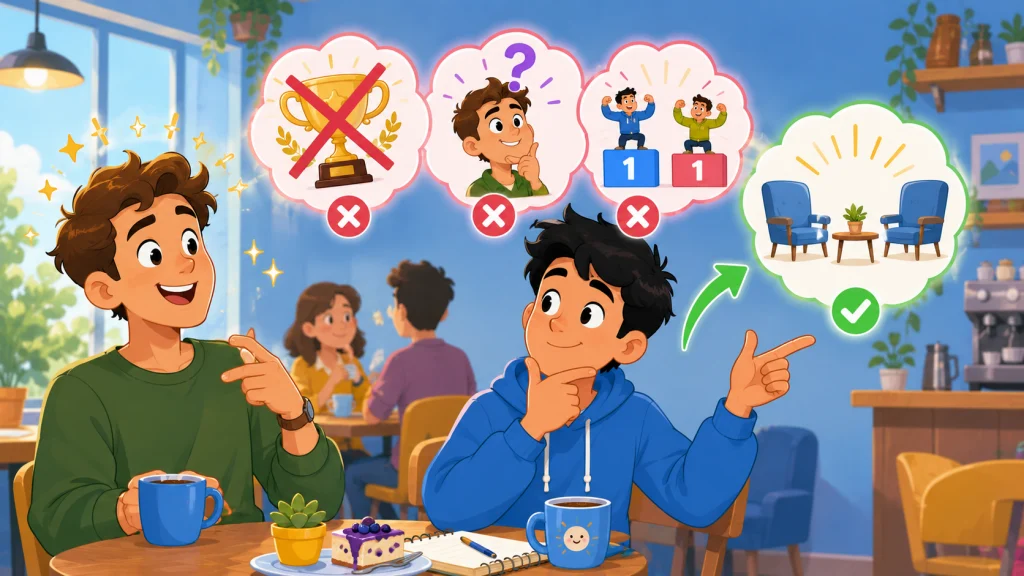
What not to say when you want the bragging to stop
The easiest bad move is attacking the achievement itself. If someone worked hard for something, mocking the accomplishment makes you sound resentful even when their delivery was unbearable. You do not need to say the promotion is meaningless, the car is ugly, the trip was overrated, or the connection is fake to make the point that the conversation has become one-sided. Keep the criticism on the behavior you can actually hear.
The second bad move is inventing a motive, especially insecurity, jealousy, or some personality label you cannot know from a bragging habit. The third is turning around and bragging harder, because now both of you are doing the exact thing that made the conversation annoying. People also over-explain here, usually because they want to prove they are not being mean, and the explanation ends up sounding more severe than the original line. If you are tempted to give a speech, cut it until the sentence only names the pattern and what you want to happen next.
Final thoughts: stop scoring and start steering
A good comeback to bragging does not need to crush anyone’s ego. It only needs to make the status contest less rewarding and give the conversation somewhere else to go. Start with the lightest response that fits, because a brief acknowledgment or redirect is often enough. Save the direct callout for the person who keeps repeating the pattern after the softer options have already failed.
What matters most is whether the line restores balance instead of creating a second performer. I have seen people win the room with four quiet words and lose it with a perfectly clever paragraph that lasted too long. You do not need to beat the bragger at bragging, insulting, or storytelling. You just need a reply that reminds everyone, including you, that a conversation does not need a winner.
Frequently asked questions
Most questions about bragging come down to the same problem: people want a line that is sharp without sounding needlessly hostile. The right answer depends on whether you are hearing one proud moment, a repeated pattern, or a direct attempt to one-up you. I would rather start with a line that leaves the conversation recoverable. If the person keeps pushing after that, you can get more direct without having started at maximum volume.
The other thing people overthink is whether the comeback has to be funny. It does not. A plain “You do not have to top everything” can work better than a joke if the pattern has stopped being playful. Use humor when the room can carry it, and use direct language when everyone already knows the joke has worn out.
💬 What do you say to someone who brags all the time?
Start with something short like “You really do like winning every conversation.” If it keeps happening, move to a direct line such as “Can we talk without ranking everything?”
🏆 What is a funny comeback for a one-upper?
“Congratulations on winning the conversation” works when the relationship can handle sarcasm. If you want less edge, try “Mine can just be good too.”
🎤 How do you stop someone from making every story about themselves?
Redirect the floor instead of debating them. “Hold that thought, I want to hear how her story ends” makes the pattern clear and gives the original speaker their space back.
🧊 Should I ignore someone who keeps bragging?
You can, especially when the conversation is not worth the effort. A neutral acknowledgment followed by a topic change or exit often shuts down the cycle better than trying to outsmart it.
🎯 How can I call out bragging without sounding jealous?
Comment on the pattern, not the achievement. “You keep turning this into a comparison” is cleaner than insulting what they accomplished.
The easiest rule to remember is that your reply should match the size of the problem. Ordinary excitement deserves ordinary warmth, repeated one-upmanship deserves a firmer boundary, and a conversation that has become exhausting may deserve an exit. You are not required to diagnose the person or deliver a perfect roast. You only need enough language to stop getting pulled into a contest you never agreed to enter.